

Escalating crackdown on U.S. colleges, Trump DOJ Targets George Washington University Over Civil Rights in Gaza Protest Fallout. George Washington University (GWU) is facing a federal civil rights investigation by the Trump administration’s Department of Justice (DOJ), which alleges the school failed to protect Jewish and Israeli students during last year’s pro-Palestinian campus protests.
The DOJ’s findings, announced Tuesday, make GWU the latest target in a sweeping campaign against U.S. universities accused of allowing antisemitism to take root amid protests linked to the war in Gaza. The administration has already taken enforcement actions against Harvard, Columbia, UCLA, and several others in some cases freezing hundreds of millions of dollars in federal grants until schools reach settlement agreements.
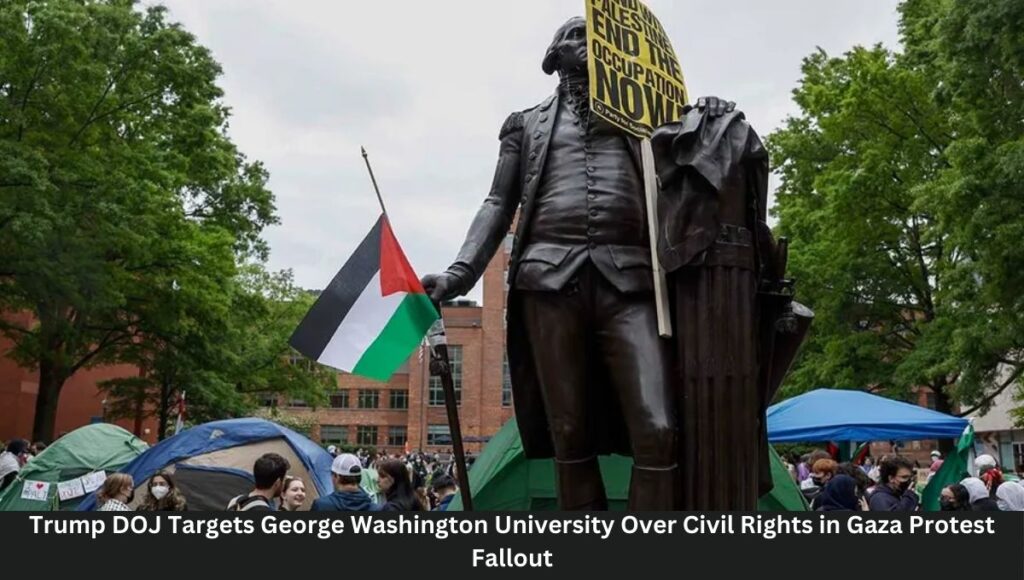
Trump DOJ Targets George Washington University Over Civil Rights in Gaza Protest Fallout
DOJ Letter Cites “Deliberate Indifference”
In a letter sent to GWU President Ellen Granberg, Assistant Attorney General Harmeet Dhillon wrote that the university had been “deliberately indifferent” to a “hostile educational environment” for Jewish, Israeli, and American-Israeli students during April and May 2024.
According to the DOJ, pro-Palestinian protesters established an encampment at University Yard that lasted two weeks, allegedly engaging in conduct intended to “frighten, intimidate, and deny” Jewish students equal access to campus life.
Dhillon’s letter claims university officials had “actual notice of the abuses occurring” yet failed to take “meaningful action” to stop them. Specific allegations include:
- Blocking entrances to campus facilities
- Creating physical safety risks to Jewish and Israeli students
- Allowing antisemitic harassment to go unpunished
The DOJ is demanding “immediate remediation” and has given GWU until August 22 to respond. If no voluntary resolution is reached, the department says it will move forward with enforcement.
Potential Penalties Mirror Other Cases
While the letter does not specify potential penalties, the DOJ’s actions follow a familiar pattern under the Trump administration:
- UCLA Case (July 2024): DOJ announced similar findings on July 29. Less than a week later, the White House suspended over $500 million in federal grants. UCLA has since entered negotiations involving financial penalties and policy concessions.
- Columbia University: Lost $400 million in federal funding before agreeing to a $220 million settlement that included campus speech policy changes.
- Harvard University: Currently in talks to unfreeze more than $2 billion in grants; negotiations reportedly center on a $500 million settlement and compliance measures.
The enforcement model has emerged as a hallmark of the Trump administration’s higher-education crackdown, combining civil rights claims with aggressive financial leverage.
GWU Responds to Allegations
GWU spokesperson Shannon McClendon said the university is reviewing the DOJ’s letter but rejected the suggestion that it has tolerated antisemitism.
“GW condemns antisemitism, which has absolutely no place on our campuses or in a civil and humane society,” McClendon said in a written statement. “Our actions clearly demonstrate our commitment to addressing antisemitic actions and promoting an inclusive campus environment.”
McClendon also stressed that the university has taken disciplinary action against individuals and organizations in accordance with policy and law.
Spring 2024: Protests and Police Tensions
The dispute stems from a wave of pro-Palestinian protests that swept U.S. campuses in spring 2024, including encampments, rallies, and teach-ins calling for universities to cut ties with Israeli institutions and divest from companies linked to the conflict in Gaza.
At GWU, the protest encampment at University Yard lasted two weeks before being dismantled.
The school’s leadership initially called on D.C. police to remove the tents, but city officials refused, citing First Amendment concerns.
The standoff highlighted tensions between local and federal authorities over how to manage campus protests in the capital.
This week, Trump announced he would take federal control of the D.C. police department and deploy 800 National Guard troops to the city a move his administration says is aimed at “restoring order” to campuses and public spaces.
Legal Basis: Title VI of the Civil Rights Act
The DOJ’s case against GWU is grounded in Title VI of the Civil Rights Act of 1964, which prohibits discrimination based on race, color, or national origin in programs or activities receiving federal funding.
Courts have interpreted Title VI to cover certain forms of antisemitic harassment, particularly when tied to shared ancestry or ethnic characteristics.
If the DOJ determines that GWU failed to address harassment that created a hostile environment for Jewish students, it could threaten the school’s federal funding.
Given GWU’s reliance on research grants and student aid programs, such a move could have significant financial consequences.
Trump Administration’s Broader Campus Crackdown
GWU’s case is part of a wider DOJ initiative launched in February 2024, when the administration announced a federal task force to investigate alleged campus antisemitism at 10 universities, including:
- Columbia University
- Harvard University
- George Washington University
- Johns Hopkins University
- New York University
- Northwestern University
- UCLA
- UC Berkeley
- University of Minnesota
- University of Southern California
Since then, the list of targeted schools has grown, and the Department of Education has issued warnings to over 60 universities that they could face enforcement if they fail to protect Jewish students.
Critics say the administration is using civil rights law as a political tool to reshape higher education. Supporters argue that the measures are necessary to address rising antisemitism and ensure safe learning environments.
Historical Context: Campus Speech and Federal Power
The Trump administration’s approach marks one of the most aggressive uses of federal funding leverage against universities since the civil-rights era.
In the 1960s, the Johnson administration used Title VI to pressure Southern schools into desegregating.
In the 1980s, the Reagan administration clashed with universities over affirmative action and campus speech codes.
Today’s disputes mirror those earlier battles but with the political and cultural divisions of the Israel-Palestine conflict layered on top.
The administration has framed the protests not as political speech but as civil rights violations, a legal framing that enables funding cuts without passing new legislation.
What Comes Next for GWU
With less than two weeks to respond to the DOJ’s letter, GWU faces several options:
- Negotiate a Voluntary Resolution Agreement
- Could include policy changes, training programs, and possibly financial penalties.
- Challenge the DOJ’s Findings
- Would likely escalate to a public legal battle with uncertain outcomes.
- Risk Federal Funding Cuts
- Potentially hundreds of millions in research and student aid dollars at stake.
Past cases suggest that most universities opt to negotiate rather than risk extended funding freezes.
Impact Beyond the District
As a high-profile institution in the nation’s capital, GWU’s case could set a precedent for how the administration handles similar allegations nationwide.
If the DOJ follows through with enforcement especially if it includes a funding suspension other schools under investigation may move quickly to reach settlements to avoid prolonged standoffs.
Also Read: Rubio Orders Visa Scrutiny for Harvard Visitors Amid Trump Crackdown on Higher Education
Also Read: DOJ sets sights on George Washington University
Related Posts:
- Columbia University Settles Antisemitism Claims for…

- Columbia University Faces Loss of Accreditation Over…

- Trump vs. Harvard: Federal Funding Cut Sparks Clash…

- 11 Explosive Reasons Pentagon Cut All Military Ties…

- Trump Defends 600K Chinese Student Visas, Faces MAGA…

- Harvard’s SEVP Certification Revoked: What This…
