
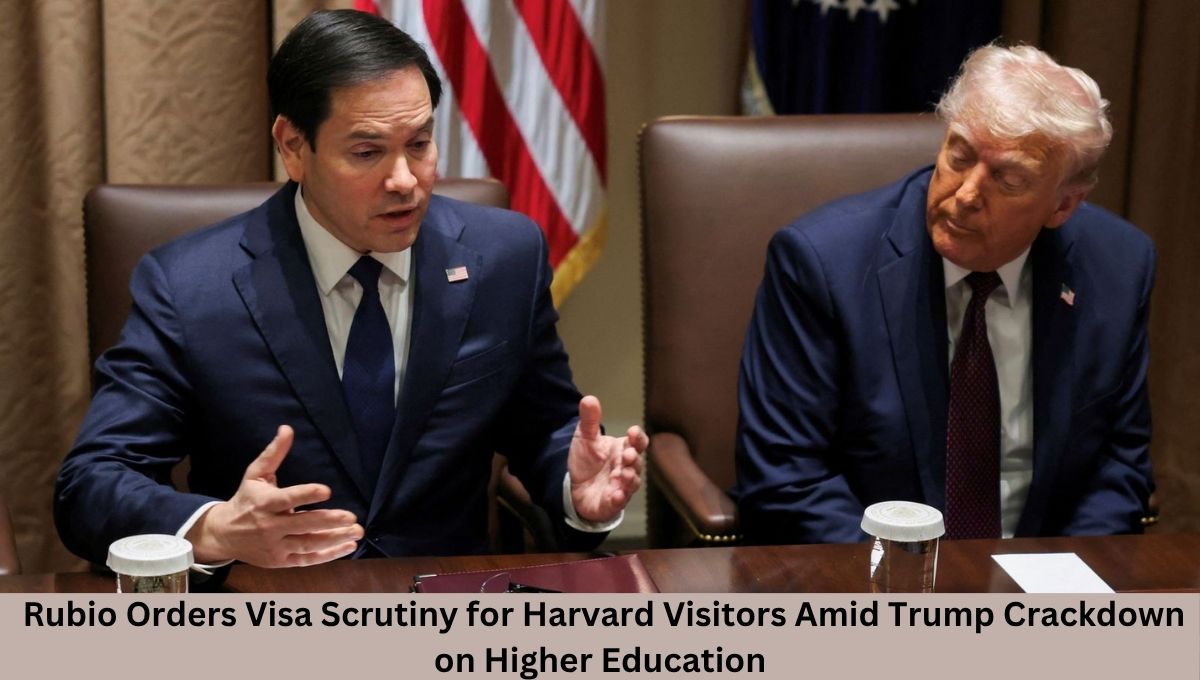
In a controversial new directive, Rubio Orders Visa Scrutiny for Harvard Visitors Amid Trump Crackdown on Higher Education. Secretary of State Marco Rubio has ordered U.S. embassies to apply heightened scrutiny to social media accounts of anyone seeking to visit Harvard University, citing national security concerns.
The memo, issued Friday, suggests that a lack of public social media activity may be cause for visa denial, igniting backlash from immigration attorneys, civil rights groups, and higher education advocates. The move escalates the Trump administration’s ongoing battle with elite universities and signals an aggressive shift in U.S. immigration policyone that could have long-lasting effects on American higher education.
Rubio Orders Visa Scrutiny for Harvard Visitors Amid Trump Crackdown on Higher Education
Social Media Scrutiny as a Visa Requirement
Rubio’s cable, sent to U.S. consular officers worldwide, specifically targets foreign nationals affiliated with Harvard, including prospective students, researchers, faculty, guest speakers, and even tourists.
It instructs visa officers to evaluate applicants’ social media presence and to request that their accounts be made public during the visa review process.Rubio argued that the absence of social media posts or private accounts could suggest an applicant is being evasive.
“Consular officers should consider whether the lack of any online presence, or having social media accounts restricted to ‘private,’ may be reflective of evasiveness,” the memo states. This guidance, seen by critics as Orwellian, expands an already intense visa vetting process and raises profound privacy and free speech concerns.
Civil Liberties Groups Sound the Alarm
The directive has drawn sharp criticism from civil liberties advocates. Greg Lukianoff, CEO of the Foundation for Individual Rights and Expression, warned in The Atlantic that this policy could trap applicants in a “damned if you do, damned if you don’t” scenario.
“If you post views the government doesn’t like, you’re flagged. If you don’t post at all, that’s suspicious too,” Lukianoff said.
Sofia Cope of the Electronic Frontier Foundation called the move an “outrageous overreach,” stressing that online privacy should not be grounds for visa denial. Legal experts argue that such measures are not only invasive but possibly unconstitutional, especially when applied to academic and cultural exchange.
Harvard at the Center of a Political Firestorm
This latest visa crackdown is part of a broader war between the Trump administration and Harvard University. Just this week, the administration has:
- Halted student visa interviews for Harvard applicants.
- Threatened to strip Harvard of its ability to enroll foreign students.
- Ordered a review of $100 million in federal contracts with the university.
- Froze $3 billion in research funding.
- Accused the university of fostering antisemitism and political bias.
Harvard is now suing to protect $2.2 billion in federal research grants and defend its ability to welcome international students.
Harvard President’s Standing Ovation at Commencement
At Harvard’s 2025 commencement, newly-appointed President Alan Garber made a subtle but powerful statement defending the school’s global student body. Addressing graduates, Garber said:
“To the class of 2025, from down the street, across the country, and around the world.”
The crowd erupted in a standing ovation, clearly interpreting the remark as a rebuke of Trump’s crackdown on foreign students and the administration’s broader attacks on elite universities.
Global Response: Universities Poised to Benefit
Trump’s campaign against top U.S. schools is prompting an international brain drain. Universities across Europe and Asia are actively courting students disillusioned by U.S. policies.
- Osaka University in Japan is offering full support for U.S.-based students looking to transfer.
- Kyoto University and Tokyo University are reportedly crafting similar incentives.
- Hong Kong, Germany, France, Ireland, and Singapore are ramping up efforts to attract international students with simplified admissions and financial aid.
Even China’s Xi’an Jiaotong University has appealed directly to Harvard students, offering “streamlined” admission and “comprehensive” support.
Repercussions for U.S. Higher Education
With over 1.1 million foreign students in the U.S. contributing $50 billion to the economy (54% from India and China), the administration’s actions threaten to destabilize a crucial revenue stream and diminish America’s academic influence.
According to Jessica Turner, CEO of global university rankings firm Quacquarelli Symonds, interest in studying in the U.S. has dropped sharply:
- Visits to its “Study in America” guide have declined 17.6%.
- Interest from India alone is down more than 50%.
Polling shows that students and parents now see American universities as risky, with concerns over visa uncertainty, funding cuts, and political interference.
Fallout from Antisemitism and Gaza Protests
The administration has also justified its actions by pointing to allegations of antisemitism stemming from pro-Palestinian protests and controversial comments by former Harvard President Claudine Gay.
While Harvard has since launched a task force and released findings confirming discrimination against both Jewish and Muslim students, the White House is demanding broader reforms.
These include the elimination of diversity initiatives, changes to admissions practices, and more “viewpoint diversity” among faculty.
A Legal and Cultural Battle Ahead
Harvard has begun mounting legal resistance. A federal judge has temporarily blocked the administration’s visa ban, but the Department of Homeland Security has given the university 30 days to formally respond. The outcome could set a precedent for how much political control the federal government can exert over academic institutions.
Greg Wolfson of the American Association of University Professors warned, “Even if courts intervene, the chilling effect is already here. The independence of higher education is under real threat.”
The Ivory Tower Under Siege
As Trump’s campaign to reshape U.S. higher education marches on, universities across the country are bracing for more political and financial pressure. For Harvard, the fight is no longer just about policy it’s about the core identity and global mission of the institution.
“If this can happen to Harvard,” one graduate said, “it can happen to any university in the country.” The battle unfolding between Washington and academia is about much more than student visas. It’s a test of American values, of academic freedom, and of the nation’s willingness to remain a beacon for global talent.
Also Read: Marco Rubio Says Thousands of US Visas Revoked as Trump Crackdown Escalates
Also Read: State Department begins ‘vetting’ all visa applications for foreigners visiting Harvard
Related Posts:
- 11 Explosive Reasons Pentagon Cut All Military Ties…

- 7 Key Revelations from Trump’s ‘Perfectly Normal’…
- Barron Trump Rejected by Harvard? Rumors, Reactions,…

- 5 Powerful Highlights as Trump Lands Second Nobel…

- Trump’s 2025 Gaza Peace Plan Signing and Historic…

- 10 Explosive Facts About Donald Trump’s $1 Billion…
