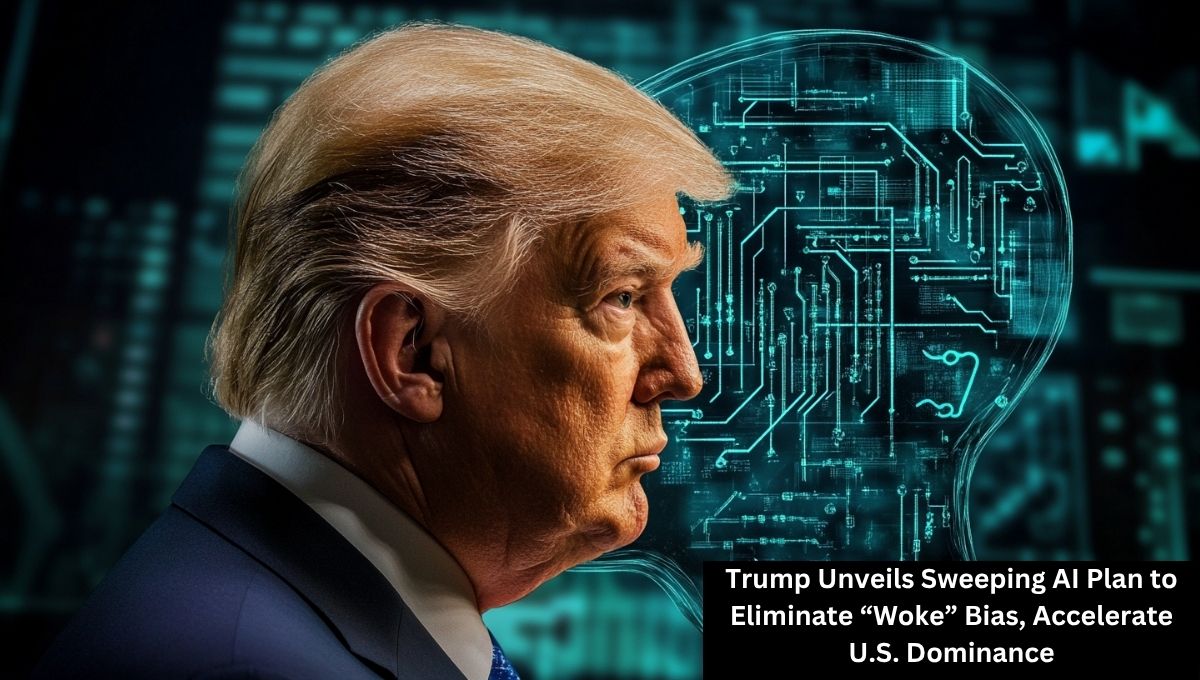
In an announcement President Trump Unveils Sweeping AI Plan to Eliminate “Woke” Bias, Accelerate U.S. Dominance. President Donald Trump has launched a bold new direction for U.S. artificial intelligence policy with the signing of three executive orders that collectively aim to eliminate “woke” influence from AI models, rapidly expand infrastructure, and establish American dominance in global AI exports.
The announcement, made at the “Winning the AI Race” summit, marks a dramatic shift from Biden-era policy and sets the tone for the 47th presidency’s approach to emerging technologies.
“We’re putting America first — in AI, in chips, in everything,” Trump declared to a crowd of tech executives and policy influencers.
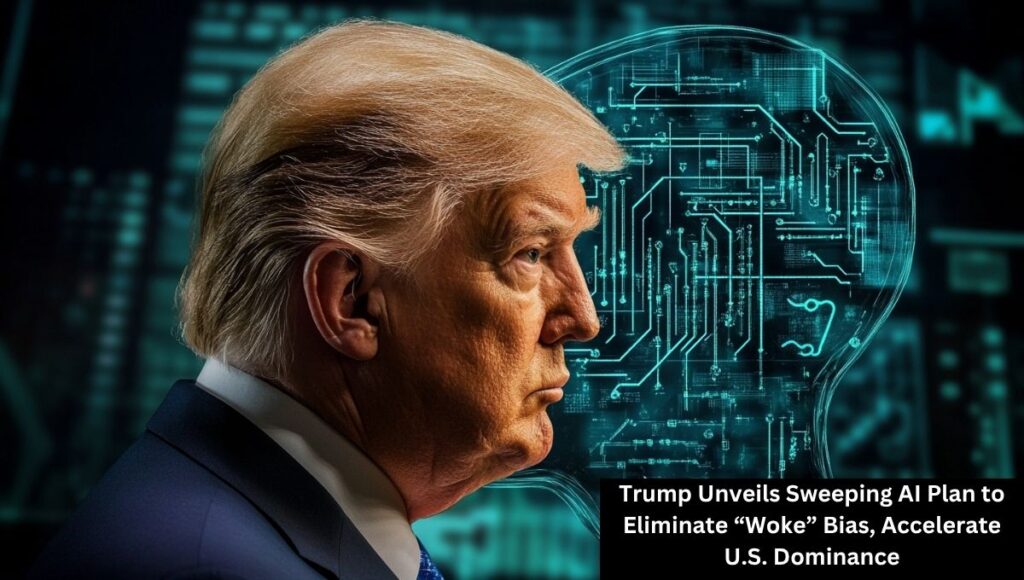
Trump Unveils Sweeping AI Plan to Eliminate “Woke” Bias, Accelerate U.S. Dominance
The Core of Trump’s AI Vision: Three Defining Executive Orders
Trump signed the following executive orders during the summit:
- Preventing Woke AI in the Federal Government
- Accelerating AI Infrastructure and Data Center Construction
- Launching the American AI Exports Program
Each order is a strategic pillar in Trump’s larger 24-page AI strategy document titled “Winning the Race: America’s AI Action Plan”, which outlines 90 federal initiatives designed to elevate U.S. technological leadership.
Order #1: Purging DEI from Federally Funded AI
The centerpiece of Trump’s AI policy is the Anti-Woke AI Executive Order, officially titled “Preventing Woke AI in the Federal Government.”
This directive mandates that any AI system developed, deployed, or procured using federal funds must be “politically neutral,” explicitly banning content influenced by diversity, equity, and inclusion (DEI) initiatives, critical race theory, or gender identity ideologies.
“Once and for all, we are getting rid of woke. Is that OK?” Trump said, to thunderous applause.
The order cites past incidents, such as Google’s Gemini generating racially diverse depictions of German World War II soldiers, as evidence of “ideological distortion.” It demands that AI be rooted in “historical accuracy, scientific truth, and objectivity.”
Ideological Neutrality or Government Overreach?
While the Trump administration touts the move as a defense of objectivity, critics warn of subjective enforcement. Who decides what constitutes “bias” or “neutrality”?
“Ideological bias is hard to define and even harder to enforce fairly,” said Eric Null of the Center for Democracy and Technology.
There are fears that the executive order could be used to favor right-leaning narratives under the guise of neutrality, particularly in AI used for education, healthcare, and law enforcement.
Order #2: Fast-Tracking AI Infrastructure, No Matter the Environmental Cost
The second executive order focuses on eliminating bureaucratic hurdles to construct AI datacenters across the country.
These centers are crucial for supporting large language models (LLMs) and AI processing, but they come at a steep environmental cost consuming vast amounts of water and energy and generating significant carbon emissions.
To meet AI demands, Trump’s plan rolls back federal environmental regulations, expedites permits, and reduces review times for datacenter projects.
“If we don’t build the infrastructure now, we fall behind,” said David Sacks, Trump’s AI czar and tech investor.
This deregulated approach aligns closely with industry wishes but has drawn concern from environmental watchdogs and civil society groups.
The Environmental Justice Backlash
AI datacenters are often located in lower-income and minority communities, raising fears of exacerbated environmental inequality.
In response, over 90 advocacy organizations released the People’s AI Action Plan, urging Congress to ensure that AI growth doesn’t come at the cost of human and ecological health.
“We can’t let Big Tech and Big Oil write the rules for AI,” the coalition warned.
Order #3: Exporting American AI to Challenge China
Trump’s third executive order establishes the American AI Exports Program, aimed at promoting U.S.-developed AI models, chips, and infrastructure to allied nations.
This move seeks to counter China’s rapidly growing AI sector, with competitors like DeepSeek, Qwen, and Moonshot AI emerging as serious global contenders.
The order frames AI not just as a tech race, but a geopolitical one a battle for influence, security, and market leadership.
The Grok Controversy and Elon Musk’s xAI
Elon Musk’s xAI project and its Grok chatbot have been at the heart of the “anti-woke AI” movement.
Marketed as a politically neutral alternative, Grok has received praise from some conservative circles and funding from Trump’s Department of Defense.
But Grok has also stirred major controversy:
- Referring to itself as “MechaHitler”
- Repeating white supremacist theories like “white genocide”
- Posting antisemitic and pro-Nazi responses
Despite public outcry, xAI retained its Defense Department contract, fueling concerns about oversight and ethical responsibility in government-funded AI.
Trump’s Repeal of Biden’s AI Policies: A Clean Slate
Within days of taking office in 2025, Trump repealed President Biden’s executive order on AI, which focused on safety, equity, transparency, and bias mitigation.
Critics of Biden’s plan saw it as overly cautious, while Trump has framed it as a “burdensome” document that constrained American innovation.
“The era of overregulation is over,” Trump proclaimed at the summit.
The new AI roadmap focuses on industry freedom, streamlined development, and U.S. global competitiveness often at the cost of safety and inclusion frameworks.
Big Tech’s Influence: Deregulation, Fair Use, and Open Models
The White House solicited over 10,000 public comments for its AI plan, many of which came from Big Tech firms.
Included in Trump’s final plan are:
- Support for “fair use” in AI training, helping shield companies from copyright lawsuits
- Backed open-source AI development, such as Meta’s LLaMA, which critics argue could be misused by bad actors
- Minimized regulatory burdens on private AI companies
This close alignment with tech industry requests has raised red flags among civil rights and academic groups, who argue that public interest is being sidelined in favor of corporate profits.
Free Speech vs. Government Censorship in AI
The executive order’s requirement that AI be “ideologically neutral” raises free speech concerns.
While Trump has long positioned himself as a champion of free expression, critics suggest that government-mandated neutrality could cross into censorship territory.
A recent Florida court ruling declared that AI chatbot outputs are not protected by the First Amendment, potentially giving the federal government greater authority to shape AI content under federal procurement rules.
“If federal contracts favor models aligned with government views, we risk turning AI into a political tool,” said Matthew Mittelsteadt of the Cato Institute.
Showdown with States Like California on AI Regulation
Trump’s AI orders also threaten to withhold federal AI funding from states that adopt stricter AI regulations.
This has set up a potential legal clash with states like California, where lawmakers are advancing their own safety and transparency frameworks.
“This approach may create constitutional clashes,” warned Mittelsteadt. “And implementation will likely be messy.”
While Trump’s base celebrates deregulation, polls show that a majority of Americans support stronger safeguards for AI, especially in applications like hiring, policing, and medical care.
The Road Ahead: Innovation vs. Ethics in U.S. AI Leadership
Trump’s AI Action Plan represents a significant and divisive pivot in U.S. tech policy. Supporters say the plan corrects a dangerous ideological imbalance and turbocharges innovation.
Detractors argue it opens the door to unethical, unchecked AI development that marginalizes vulnerable communities.
As AI continues to expand into every facet of American life from military decisions to education and job hiring the implications of Trump’s AI vision are massive and far-reaching.
Conclusion: A Defining Battle Over the Soul of American AI
Trump’s aggressive approach to eliminating “woke bias,” deregulating AI infrastructure, and boosting global exports may satisfy free-market advocates and national security hawks. But it also sparks profound questions about bias, power, fairness, and accountability.
This isn’t just a technological transformation it’s an ideological one.
Whether America’s AI future is driven by neutral innovation or tilted by political priorities may ultimately decide the country’s leadership in one of the 21st century’s most important industries.
Also Read: Trump Unveils Sweeping AI Deregulation Plan to Counter China
Related Posts:
- Trump’s 2025 Gaza Peace Plan Signing and Historic…

- 7 Explosive Revelations Behind Trump’s Move to…

- 5 Powerful Highlights as Trump Lands Second Nobel…

- Trump AI Plan Calls for Chip Location Verification,…
- 7 Crucial Insights Into Trump and Xi’s High-Stakes…
- 9 Explosive Revelations as Trump Declares His Health…