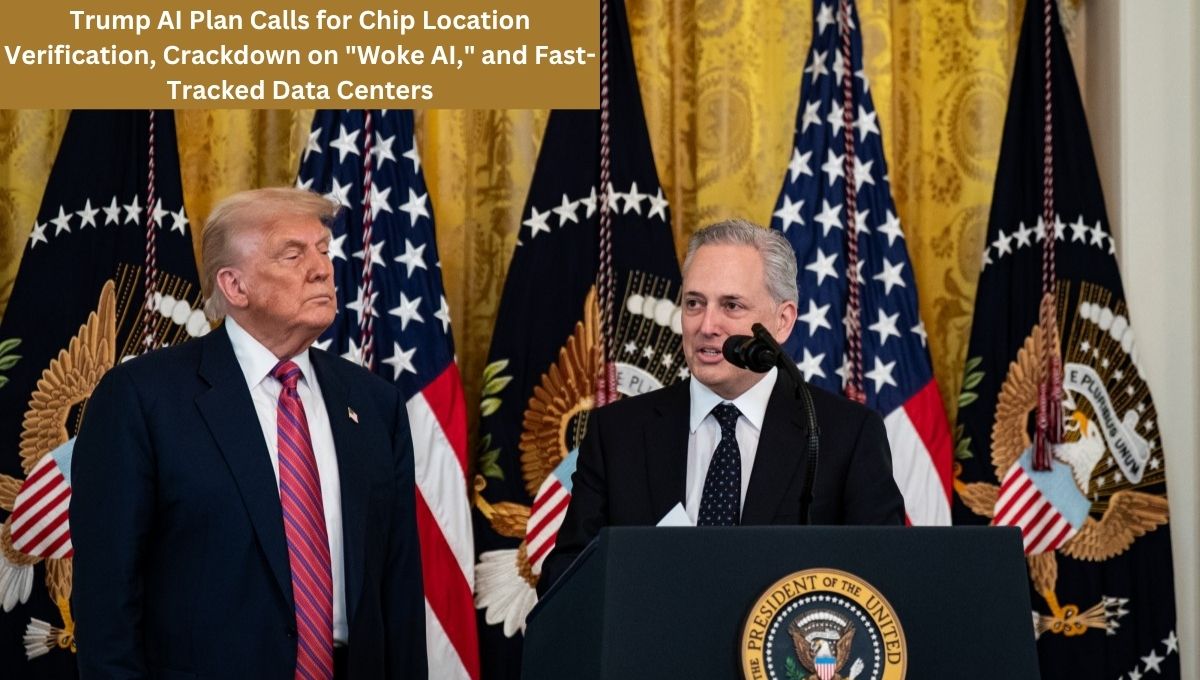
A highly anticipated Trump AI Plan Calls for Chip Location Verification, Crackdown on “Woke AI,” and Fast-Tracked Data Centers. The Trump administration released its AI Action Plan on Wednesday, outlining a sweeping vision to secure America’s dominance in artificial intelligence (AI). The plan recommends new export controls, AI chip location verification, elimination of ideological bias in AI systems, and regulatory rollbacks to accelerate data center construction.
Signed through three executive orders, the Trump AI Action Plan is the administration’s boldest tech move to date. It marks a strategic shift away from what it calls “radical climate dogma” and “ideological bias,” emphasizing instead infrastructure expansion, AI neutrality, and tech export competitiveness.
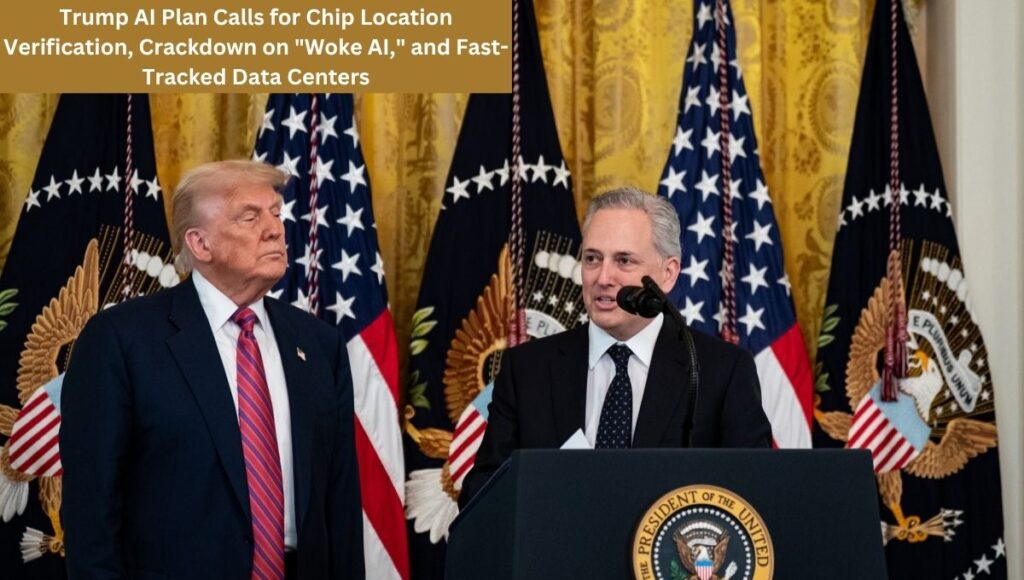
Trump AI Plan Calls for Chip Location Verification, Crackdown on “Woke AI,” and Fast-Tracked Data Centers
Chip Location Verification Proposed to Thwart Adversaries
One of the plan’s most concrete policy proposals is the implementation of location verification for AI chips, especially those manufactured by U.S. tech giants like Nvidia and AMD.
The policy is designed to prevent these chips from ending up in nations such as China, Iran, and North Korea, where export is currently banned.
“I was encouraged to see that the recommended export control policy includes location verification mechanisms and aligns closely with our bipartisan Chip Security Act,” said Rep. Bill Foster (D-IL).
Senator Tom Cotton (R-AR) echoed similar sentiments, calling it a necessary measure to prevent advanced technology from being “weaponized by Communist China.”
Though implementation details remain unclear, experts say this measure could include hardware-level geofencing, cloud verification protocols, or remote firmware checks.
Woke AI Targeted: Trump Orders Federal AI to Be Ideologically Neutral
In a move drawing sharp attention, the Trump administration ordered the removal of what it called “woke AI” from federal use.
Trump criticized Diversity, Equity, and Inclusion (DEI) frameworks embedded in AI models, arguing they lead to distortions in historical accuracy and “sacrifice truthfulness” for social engineering.
“DEI displaces the commitment to truth in favor of preferred outcomes,” the White House order stated.
The Trump AI plan claims that AI models have altered the race or gender of historical figures and refused to generate content celebrating white individuals while complying with similar requests for other races.
Trump’s order demands that Large Language Models (LLMs) used by the federal government be neutral and nonpartisan, and that they avoid “ideological judgments” unless specifically requested by users.
Plan Promotes Aggressive AI Export Strategy to Allies
While restricting adversaries’ access, the Trump AI Action Plan seeks to boost AI hardware and software exports to U.S. allies such as the UK, Israel, Japan, and EU countries.
Trump argues that such moves will strengthen alliances and ensure that like-minded nations are not left dependent on Chinese AI.
“We believe we’re in an AI race, and we want the United States to win that race,” said Trump-appointed AI and crypto advisor David Sacks.
Critics argue the plan could fuel global surveillance regimes and ignore safeguards put in place by the Biden administration.
Fast-Tracking Data Center Permits by Rolling Back Environmental Rules
One of the most controversial components of the plan is the easing of environmental regulations to facilitate the rapid construction of data centers.
This includes potential rollbacks of the Clean Water Act and Clean Air Act, with the administration citing the need to defeat “radical climate dogma.”
According to the International Energy Agency, global electricity demand from data centers is projected to more than double by 2030, surpassing Japan’s current national consumption.
“America must expand energy infrastructure to meet the needs of an AI-powered economy,” the plan states.
Can U.S. Power Its AI Ambitions?
Data centers require massive electricity loads and water resources. With AI computing demands exploding, many fear the U.S. grid won’t keep up, especially in areas still reliant on fossil fuels like coal and natural gas.
While some companies are pursuing nuclear power, like Amazon, Meta, and Microsoft, many data centers are still powered by traditional energy sources.
“Relying solely on wind and solar with batteries becomes really, really expensive,” said Prof. Benjamin Lee of the University of Pennsylvania.
AI Expansion Likely to Raise Energy Bills
Energy experts warn that regardless of how the data centers are powered, consumers may face higher electricity bills.
Building new plants, transmission lines, and storage solutions will require major investments.
“They’re planning infrastructure for growth, which is good but ratepayers will foot the bill,” said Amanda Smith from Project Drawdown.
This creates a challenge for balancing innovation with affordability and environmental responsibility.
Trump Rescinds Biden-Era AI Safeguards
The AI Action Plan also rescinds the 2023 executive order signed by President Joe Biden, which had emphasized ethical AI development, risk management, and public safety.
Jim Secreto, a former senior Commerce Department official, called the move reckless:
“Accelerating innovation is essential, but dismantling responsible guardrails risks turning America’s AI revolution into a reckless gamble.”
Critics Warn of Tech Industry Overreach
Organizations like the AI Now Institute claim the Trump AI policy favors corporate interests over public accountability.
“The White House AI Action Plan was written by and for tech billionaires,” said AI Now co-director Sarah Myers West. “It prioritizes profits over people.”
This echoes concerns that relaxing regulations on environmental, labor, and safety grounds could lead to unchecked growth, displacing communities and degrading natural resources.
AI Regulation Tensions Hit Congress
AI regulation has become a sticking point in Congress. Trump’s budget bill initially included a ten-year moratorium on state-level AI regulation, though lawmakers stripped that language after pushback.
Trump has continued to maintain that federal oversight is sufficient, while opponents argue local governments must retain authority to address AI’s social impacts.
Surprise Policy Shift on Nvidia Chip Sales to China
In a confusing development, the Trump administration recently reversed its own ban on Nvidia’s H20 chip sales to China, allowing restricted sales despite the ongoing national security narrative.
This reversal contradicts earlier commitments to tighten AI export controls, leaving analysts wondering whether economic incentives are now outweighing geopolitical concerns.
What’s Next: Implementation Still Unclear
While the Trump AI Action Plan outlines more than 90 policy actions, many remain conceptual. The logistics of chip location verification, bias auditing tools, and infrastructure buildouts still need detailed planning and execution.
Supporters argue the plan sends a strong signal about America’s AI leadership, but critics caution against ideologically driven policy that could alienate allies and citizens alike.
As generative AI continues to shape information flows, the Trump AI Action Plan signals a forceful, if polarizing, vision for the future.
Conclusion
President Trump’s AI Action Plan is a bold attempt to reassert U.S. technological supremacy, but it comes with significant political, environmental, and ethical trade-offs. From AI chip location verification and “woke AI” purges to data center booms powered by loosened environmental standards, the road ahead is fraught with complexity.
As implementation unfolds, the world will be watching whether this vision leads to sustainable leadership or an ideological arms race in the era of artificial intelligence.
Also Read: Trump Unveils Sweeping AI Plan to Eliminate “Woke” Bias, Accelerate U.S. Dominance
Also Read: Trump unveils AI plan that aims to clamp down on regulations and ‘bias’