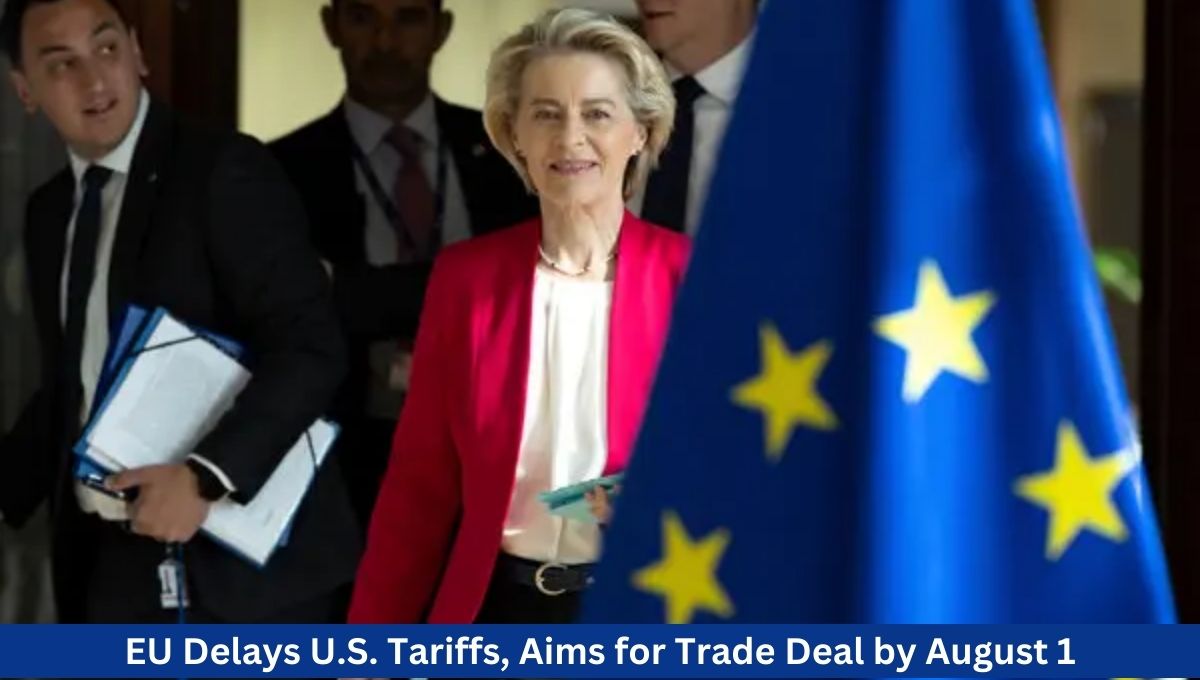
Amid building pressure EU Delays U.S. Tariffs, Aims for Trade Deal by August 1. In a pivotal move that could shape global trade dynamics, the European Union has delayed the implementation of retaliatory tariffs on U.S. goods, originally set to begin on Monday. The decision comes in the wake of President Donald Trump’s latest threat to impose a sweeping 30% tariff on EU and Mexican goods starting August 1.
Speaking at a press conference in Brussels on Sunday, European Commission President Ursula von der Leyen announced the delay, expressing hope that ongoing EU-U.S. trade negotiations could produce a deal before the August deadline.
“We will use the time we now have until the 1st of August to negotiate. We remain committed to a negotiated solution,” said von der Leyen.
EU Delays U.S. Tariffs, Aims for Trade Deal by August 1
Trump Threatens New Tariffs, Citing National Security
President Trump escalated trade tensions over the weekend by sending a formal letter to the EU, warning of 30% tariffs on European exports unless a trade agreement is reached by August 1.
Trump framed the move as a matter of national security, arguing that persistent trade deficits undermine America’s economic sovereignty.
According to the Trump administration, these global tariffs will revive domestic industries and correct decades of what Trump calls “unfair trade practices” by U.S. allies and rivals alike.
The White House emphasized that the tariffs will be enforced if no agreement is reached, sending shockwaves through financial markets and trade-dependent industries.
EU Suspends Countermeasures for Now, but Prepares Response
The EU had previously prepared a package of retaliatory measures targeting €21 billion ($25 billion) worth of U.S. goods.
These measures were scheduled to take effect Monday at midnight Brussels time, in response to earlier U.S. tariffs of 25% on steel and aluminum imposed in April.
However, in light of Trump’s recent letter, von der Leyen confirmed that the EU countermeasures will now be suspended until early August, aligning with the deadline for further U.S. tariffs.
“We prefer a negotiated solution. That’s why we are extending our suspension, but we will also continue preparing further countermeasures so we are fully prepared,” von der Leyen said.
EU Trade Ministers to Meet Monday
EU trade ministers are scheduled to meet Monday to assess the situation and discuss both the U.S. and China trade relationships.
Topics will include the suspended tariffs, Trump’s latest threat, and possible activation of a second list of retaliatory measures valued at €72 billion.
That second list, while not yet public, could include restrictions on U.S. goods, services, financial markets access, and foreign direct investment. Approval from all 27 member states would be required before implementation.
EU Lawmakers Call for Immediate Action
Despite von der Leyen’s cautious tone, not all European leaders are aligned on delaying the response.
Bernd Lange, head of the European Parliament’s trade committee, criticized the Trump administration’s abrupt tariff hike and urged the EU to activate countermeasures immediately.
“It is brazen and disrespectful to increase the tariffs on European goods from 20% to 30%. This is no way to deal with a key trading partner,” Lange told Reuters.
He added that postponing countermeasures was no longer justified and pushed for activation of both the first and second retaliation packages without delay.
EU Stresses Need for Diversified Trade Partnerships
Standing alongside Indonesian President Prabowo Subianto, von der Leyen emphasized the EU’s strategy to diversify its trade relationships, calling the Trump tariffs a stark reminder of the risks of overdependence.
She referenced the EU’s recent free trade agreement with Indonesia as a model for future cooperation in Asia and Latin America.
“Few economies in the world match the EU’s level of openness and adherence to fair trading practices,” von der Leyen said.
Economic Impact of U.S.-EU Trade Dispute
The standoff between the U.S. and EU America’s largest trading partner comes at a time of global economic uncertainty.
According to Eurostat, EU-U.S. trade in goods and services reached €1.7 trillion ($2 trillion) in 2024, or nearly €4.6 billion per day.
Europe’s top exports to the U.S. include:
- Pharmaceuticals
- Cars and automotive parts
- Aircraft and aerospace components
- Chemicals and medical instruments
- Wine and spirits
Tariffs on any of these goods could have wide-reaching effects on transatlantic supply chains, especially in Germany, France, and Italy, where manufacturing sectors are deeply intertwined with U.S. demand.
Trump’s Tariffs Could Hit Every Corner of the Economy
Analysts warn that if the 30% tariffs are enforced, they could result in higher consumer prices, supply shortages, and reduced competitiveness on both sides of the Atlantic.
In the U.S., companies that rely on European imports could face production slowdowns. In Europe, exporters might struggle to maintain access to the lucrative American market, potentially laying off workers or shifting trade elsewhere.
The tariffs also threaten to destabilize global trade flows and diminish the credibility of World Trade Organization (WTO) frameworks designed to prevent such disputes.
U.S.-EU Trade Relations Already on Thin Ice
This is not the first time U.S.-EU trade relations have soured under Trump. In 2018, his administration-imposed steel and aluminum tariffs under Section 232, prompting immediate EU retaliation.
Though relations improved briefly in 2020, tensions flared again following the revival of aircraft subsidy disputes, particularly between Airbus and Boeing.
This time, the scale and scope of Trump’s proposed tariffs are broader, covering multiple sectors and threatening to expand into areas like digital services, financial services, and agriculture.
Anti-Coercion Instrument Not Yet Invoked
Von der Leyen was asked whether the EU would activate its newly created Anti-Coercion Instrument, which allows the bloc to impose measures on countries that exert undue economic pressure.
“This instrument is created for extraordinary situations we are not there yet,” she clarified.
Nonetheless, the EU remains ready to use the mechanism if the tariff threats escalate into broader economic coercion.
A Crossroads for Global Trade Stability
The coming weeks will be crucial. If the EU and U.S. can strike a deal by August 1, they may avoid a devastating transatlantic trade war.
But failure to reach agreement could result in one of the largest tariff escalations in modern history impacting economies on both sides and sending ripple effects across Asia, Africa, and Latin America.
“This is now the time for negotiations,” von der Leyen said Sunday. “But if those fail, we will be fully prepared.”
Conclusion: Deal or Deadlock by August 1
As the EU holds off on retaliatory tariffs and Trump pushes forward with plans for new levies, the world waits for what happens next. Will both sides find common ground in time? Or are we on the brink of a full-blown trade war between two of the world’s largest economies?
Only one thing is clear: August 1 is the make-or-break moment.
Stay tuned as trade ministers meet this week and negotiations continue. One side’s restraint may be the other’s final opportunity to walk back from the edge.
Also Read: Trump’s 30% Tariffs on EU, Mexico Spark Global Trade Turmoil
Also Read: Trump’s Tariffs Make an E.U. Deal Harder to Achieve, Experts Say
Related Posts:
- EU Races to Avert Trump’s Tariff Threat as July 9…

- Trump Finalizes Historic $1.35 Trillion EU Trade…

- Trump’s 30% Tariffs on EU, Mexico Spark Global Trade Turmoil
- Trump Targets Sri Lanka, BRICS with Sweeping Tariffs
- EU Leaders Delay €140 Billion Plan to Use Frozen…

- 7 Alarming Reasons Mexico’s Shock Tariffs Hammer…