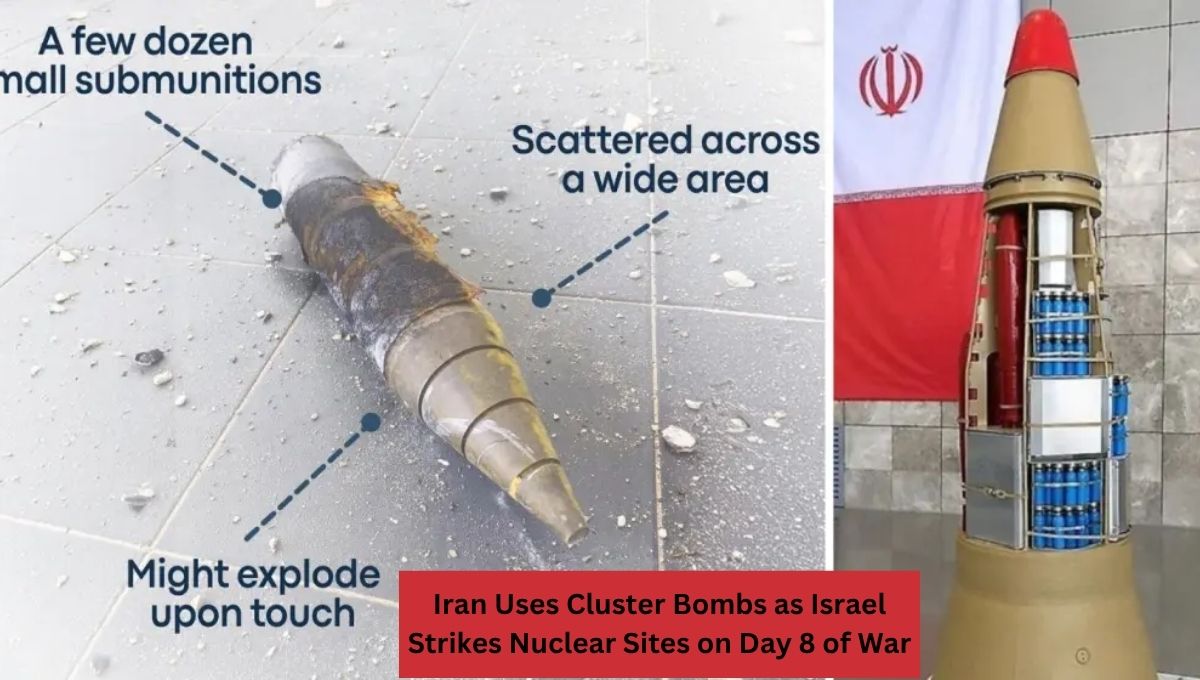
In a war escalating with a dangerous paceIran Uses Cluster Bombs as Israel Strikes Nuclear Sites on Day 8 of War. Fordow remains intact as Trump considers U.S. involvement; fears grow of nuclear breakout. The Israel-Iran conflict entered its eighth day on Friday, escalating dramatically with Iran’s use of cluster munitions in a missile strike that hit Soroka Medical Center in Beersheba, Israel.
Seventy-one people were injured in what Israeli officials have labeled a war crime and a dangerous turning point. The strike prompted swift Israeli retaliation, including airstrikes on Iran’s nuclear infrastructure at Natanz, Isfahan, and Arak.
Meanwhile, the deeply fortified Fordow facility remains undamaged, raising concerns about Iran’s ability to continue enriching uranium toward weapons-grade levels. With both sides refusing to de-escalate, and U.S. President Donald Trump weighing direct military intervention, the Middle East faces a crisis that could spiral into regional or global war.
Iran Uses Cluster Bombs as Israel Strikes Nuclear Sites on Day 8 of War
Iran’s Cluster Bomb Strike Hits Israeli Hospital
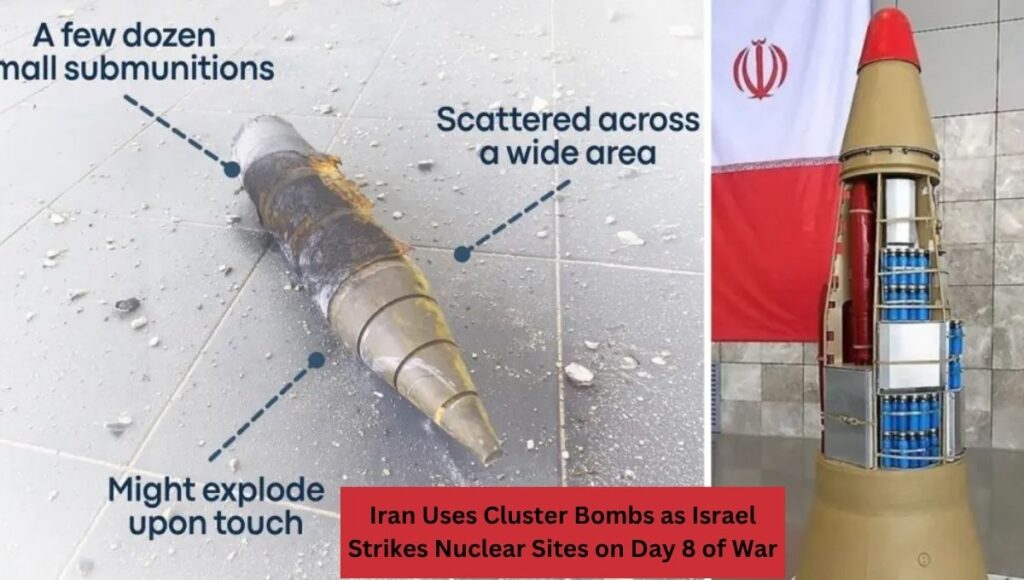
Iran’s latest missile barrage marked the first use of cluster bombs in the current conflict. The controversial weapon struck Soroka Medical Center, scattering submunitions across a wide area, including civilian neighborhoods in Beersheba.
The Israeli Health Ministry confirmed 71 injuries, most of which were minor or due to panic. Witnesses described chaos inside the hospital, with ceilings collapsing and patients being evacuated under fire.
“I heard a boom, and suddenly the ceiling was on me,” said Alon Uzi, a patient inside the emergency ward. “I was covered in white dust.”
Brigadier General Effie Defrin, an Israeli military spokesperson, called the attack “state-sponsored terror” and a clear violation of international law.
What Are Cluster Munitions, and Why Are They So Controversial?
Cluster bombs are weapons that release dozens of smaller explosive devices (submunitions) over a wide area. Many of these do not detonate immediately, creating a long-term risk of injury or death, especially to civilians.
Over 110 countries have banned their use under the Convention on Cluster Munitions. However, Iran, Israel, and the United States have not signed the treaty. Their use in civilian areas is condemned by human rights groups and military experts alike.
Iran Claims Strike Targeted Military Site Near Hospital
The Islamic Revolutionary Guard Corps (IRGC) claimed it was targeting an Israeli military and intelligence facility near the hospital not the hospital itself. Iranian media said the missile was aimed at the Gav-Yam tech park, about 3 kilometers away.
Israel denies any military installation was near the hospital and views the strike as a deliberate attack on civilians.
Netanyahu Vows Iran Will “Pay the Full Price”
In a press conference following the strike, Israeli Prime Minister Benjamin Netanyahu promised a massive response.
“The tyrants of Tehran will pay the full price. This will not go unanswered,” Netanyahu said. “We are committed to neutralizing Iran’s nuclear threat.”
He further hinted that regime change in Iran could be a long-term consequence of this conflict—though he stressed it’s up to the Iranian people to choose their destiny.
Israel Targets Nuclear Sites in Natanz, Isfahan, and Arak
In retaliation, the Israeli Air Force launched large-scale strikes on key Iranian nuclear sites:
- Natanz: Known for uranium enrichment, this site suffered heavy damage to its surface structures.
- Isfahan: Hosts several nuclear-related facilities and experienced widespread explosions.
- Arak (Khondab): A heavy-water reactor Iran planned to activate next year. Satellite imagery showed a blackened crater and destroyed towers.
David Albright, a former UN nuclear inspector, said: “The Israelis hit Arak because Iran planned to make it operational soon. They’re trying to deny Iran the ability to restart plutonium production.”
Fordow Facility Still Intact—A Nuclear Flashpoint
Despite Israel’s precision strikes, the Fordow enrichment plant near Qom buried deep in a mountain remains operational. This facility has been central to Western concerns since uranium enriched to 83.7% purity was found there in 2023.
Experts say Israel likely lacks the capability to destroy Fordow alone. Only the U.S. has the Massive Ordnance Penetrator (MOP) a 30,000-pound bunker buster capable of penetrating such fortified sites.
Trump May Deploy U.S. Forces: “Two Weeks” to Decide
With fears of a nuclear Iran mounting, President Donald Trump has said he will decide “within two weeks” whether to back Israel with U.S. military force. White House Press Secretary Karoline Leavitt confirmed the timeline but declined to share specifics.
Trump’s special envoy, Steve Witkoff, has reportedly held multiple phone calls with Iranian Foreign Minister Abbas Araqchi, suggesting the U.S. is still pursuing backchannel diplomacy.
“If it’s a choice between fighting and a nuclear Iran, we’ll do what we have to do,” Trump said.
U.S. Quietly Moves Military Assets in Gulf
Amid rising tension, the Pentagon has relocated nearly 40 aircraft from its airbase in Qatar. Analysts believe this is a preemptive move to shield U.S. assets from potential Iranian strikes if war expands.
IRGC Leadership Targeted by Israeli Airstrikes
In a strategic blow to Iran, Israeli strikes killed Mohammed Kazemi, the IRGC’s intelligence chief, and senior officers Hassan Mohaghegh and Mohsen Bagheri. Iran quickly appointed Brigadier General Majid Khadami as the new intelligence chief.
The targeted assassinations signal Israel’s deep intelligence penetration and its aim to decapitate Iran’s strategic leadership.
Iran Threatens to Close Strait of Hormuz
As pressure mounts, an Iranian lawmaker hinted that Tehran may close the Strait of Hormuz, a key chokepoint for 20% of the world’s oil. Such a move could cripple global energy markets and trigger a broader war involving regional and global powers.
Inside Iran: Blackouts and Censorship
Iran has shut down most of the internet, banned filming in public, and stopped providing casualty updates. One Tehran resident, Arash, described the destruction near his home: “I saw three dead children and two women. Is this what liberation looks like? Tell Netanyahu to stay away from our country.”
A Conflict Rooted in Espionage: The Mossad Files
Much of today’s conflict traces back to the 2018 Mossad raid in Tehran, where agents extracted 500 kg of nuclear documents. These files revealed Iran’s secret plans to build nuclear warheads and triggered the U.S. withdrawal from the 2015 nuclear deal.
Conclusion: Brink of Regional War
With cluster bombs, civilian casualties, nuclear facilities under attack, and U.S. intervention looming, the Israel-Iran war is now on the brink of uncontrollable escalation.
The coming days will be decisive. The world watches as leaders in Tehran, Jerusalem, and Washington weigh their next moves. Whether diplomacy or destruction prevails will determine not just the fate of two nations but potentially the security of the entire region.
Also Read: How the world is reacting to Israel attacks on Iran nuclear, military sites
Related Posts:
- Israel-Iran War Escalates: Cluster Bombs, Missile…
- Netanyahu: Iran Regime Collapse “Not a Goal,” But…
- 3 Explosive Conditions Iran Sets to End War with US…

- 10 Explosive Signals: Trump Rates Iran War “15/10”…

- 10 Explosive Strikes: Israel Bombs Tehran Oil Depots…

- 10 Powerful Revelations from the Trump–Putin Call on…