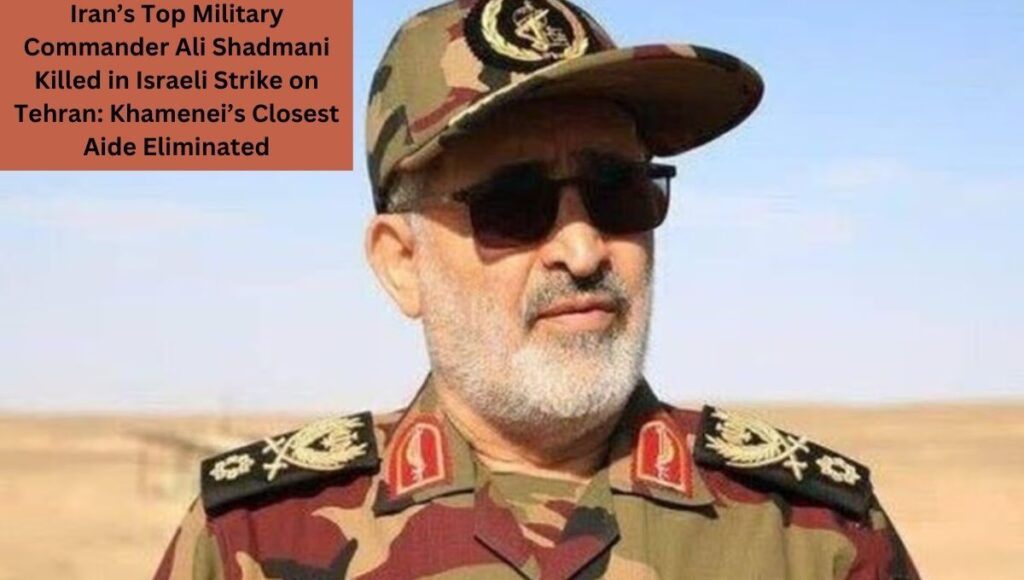
In a stunning escalation of the Israel-Iran conflict, Iran’s Top Military Commander Ali Shadmani Killed in Israeli Strike on Tehran: Khamenei’s Closest Aide Eliminated. Israel announced on Tuesday that it had killed Ali Shadmani, Iran’s newly appointed wartime Chief of Staff, in a targeted airstrike on a command center in central Tehran.
Shadmani, a top-ranking Iranian commander and one of Supreme Leader Ayatollah Ali Khamenei’s most trusted military advisors, was reportedly overseeing both the Islamic Revolutionary Guard Corps (IRGC) and the Iranian army at the time of his death.
The strike marks a pivotal moment in Israel’s Operation Rising Lion, a rapidly intensifying military campaign that has seen Israel expand its operations deep into Iranian territory, resulting in the deaths of multiple high-ranking Iranian military officials.
Iran’s Top Military Commander Ali Shadmani Killed in Israeli Strike on Tehran: Khamenei’s Closest Aide Eliminated
Who Was Ali Shadmani?
Ali Shadmani was no ordinary general. He was described by Israeli officials as the most senior military commander in Iran’s armed forces and a key architect of Iran’s war strategy. Until his death, he served as the head of Khatam al-Anbiya Central Headquarters, Iran’s elite war-time command post.
Shadmani had only recently assumed this position following the death of Major General Gholam Ali Rashid, who was killed days earlier in a separate Israeli strike. Prior to his promotion, Shadmani was the Deputy Commander of Khatam al-Anbiya and previously led the Operations Directorate within Iran’s General Staff.
According to the Israel Defense Forces (IDF), Shadmani was directly responsible for overseeing Iran’s coordinated military response to Israeli attacks, shaping tactical decisions and coordinating retaliatory missile launches. His close ties to Khamenei placed him at the center of Iran’s military and political power structure.
How the Strike Happened
According to Israeli officials, the operation was carried out after “a sudden opportunity” was identified by intelligence sources late Monday night. A targeted airstrike was launched on a staffed command facility in the heart of Tehran, where Shadmani was reportedly holding a strategy session.
The Israeli Air Force used precision-guided munitions to strike the facility, eliminating Shadmani and several other senior personnel. While Iranian state media has not confirmed his death, the IDF released a statement describing the operation as a major blow to Iran’s military command.
“Ali Shadmani, the most senior commander and the closest figure to Khamenei, has been eliminated. He was directing IRGC and army responses. His loss is irreplaceable,” the statement read.
Khatam al-Anbiya: Iran’s Military Brain
Shadmani’s death carries significant implications for Iran’s military structure. The Khatam al-Anbiya Central Headquarters is more than just a battlefield command it’s the strategic heart of Iran’s military planning, overseeing coordination between the IRGC, the army, missile divisions, and intelligence wings.
The headquarters is responsible for firepower allocation, war simulations, and real-time command over active military zones. Losing two commanders (Rashid and now Shadmani) in less than a week represents a devastating breach of Iran’s military leadership chain.
Western analysts say this development is likely to lead to confusion and missteps in Iran’s ongoing retaliatory campaign against Israel.
Iran’s Military Reshuffle: New Leaders Emerge
Following the deaths of Shadmani and other commanders, Iran has rushed to fill key leadership positions. Supreme Leader Khamenei has tapped Brigadier General Abdolrahim Mousavi, previously the commander-in-chief of the Iranian army, to become the new Chief of Staff of the Armed Forces the first non-IRGC figure to hold the position.
To lead the IRGC, Mohammad Pakpour, a decorated commander of Iran’s ground forces, has been appointed as the new Commander-in-Chief. He has decades of battlefield experience and previously directed major headquarters within the IRGC.
Amir Hatami, a seasoned military strategist and former defense minister, was promoted to Major General and is now in charge of Iran’s conventional army.
Meanwhile, Majid Mousavi has taken over as the head of the IRGC’s Aerospace Division, succeeding the late Ali Akbar Hajizadeh, who was killed in another Israeli strike. Each new appointee is a war veteran with experience dating back to the Iran-Iraq War of the 1980s.
What This Means for the Iran-Israel Conflict
The death of Ali Shadmani is the latest in a string of high-profile assassinations by Israel aimed at crippling Iran’s war-fighting capacity.
Since Operation Rising Lion began on June 13, the Israeli military has carried out surgical strikes across Iran, targeting missile facilities, command centers, and key leadership compounds.
In retaliation, Iran has launched waves of drones and ballistic missiles, striking military and residential targets in Israel and vowing to escalate further.
However, the leadership vacuum created by these assassinations could slow down Iran’s military decision-making and increase the risk of strategic errors.
Tehran in Shock: Death Toll Mounts, Air War Rages
As airstrikes continue, Tehran remains under siege. Explosions were reported across the city, including in Niavaran, Saadat Abad, and downtown districts like Valiasr and Hafte Tir.
Civilian casualties are rising, with Iranian officials now confirming more than 220 deaths, including 25 children.
Reports of panic, mass evacuations, and traffic gridlocks have overwhelmed the capital. Shadmani’s death has only deepened public anxiety, with many fearing a prolonged and bloody conflict.
Global Reactions and the Road Ahead
International observers have warned that the ongoing assassination campaign could provoke Iran into broader regional retaliation, potentially involving proxies in Lebanon, Iraq, and Syria. Meanwhile, oil prices have surged, and global markets are rattled by the prospect of a wider Middle East war.
Whether Shadmani’s death will deter Iran or galvanize its new commanders remains to be seen. What is certain is that the elimination of Iran’s top strategist is a major tactical victory for Israel but one that comes with steep strategic risks.
Also Read: Trump Hails Israeli Strike on Iran as “Excellent,” Warns Tehran to Make a Deal or Face More Attacks
Also Read: Who was Ali Shadmani? Who are Iran’s other top military officials killed by Israel?
Related Posts:
- Operation Rising Lion: Israel Strikes Deep into Iran…
- Israel-Iran Conflict Reaches New Heights as Missile…

- 3 Explosive Conditions Iran Sets to End War with US…

- 10 Explosive Strikes: Israel Bombs Tehran Oil Depots…

- 10 Explosive Warnings as Donald Trump Calls Iran…

- 7 Powerful Facts About Ayatollah Ali Khamenei’s…