
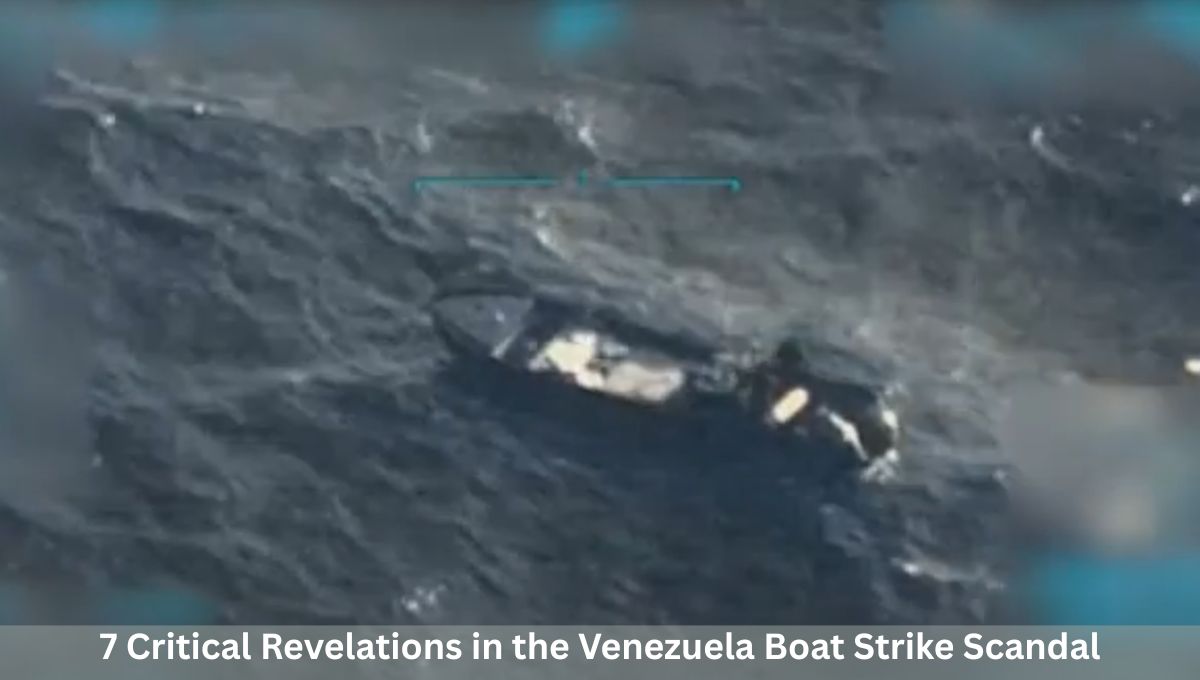
7 Critical Revelations in the Venezuela Boat Strike Scandal that are intensifying a political and legal firestorm. A political and legal storm is engulfing Washington as new details emerge about a deadly US military strike on an alleged Venezuelan drug-trafficking boat. What began as a routine national-security announcement has spiraled into one of the most contentious controversies of the Trump administration’s second term.
At the center of the dispute is a “double-tap” strike carried out on 2 September 2025, during which a second missile reportedly killed two survivors who were clinging to the wreckage of their destroyed vessel. The Trump administration insists the operation was lawful, necessary, and part of a wider strategy to neutralize “narco-terrorist groups.” Critics, however, say the strike may have violated the Geneva Conventions and could amount to a war crime.
This investigative deep-dive explores what happened, who approved the strike, what both sides are saying, and why the question of legality threatens to overshadow the administration’s expanding military operations in the Caribbean.

7 Critical Revelations in the Venezuela Boat Strike Scandal
What Triggered the Boat Strike Controversy?
On September 2, 2025, the US military—under Operation Southern Spear, a large-scale campaign aimed at dismantling drug-trafficking networks—struck a boat in the Caribbean Sea that officials claimed was carrying narcotics to the United States.
The Initial Strike
According to the Trump administration, the first missile destroyed the vessel and killed nine of the eleven people aboard.
But two men survived and were left clinging to burning debris.
The Double-Tap Strike
The Washington Post reported that a second missile—the controversial “double tap”—was fired moments later, killing the survivors. The report alleged that Defense Secretary Pete Hegseth had issued a verbal directive to “kill everybody” on the boat.
This single detail ignited bipartisan outrage, concern among international legal experts, and growing skepticism within US military circles.
The White House Confirms the Chain of Command
On Monday, the White House confirmed that:
- Defense Secretary Pete Hegseth authorized the mission, and
- US Navy Admiral Frank Bradley ordered the second strike.
White House Press Secretary Karoline Leavitt stressed that Admiral Bradley acted “well within his authority and the law.” Importantly, however, she did not deny reports that the first missile left two survivors.
The administration continues to portray the operation as an act of self-defense meant to prevent illicit drugs from reaching the US.
Hegseth’s Defense
Hegseth fiercely denied that he issued an order to kill all individuals onboard:
“As usual, the fake news is delivering fabricated, inflammatory, and derogatory reporting.”
Yet in the same breath, he defended the lethal nature of the mission:
“These highly effective strikes are intended to destroy narco-boats and kill narco-terrorists who are poisoning the American people.”
Congress Launches Bipartisan Investigations
The fallout has been swift and unusually bipartisan.
Both Republican and Democratic lawmakers have raised concerns about the legality of the strike and Hegseth’s reported role.
Senate Armed Services Committee Steps In
Senator Roger Wicker, the Republican chair, said the committee would:
- Interview Admiral Bradley
- Review audio and video from the operation
- Determine whether orders were lawful
The House Committee Follows Suit
The House Armed Services Committee announced a parallel investigation, seeking “a full accounting” of the events.
Lawmakers from both parties want clarity on:
- Who issued the “kill order”
- Whether the survivors posed an ongoing threat
- Why lethal force was used in place of capture
- Whether international law was breached
The investigations suggest that the administration will struggle to control the narrative.
Legal Experts Raise Alarm Over Possible War Crimes
The most explosive dimension of this scandal centers on international law, specifically the protections afforded to shipwrecked or incapacitated individuals during armed conflict.
Are Drug Traffickers Combatants?
The Trump administration claims the US is engaged in a “non-international armed conflict” with narco-terrorist organizations.
Under this framing, drug traffickers become legitimate military targets. But multiple experts say this argument stretches the definition of armed conflict beyond recognition.
Why the Second Strike May Be Illegal
International humanitarian law, including the Geneva Conventions, prohibits targeting individuals who are:
- Wounded
- Captured
- Shipwrecked
- Unable to continue fighting
Law professor Rachel VanLandingham stated:
“That second strike against individuals clinging to wreckage is a war crime. Those individuals have protected status unless they were actively attacking.”
Because the two men were reportedly incapacitated and unable to fight back, experts say they should have been rescued—not killed. The Trump administration disputes this, insisting the individuals remained a threat.
Trump’s Contradictory Statements Add to Confusion
President Donald Trump appeared to undercut his own administration’s position while speaking aboard Air Force One.
On one hand, he said:
“I wouldn’t have wanted that—not a second strike.”
On the other hand, he defended the initial missile attack as “very lethal” and suggested he would “look into” what happened.
He also claimed that Hegseth told him personally:
“He did not order the death of those two men.”
A Gap Between the White House and the Pentagon?
While Trump distanced himself from the second strike, his press secretary fully backed Hegseth, saying the operation complied with the law of armed conflict.
This discrepancy has fueled speculation about internal divisions or miscommunication inside the administration.
Expanding US Military Presence in the Caribbean
The controversy comes at a time when the US has sharply increased its military footprint in the Caribbean and the Pacific as part of Operation Southern Spear. More than 80 individuals have been killed in similar boat strikes since early September, according to official statements.
Notably:
- The US typically releases grainy footage of boats being attacked,
- Officials provide almost no evidence of drug-trafficking activity,
- Identities and nationalities of the deceased are often withheld.
This lack of transparency has further eroded trust among lawmakers and watchdog groups.
Venezuela Condemns the Strikes as an Act of Aggression
The Venezuelan government has fiercely denounced the US actions.
National Assembly Responds
Venezuela’s National Assembly called the strikes:
- Illegal
- Dangerous
- A violation of sovereignty
It also vowed to conduct a “rigorous and thorough investigation” of the September 2 incident.
Maduro’s Position
President Nicolás Maduro has accused Washington of seeking regime change, arguing that the US is willing to escalate tensions to justify intervention.
He denies US allegations that he leads the so-called “Cartel de los Soles,” calling it a politically motivated fabrication.
Inside the Pentagon—Media Crackdown Meets Reality
Another subplot of this scandal is the evolving relationship between the Pentagon and the press.
Hegseth’s Hard-Line Stance Toward Reporters
Since becoming Defense Secretary, Hegseth has:
- Restricted journalist access to the Pentagon
- Eliminated workspace for veteran defense reporters
- Halted regular on-camera briefings
- Promoted pro-Trump influencers as preferred “media voices”
These moves were designed to protect sensitive operations and curb leaks.
But the Boat Strike Story Broke Anyway
Despite restricted access:
- The Washington Post
- CNN
- Other outlets
still obtained insider accounts from “current and former officials.”
This has highlighted a fundamental paradox:
Hegseth’s crackdown on transparency may have intensified skepticism rather than preventing it.
Larger Geopolitical Stakes: US–Venezuela Relations at a Breaking Point
Beyond the legal and political uproar lies a deeper geopolitical tension.
A Phone Call Fuels Suspicion
Trump recently confirmed that he spoke briefly with Maduro, urging him to:
- Resign immediately
- Leave Venezuela with his family
Maduro reportedly demanded:
- Amnesty for top aides
- Continued control over the military
Trump refused both conditions. The US then declared Venezuelan airspace “closed in its entirety.”
Caracas Sees a Pattern
Venezuelan officials argue that:
- The US is escalating militarily
- Sanctions are tightening
- Diplomatic pressure is increasing
All of this appears, to them, to point toward a coordinated effort to force regime change.
Why Identifying the Order-Giver Matters
The central question—who approved the second strike—carries immense legal significance.
If the survivors were not posing an active threat, killing them could be:
- A violation of the Law of Armed Conflict
- An illegal extrajudicial execution
- Grounds for prosecution under international war crimes statutes
Experts stress that the legality depends on:
- Whether the individuals could continue fighting
- Whether they were actively hostile
- Whether the mission commander acted on clear, lawful orders
So far, no official transcript, video footage, or audio recording has been released. Congress hopes these materials will clarify whether Admiral Bradley acted independently or followed a directive influenced by Hegseth.
The Road Ahead—Expect More Revelations
This scandal is far from over.
Upcoming investigations from both chambers of Congress may reveal:
- Whether the strike violated US or international law
- How decisions were made in real time
- Whether improper political pressure influenced commanders
- Whether the US is stretching the definition of “narco-terrorism”
The controversy has already shaken trust within the Pentagon and exposed tensions between the White House and military leadership. With more strikes continuing under Operation Southern Spear, the political stakes will only grow.
Conclusion: A Defining Test for US Military Accountability
The Venezuela boat strike scandal encapsulates a larger debate about American military power, transparency, and the limits of executive authority.
At issue is not only the legality of a single operation but the broader approach of the Trump administration toward:
- Combating drug trafficking
- Using lethal force against non-state actors
- Managing relations with adversarial governments
- Controlling public scrutiny of military operations
As lawmakers, legal experts, the Pentagon, and the White House offer competing narratives, the truth of what happened on September 2 will shape how history remembers this moment—and may determine whether accountability is delivered.
One thing is certain:
The world is watching, Congress is preparing, and the questions are not going away.
Also Read: White House confirms second boat strike was ‘self-defense’ despite initial denial


