7 Urgent Signals: The US–Venezuela Standoff Is Escalating Toward Conflict after President Donald Trump declared Venezuelan airspace “closed.” Tensions between the United States and Venezuela have entered one of their most volatile phases in years after President Donald Trump issued a sudden declaration urging pilots, airlines, drug traffickers, and human traffickers to consider the airspace above and surrounding Venezuela “closed.”
The declaration — delivered through a sharply worded Truth Social post — has set off global concern, ignited political uproar in Washington, and prompted accusations from Venezuelan President Nicolás Maduro’s government that the US is preparing for “colonialist aggression.”
For months, US forces have been conducting deadly strikes on suspected drug-smuggling vessels across the Caribbean and the eastern Pacific, a counter-narcotics campaign that critics warn is sliding dangerously close to direct conflict. Trump’s new statement marks the clearest sign yet that the operation could expand onto Venezuelan territory.
This in-depth report explains the current crisis, the military moves behind the scenes, Venezuela’s sharp retaliation, and why analysts believe the situation is approaching a critical point.
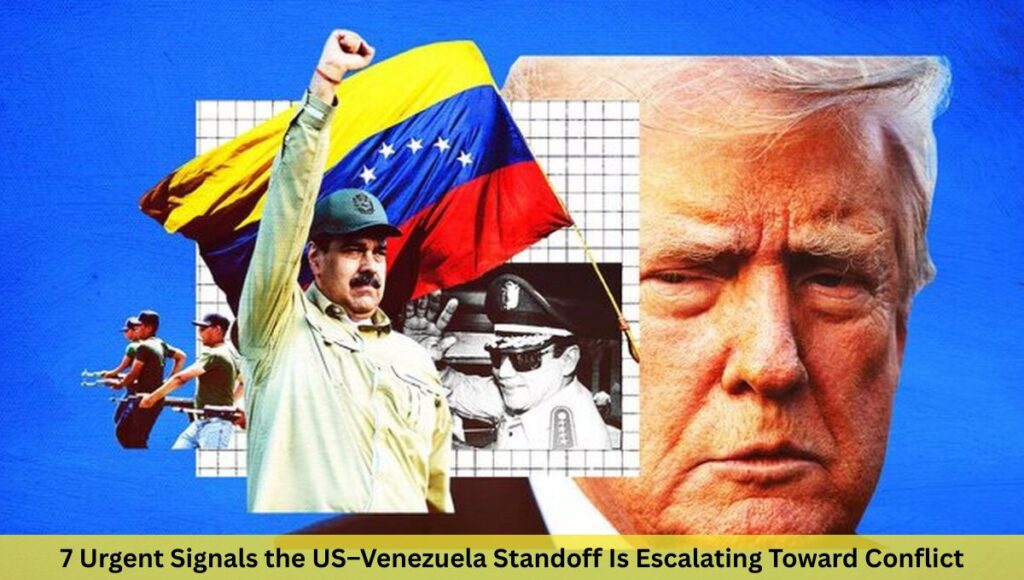
7 Urgent Signals the US–Venezuela Standoff Is Escalating Toward Conflict
What Triggered the Latest Spike in US–Venezuela Tensions?
Trump’s Airspace Closure Warning
On Saturday, Trump posted an unusually pointed message:
“To all Airlines, Pilots, Drug Dealers, and Human Traffickers. Please consider THE AIRSPACE ABOVE AND SURROUNDING VENEZUELA TO BE CLOSED IN ITS ENTIRETY.”
The wording — grouping pilots with traffickers — stunned aviation circles and foreign policy observers. It followed warnings from the US Federal Aviation Administration (FAA) about rising military activity in and around Venezuela, leading multiple major airlines to suspend their routes.
US Strategy Targets Maduro’s Alleged Narco Network
For months, the US administration has intensified pressure on Caracas, arguing that Venezuela’s leadership oversees major drug-trafficking operations. Washington recently designated the Cartel de los Soles, which it claims is headed by Maduro and high-ranking military officials, as a Foreign Terrorist Organization.
This terrorist designation gives US agencies broader authority for intelligence operations, seizures, and possible military action. Venezuela, however, has rejected the allegation as a fabricated pretext for invasion.
Is the US Considering Military Action in Venezuela?
Speculation about a potential US strike intensified after several developments converged in recent weeks.
1. US Bombings of Suspected Smuggling Boats
Since September, at least 83 people have been killed in US strikes against suspected drug-smuggling vessels in the Caribbean and eastern Pacific. Washington has not provided proof that the targeted vessels were involved in trafficking, prompting human rights experts to warn that the attacks may constitute extrajudicial killings.
2. Trump’s Hint of Ground Strikes
During a press interaction, Trump made an ominous statement:
“The land is easier, but that’s going to start very soon.”
Analysts interpreted this as a suggestion that US land-based operations inside Venezuela could be under consideration.
Bloomberg and multiple defense sources report that the US has deployed:
- The USS Gerald Ford, the world’s largest aircraft carrier
- A strike group of warships
- Approximately 15,000 troops in the region
The deployment is the largest US military presence in the Caribbean since the 1989 Panama invasion.
4. Intelligence Targeting Potential Strike Sites
According to the New York Times, US intelligence agencies have identified potential targets in Venezuela linked to:
- Drug production
- Storage hubs
- Supply-chain nodes used by Colombian cartels operating through Venezuelan territory
There has been no official confirmation from the Pentagon or White House, but leaks suggest preparations for potential limited strikes.
How Venezuela Responded to the Airspace Closure Declaration
The Venezuelan government reacted swiftly and angrily, calling Trump’s order a violation of its sovereignty.
Maduro Labels Warning a ‘Colonialist Threat’
In a strongly worded statement, Venezuela’s foreign ministry said:
- Trump’s comments constitute “a hostile, unilateral and arbitrary act.”
- The US has no legal authority to close another nation’s airspace.
- The statement is an explicit threat of force and a breach of international law.
Maduro also urged Venezuelans to be prepared to “give their lives” to defend the country.
Venezuela Bans Six Major Airlines
Caracas retaliated by revoking the takeoff and landing rights of:
- Turkish Airlines
- Iberia
- TAP Air Portugal
- Avianca
- LATAM
- GOL
The Venezuelan government accused these carriers of participating in “actions of state terrorism promoted by the United States.”
Military Exercises Intensify
Venezuela conducted coastal military drills, broadcasting:
- Anti-aircraft batteries
- Mobile artillery units
- Troop movements
State TV asserted that the country is ready to defend its airspace by force if necessary.
Why Congress Is Alarmed
Trump’s declaration sparked bipartisan criticism in Washington over concerns he may be bypassing Congress to initiate military action.
Democrats Warn of a “Costly New War”
Senate Majority Leader Chuck Schumer posted:
“Trump’s reckless actions towards Venezuela are pushing America closer and closer to another costly foreign war.”
Republican Allies Break Ranks
Congresswoman Marjorie Taylor Greene — traditionally a strong Trump supporter — also warned:
“Reminder, Congress has the sole power to declare war.”
The criticism highlights growing anxiety that Trump may use counter-narcotics authorities to justify military operations without congressional approval.
The Pentagon Pizza Report: A Viral but Unreliable Indicator
Amid the escalating tensions, a quirky social-media trend known as the Pentagon Pizza Report has added fuel to speculation. The account, which tracks fast-food deliveries near major US security buildings, claimed that the Domino’s closest to the Pentagon experienced a spike in orders.
Users quickly began posting dramatic comments such as:
- “Adios Maduro.”
- “It’s coming guys.”
- “Venezuela get ready to learn B2 stealth bomber.”
However, the metric has no official connection to military activity. The theory originated from pizza-delivery anecdotes around major geopolitical events in the 1990s and has since taken on a life of its own online.
It should not be taken as evidence of imminent military action.
Maduro’s Concerns: Is the US Trying to Depose Him?
Venezuela insists the US objective is regime change, not counter-narcotics enforcement. Maduro has accused Washington of:
- Using military pressure to destabilize his government
- Interfering in Venezuela’s sovereignty
- Fabricating terrorism allegations to justify intervention
These fears are not new — the US previously recognized opposition leader Juan Guaidó as Venezuela’s legitimate leader, and has repeatedly sanctioned Maduro’s administration.
Are Diplomatic Channels Still Open?
Despite the fiery rhetoric, both sides have maintained some degree of communication.
Unexpected Trump–Maduro Phone Call
The New York Times reported that:
- Trump and Maduro spoke recently over the phone
- They discussed a possible face-to-face meeting
- No date has been set
If such a meeting occurred, it would be historic, representing the first direct encounter between a US president and Maduro. The White House has neither confirmed nor denied the report.
Impact on Venezuelan Civilians and Economy
Although tensions are rising, daily life inside Venezuela continues with a mix of anxiety and routine.
Economic Disruptions
- Holiday shopping in Caracas remains busy
- Supply-chain disruptions are sporadic but noticeable
- Oil production — including Chevron’s operations — continues
Repatriation Flights Suspended
Venezuela warned that the US’s heightened security posture will suspend:
- Deportation flights
- Repatriation flights for Venezuelan migrants
Over 13,000 Venezuelans have been returned this year via chartered flights.
The Death Toll So Far
Since the US anti-narcotics operation began:
- At least 83 people have died in maritime strikes
- None of the dead have been publicly linked to drug cartels through official evidence
- Critics warn the operations lack transparency and oversight
This rising toll is one of the major factors fueling fears of escalation.
What Happens Next? Key Scenarios
Analysts believe several pathways are now possible:
1. Limited US Strikes
Targeting cartel-linked infrastructure inside Venezuela or along the Colombia border.
2. Expanded Maritime Operations
Increasing naval patrols and maritime interdictions, which risk further fatalities.
3. Diplomatic Reset
A Trump–Maduro meeting could lower tensions.
4. Political Crisis in Washington
Congress may attempt to limit Trump’s war powers if fears grow.
5. Miscalculation Leading to Conflict
With both militaries on high alert, an accidental clash could spark escalation.
Conclusion
The US–Venezuela standoff has reached its most dangerous stage in years. Trump’s declaration that Venezuelan airspace is “closed,” combined with military deployments, political backlash, and Venezuela’s defiant response, has created a fragile situation where a single misstep could trigger conflict.
While diplomacy remains possible — and perhaps more necessary than ever — the coming days will determine whether the crisis escalates into confrontation or stabilizes through engagement.
Also Read: 9 Critical Signals as Venezuela Faces Rising US Military Pressure
Related Posts:
- 5 Major Takeaways from the US Supreme Court's…

- 11 Explosive Revelations From Ted Cruz’s Leaked…
- Trump Threatens Military Action in Nigeria Over…
- Trump’s 20-Point Gaza Peace Plan Gains Urgent Global…

- 9 Explosive Claims as Trump Says US Winning Iran War
- 7 Heartbreaking Facts About Venezuela's Earthquake Disaster