In a surprising intervention, Trump Warns Netanyahu Against Iran Strike as U.S.-Tehran Nuclear Talks Near Breakthrough. U.S. President Donald Trump confirmed on Wednesday (May 28) that he had explicitly told Israeli Prime Minister Benjamin Netanyahu not to take any military action against Iran amid sensitive nuclear negotiations.
Trump, speaking to reporters from the Oval Office, emphasized that such a move would be “very inappropriate right now” as the United States edges closer to what he hinted could be a new nuclear deal with Tehran. “I told him this would be inappropriate to do right now because we’re very close to a solution,” Trump stated. “That could change at any moment.”
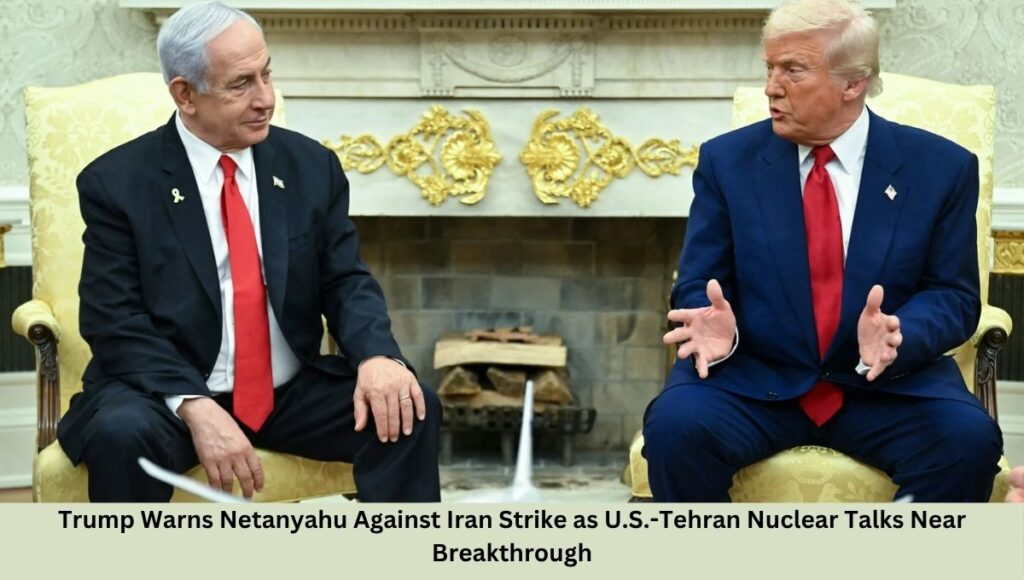
Trump Warns Netanyahu Against Iran Strike as U.S.-Tehran Nuclear Talks Near Breakthrough
Mounting Tensions Between Israel and the U.S. Over Iran Strategy
The confirmation came just hours after the New York Times reported that Israeli officials had considered a military strike on Iran’s nuclear enrichment facilities a claim the Israeli government promptly dismissed as “fake news.”
However, Trump’s public remarks lent credibility to the report, suggesting there are real concerns in Washington that Israel may act unilaterally and derail diplomatic progress.
The alleged Israeli threat of preemptive strikes stems from fears that the U.S. is softening its stance, potentially allowing Iran to retain limited enrichment capabilities—an unacceptable outcome for Israel, which sees it as a red line.
According to U.S. intelligence assessments cited by the Times, Israel could mobilize and launch a targeted attack on Iranian nuclear sites within seven hours, leaving minimal room for diplomatic maneuvering.
Talks with Iran Reach Critical Stage in Rome and Oman
As speculation over a possible Israeli strike circulated, American and Iranian officials held their fifth round of negotiations last week in Rome, following earlier sessions in Oman.
These back-channel talks, mediated by regional partners, aim to revive a nuclear agreement resembling the 2015 Joint Comprehensive Plan of Action (JCPOA), which collapsed in 2018 after Trump unilaterally withdrew the U.S. from the pact.
“I think we’re going to see something very sensible…people will be surprised by what’s happening there,” Trump told reporters.
Two senior Iranian sources told Reuters that Tehran may agree to pause uranium enrichment for a year if Washington releases frozen Iranian funds and publicly acknowledges Iran’s right to civilian nuclear energy under the Nuclear Non-Proliferation Treaty (NPT).
Iran Offers Compromise Amid Sanctions and Pressure
Despite facing stringent U.S. sanctions and intense regional scrutiny, Iran has repeatedly denied seeking nuclear weapons, asserting that its program is strictly for peaceful purposes.
In a recent interview with NBC News, Ali Shamkhani, a top adviser to Iran’s Supreme Leader, offered a roadmap for compromise: commit to never producing nuclear weapons, limit uranium enrichment to low civilian-grade levels, allow international inspectors full access, and eliminate stockpiles of highly enriched uranium.
This proposal may signal a willingness to strike a deal, provided Washington reciprocates with economic relief and formal recognition of Iran’s rights under international law.
Trump’s “Two Outcomes” Warning: Diplomacy or War
Throughout the week, President Trump has adopted a cautiously optimistic tone, repeatedly saying that Iran seems willing to engage diplomatically. Still, he left no doubt about the consequences if talks fail.
“There were only two outcomes,” he told reporters. “There’s a smart outcome, and there’s a violent outcome. And I don’t think anybody wants to see the second.”
Trump, speaking at an investment summit in Riyadh earlier in May, also issued a stern warning to Iran. He labeled the regime as the “most destructive force” in the Middle East and pledged the U.S. would never allow it to obtain a nuclear weapon. At the same time, he called his approach both “a final warning and a potential opening.”
Israeli Officials Engage in U.S. Meetings Amid Fallout
Adding further intrigue, the New York Times reported that Netanyahu’s Minister of Strategic Affairs Ron Dermer and Mossad Chief David Barnea recently met Trump’s special envoy Steve Witkoff in Rome. They later traveled to Washington for high-level discussions with CIA Director John Ratcliffe and had follow-up meetings with U.S. counterparts.
These meetings highlight the depth of Israeli concern over the direction of the U.S.-Iran talks. Still, the White House appears committed to keeping Israel at arm’s length for now.
Trump notably bypassed Israel on his recent Middle East tour and has made policy decisions that diverge from traditional U.S.-Israel diplomatic norms.
Homeland Secretary Kristi Noem acknowledged having a “very candid conversation” with Netanyahu and relayed Trump’s desire for unity while negotiations proceed.
“Fake News” or Real Rift? Diverging Narratives Exposed
While Netanyahu’s office has tried to downplay any rift with Washington, the visible divergence in messaging suggests otherwise. Trump’s candid acknowledgment that he asked Netanyahu to “back off” from any strikes marks a rare moment of public disagreement between two traditionally close allies.
“It’s not a warning. I said I don’t think it’s appropriate,” Trump clarified. “If we can solve it through a document, that would be better than blowing up labs without anyone in them. That would save a lot of lives.”
A Deal on the Horizon? Or Another Breakdown?
The path ahead remains uncertain. Trump expressed hope that a deal could be finalized within weeks, but emphasized that circumstances could change rapidly.
“I think over the next couple of weeks, if it happens, it’ll be a very good surprise,” Trump said, noting that any agreement would have to be “very sensible.”
Iranian President Masoud Pezeshkian, meanwhile, offered a stoic response: “It’s not like we will die of hunger if they refuse to negotiate with us or impose sanctions. We will find a way to survive.”
Conclusion: Fragile Diplomacy at a Pivotal Moment
As U.S.-Iran nuclear talks reach their most delicate stage in years, Trump’s decision to publicly warn Netanyahu underscores just how precarious the situation is.
The president is betting on diplomacy hoping to strike a new nuclear agreement that will reduce regional tensions without triggering another war in the Middle East.
But the clock is ticking. With military threats, political pressure, and deep mistrust on all sides, the coming days may determine whether this historic gamble ends in peace or further chaos.
Also Read: Iran Defiant on Nuclear Enrichment Despite US-Israel Strikes; Araghchi Urges Negotiated Solution
Also Read: Trump warns of possible military action if Iran enriches more uranium: ‘Going to have no choice’