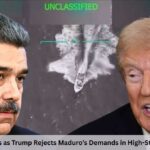
Trump Orders U.S. Military Strike on Venezuelan Drug-Carrying Vessel, Killing 11 Suspected ‘Narcoterrorists’ and escalating tensions with Nicolás Maduro.On Tuesday, President Donald Trump revealed that the U.S. military had carried out a kinetic strike in the southern Caribbean against what he described as a Venezuelan drug-carrying vessel operated by the gang Tren de Aragua. The incident, which Trump says killed 11 “narcoterrorists,” marks one of the most dramatic escalations yet in the administration’s renewed war on drugs and intensifies Washington’s long-simmering confrontation with Venezuelan President Nicolás Maduro.
The strike comes amid a massive U.S. naval buildup in the Caribbean, the largest since the 1989 invasion of Panama. While Trump hailed the operation as a decisive blow against drug traffickers, critics warn it risks plunging the region into a dangerous cycle of military escalation.

Trump Orders U.S. Military Strike on Venezuelan Drug-Carrying Vessel, Killing 11 Suspected ‘Narcoterrorists’
Trump’s Announcement: A Sudden Oval Office Revelation
The first word of the strike came not through the Pentagon, but directly from Trump himself. During an Oval Office meeting, the president interrupted remarks on an unrelated issue to announce:
“We just, over the last few minutes, literally shot out a boat, a drug-carrying boat, a lot of drugs in that boat. These came out of Venezuela. A lot of things are coming out of Venezuela. So we took it out.”
Trump later expanded on the operation in a post on Truth Social, his favored communication platform, stating:
“Earlier this morning, on my Orders, U.S. Military Forces conducted a kinetic strike against positively identified Tren de Aragua Narcoterrorists in the SOUTHCOM area of responsibility. The strike resulted in 11 terrorists killed in action. No U.S. Forces were harmed.”
Alongside the statement, Trump shared grainy aerial footage that appeared to show a speedboat racing across rough waters before erupting in a fiery explosion.
Tren de Aragua: Venezuela’s Notorious Criminal Network
Who Are They?
The Tren de Aragua (TDA) gang has become one of Venezuela’s most notorious criminal organizations, accused of drug trafficking, extortion, kidnapping, human trafficking, and violence across Latin America.
U.S. Terrorist Designation
Earlier this year, the Trump administration formally designated Tren de Aragua as a Foreign Terrorist Organization (FTO), alleging that it operates under the control of Maduro’s regime.
Washington accuses the Venezuelan president of turning the group into a “narco-terrorist proxy” to fund his government and destabilize U.S. borders through migration and criminal infiltration.
Maduro’s government has repeatedly denied such links, claiming it dismantled the gang in a 2023 prison raid. However, U.S. officials argue the group continues to operate internationally.
Escalation of Trump’s War on Drugs
Military Build-Up in the Caribbean
The strike comes just weeks after Trump ordered a major military deployment to the Southern Command (SOUTHCOM) region. Seven U.S. warships, a nuclear-powered attack submarine, and more than 4,500 sailors and Marines have been stationed in Caribbean waters.
Among the deployed forces are:
- USS Iwo Jima (Amphibious Ready Group)
- USS San Antonio
- USS Fort Lauderdale
- P-8 maritime patrol aircraft conducting reconnaissance missions
This naval surge represents the largest U.S. presence in the region in decades. Trump has repeatedly vowed to use the “full might of the United States” to combat drug cartels and narco-terrorist groups.
“More Where That Came From”
In his remarks, Trump hinted at future strikes:
“There’s more where that came from. Please let this serve as notice to anybody even thinking about bringing drugs into the United States of America. BEWARE!”
The Strike: Details and Questions
What Happened?
According to Trump and Secretary of State Marco Rubio, the U.S. military conducted a precision strike against a small motor vessel identified as a drug carrier. The strike reportedly destroyed the boat and killed all 11 people onboard.
What Was the Vessel Carrying?
Despite Trump’s repeated references to “a lot of drugs,” the Pentagon has not confirmed what type of narcotics were on board, how much, or whether physical evidence was recovered.
This lack of clarity has raised questions. Some analysts argue that blowing up the vessel rather than intercepting and seizing it is unusual, especially in counter-narcotics operations where arrests and evidence seizures are crucial.
Maduro’s Reaction: Defiance and Fury
“A Republic in Arms”
Just one day before the strike, President Nicolás Maduro warned that Venezuela would resist any U.S. aggression, declaring:
“We will declare a republic in arms if the U.S. attacks. Venezuela is confronting the biggest threat our continent has seen in 100 years.”
Maduro on Trump and Rubio
Maduro accused Trump and Secretary of State Marco Rubio of seeking regime change through military force:
“Marco Rubio wants to stain his hands with blood, with South American, Caribbean, and Venezuelan blood. Even if they put 10,000 missiles on our heads, Venezuelans will be respected.”
The Venezuelan government has petitioned the United Nations to demand an end to U.S. military deployments in the Caribbean.
International Reactions: Divided Hemisphere
Regional Allies and Critics
The U.S. strike and naval buildup have divided Latin America:
- Brazil and Colombia: Leaders Luiz Inácio Lula da Silva and Gustavo Petro criticized the deployment as destabilizing.
- Guyana and Trinidad & Tobago: Supported the move, citing concerns about drug trafficking.
- China, Russia, and Iran: Condemned U.S. actions as interference in Venezuelan sovereignty.
Financial Market Response
In the immediate aftermath of Trump’s announcement, Venezuela’s defaulted dollar bonds briefly rose, with 2031 maturities climbing above 23 cents on the dollar their highest since February 2019. Investors speculated that increased U.S. pressure might force new political outcomes in Caracas.
Legal and Human Rights Concerns
Extrajudicial Strike?
Human rights advocates argue that the decision to destroy a suspected drug boat rather than capture it sets a dangerous precedent.
Adam Isacson, Director for Defense Oversight at the Washington Office on Latin America, remarked:
“‘Being suspected of carrying drugs’ doesn’t carry a death sentence. This looks more like counter-terrorism than counter-narcotics.”
AI Manipulation Allegations
Venezuela’s Communications Minister Freddy Ñáñez claimed that Trump’s strike video was artificially generated using AI. Independent analysis by Reuters, however, found no evidence of manipulation, though it continues to verify the footage.
Trump’s Broader Strategy on Venezuela
A Maximum Pressure Revival
Since returning to the White House in January, Trump has revived his “maximum pressure” strategy against Maduro. Measures include:
- Doubling the reward for Maduro’s arrest to $50 million
- Designating multiple Venezuelan and Mexican criminal groups as terrorist organizations
- Deploying thousands of U.S. troops to the Caribbean
- Expanding sanctions and pressuring international allies to isolate Maduro
Aiming for Regime Change?
Critics argue that Trump’s rhetoric and actions go beyond counter-narcotics and suggest an intent to force regime change in Caracas.
Maduro, in turn, has accused Washington of seeking to topple his government through military threat and economic strangulation.
The Global Context: Why Venezuela Matters
Venezuela remains strategically significant for several reasons:
- Oil Reserves: Home to the world’s largest proven crude oil reserves.
- Geopolitical Alliances: Close ties with Russia, China, and Iran.
- Drug Trafficking Routes: Increasingly used as a transit hub for cocaine headed to North America and Europe.
U.S. officials believe that weakening Maduro’s regime could disrupt both drug smuggling and geopolitical adversaries’ influence in the Western Hemisphere.
Conclusion: A New Phase in U.S.-Venezuela Confrontation
The destruction of a Venezuelan drug-carrying vessel by U.S. forces and the deaths of 11 alleged narcoterrorists mark a watershed moment in the Trump administration’s second-term approach to Venezuela.
Whether hailed as a decisive strike against organized crime or condemned as a reckless act of escalation, the incident highlights the dangerous intersection of drug policy, counter-terrorism, and international geopolitics. As Trump warns that there is “more where that came from,” the world watches nervously to see whether the southern Caribbean becomes the next flashpoint of U.S. military power and whether Maduro’s vow of resistance turns into open conflict.
Also Read: Trump Doubles Maduro Bounty to $50 Million Amid Drug Trafficking Charges
Also Read: ‘Will happen again’: Rubio hints at more US strikes against drug smugglers