
With mounting international crises, Trump’s State Department Layoffs Reshape U.S. Diplomacy Amid Backlash. In a bold and controversial restructuring move, the Trump administration has initiated layoffs of more than 1,300 U.S. State Department employees, including civil servants and foreign service officers, as part of an expansive reorganization aimed at aligning American diplomacy with the “America First” foreign policy doctrine.
This wave of terminations represents one of the largest reductions of the federal workforce in modern history, sparking emotional scenes at the State Department, public protest, and strong pushback from former diplomats and lawmakers. The administration, however, insists the move is about modernizing U.S. diplomacy, reducing bureaucracy, and streamlining core operations.
Trump’s State Department Layoffs Reshape U.S. Diplomacy Amid Backlash
1,300+ Employees Laid Off in Massive Diplomatic Overhaul
According to internal documents confirmed by the Associated Press and CBS News, the layoffs include:
- 1,107 civil service employees
- 246 foreign service officers
These employees primarily hold domestic roles within the U.S., with civil servants facing a 60-day separation period, while foreign service officers will be placed on administrative leave for 120 days before their positions are formally terminated.
The total reduction, when combined with over 1,575 deferred resignations, amounts to nearly 3,000 positions eliminated a dramatic shake-up of the State Department’s 18,000-strong domestic workforce.
Supreme Court Ruling Enables Mass Layoffs
The layoffs follow a landmark U.S. Supreme Court ruling that lifted legal barriers preventing the federal government from carrying out mass dismissals.
The ruling overturned a freeze imposed by lower courts and gave the Trump administration a green light to proceed with broad downsizing across multiple federal agencies.
Officials within the Office of Personnel Management and the White House Counsel’s Office have since been coordinating efforts to ensure the firings align with federal employment law and constitutional standards.
This move fulfills one of President Trump’s key campaign promises to “dismantle the deep state” and reduce the size of government, which he argues has become bloated and ineffective.
Rubio Defends the Plan: “It’s About Efficiency, Not Politics”
Secretary of State Marco Rubio, who signed off on the restructuring plan earlier this year, defended the layoffs during a press conference in Kuala Lumpur, Malaysia:
“It’s not a consequence of trying to get rid of people. If you close the bureau, you don’t need those positions. Some of these are positions that are being eliminated, not people.”
An internal memo circulated among staff described the cuts as a necessary move to “streamline domestic operations” and prioritize core diplomatic missions.
It said the reductions were “carefully tailored to affect non-core functions, duplicative or redundant offices, and offices where considerable efficiencies may be found.”
State Department Shake-Up: 300+ Bureaus to Be Closed or Merged
The layoffs are part of a broader reorganization that will see the elimination or merger of more than 300 bureaus and offices, nearly half of the State Department’s internal structure.
According to senior officials, this restructuring is designed to create a leaner, faster, and more mission-focused foreign service.
Among the most high-profile changes is the dissolution of the Office of the Under Secretary for Civilian Security, Democracy, and Human Rights.
In its place, a new Under Secretary for Foreign Assistance and Humanitarian Affairs, confirmed by the Senate, will oversee a restructured Bureau of Democracy, Human Rights, and Labour.
This new office will be guided by a Deputy Assistant Secretary for Democracy and Western Values, signaling a shift toward what the administration calls “traditional Western conceptions of core freedoms.”
Scenes of Grief and Protest at State Department Headquarters
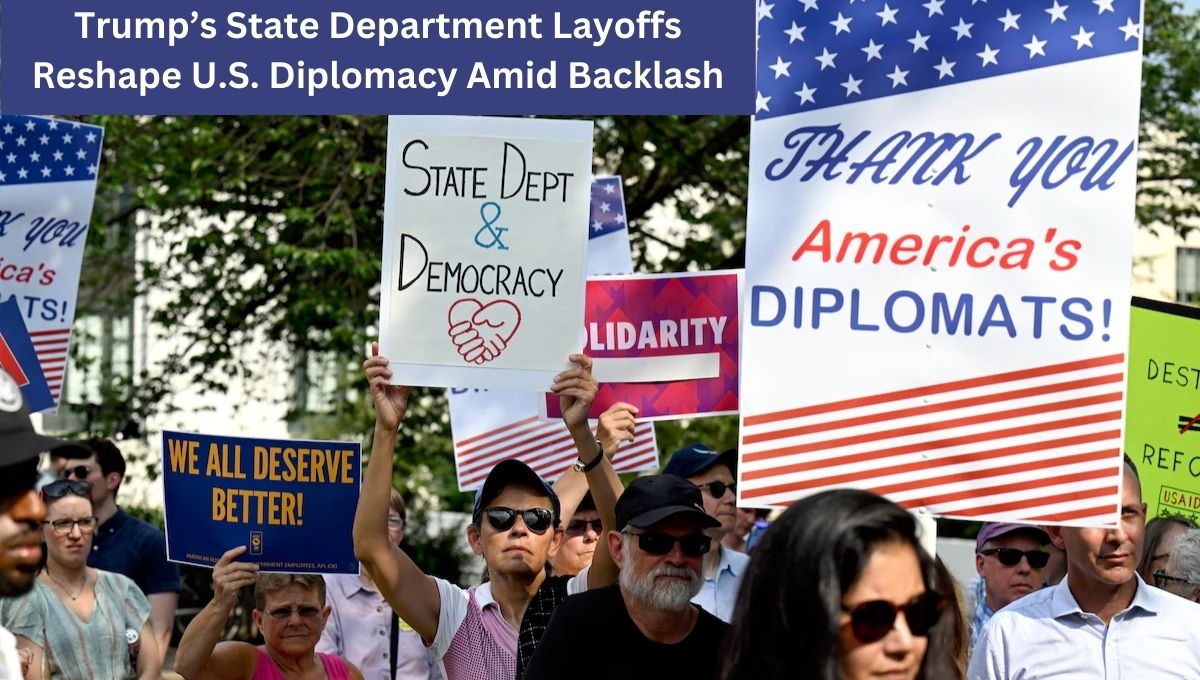
The human impact of the layoffs has been deeply felt. At the State Department headquarters in Washington, D.C., hundreds of employees gathered for a “clap-out” to honor colleagues who were being terminated. Many were seen carrying boxes, crying, and embracing coworkers as they exited the building.
Outside, protesters gathered with banners that read:
- “Thank you to America’s diplomats”
- “We all deserve better”
- “Resist fascism”
- “Remember the oath you vowed to uphold”
Senator Andy Kim (D-NJ), who previously served in Afghanistan as a civilian adviser, said: “All they wanted to do was serve this country. It’s heartbreaking.”
Inside, temporary offices were set up to handle “out-processing”, complete with separation checklists, bottle water, and boxes of tissues.
Employees were told they would lose access to email and ID badges by 5 p.m. the same day.
Humanitarian, Refugee, and Rights Offices Decimated
The layoffs disproportionately impacted programs focused on humanitarian aid, refugee resettlement, countering extremism, and global education exchanges. Key offices affected include:
- Bureau of Population, Refugees, and Migration’s Office of Admissions
- Coordinator for Afghan Relocation Efforts (CARE)
- Offices related to climate diplomacy and women’s rights
Critics say these eliminations reflect a sharp pivot away from values-based diplomacy toward a narrower, transactional approach to international relations.
USAID Officially Shut Down and Folded into State Department
Another major structural change is the official closure of the U.S. Agency for International Development (USAID).
As of July 1, the agency’s remaining functions were absorbed by the State Department, following the cancellation of more than 80% of its programs in March.
USAID, long regarded as America’s flagship development and humanitarian aid agency, distributed billions in foreign assistance annually.
Its closure has drawn fierce condemnation from public service advocates who warn that America’s global soft power has been severely weakened.
DEI Programs Eliminated, “Merit-Based” Hiring Prioritized
As part of the reorganization, the State Department also rescinded most diversity, equity, and inclusion (DEI) initiatives.
Officials said hiring and promotion decisions will now emphasize merit and national interest over identity-based considerations.
Deputy Secretary Michael Rigas described the move as part of aligning the department with “21st-century realities.”
However, many within the department see it as a regressive step that reverses years of progress in building a diverse and inclusive diplomatic corps.
Critics Warn of Global Consequences
Current and former U.S. diplomats, foreign policy experts, and lawmakers have issued urgent warnings about the impact of these cuts.
Over 130 retired ambassadors and former officials signed a letter stating that the reductions “could cripple U.S. diplomacy at a time of global instability.”
Senator Tim Kaine (D-VA) issued a scathing statement:
“This is one of the most ridiculous decisions that could possibly be made at a time when China is expanding its diplomatic footprint and Russia is continuing its brutal assault on Ukraine.”
Senator Chris Van Hollen (D-MD), who attended the protest outside the State Department, said the move jeopardizes America’s strategic credibility and long-standing diplomatic leadership.
American Foreign Service Association Sounds the Alarm
The American Foreign Service Association (AFSA), the professional association for U.S. diplomats, condemned the layoffs in a rare public rebuke:
“These layoffs are untethered from merit or mission. They target diplomats not for how they’ve served, but where they happen to be assigned. That is not reform.”
AFSA warned that without seasoned foreign service officers, the U.S. risks poorly informed foreign policy decisions, greater entanglement in future conflicts, and diminished leverage in global negotiations.
Voices from the Ground: Diplomats React
One of the diplomats impacted, Olga Bashbush, spoke to reporters after leaving the department:
“These firings were not done with dignity and respect. But I have walked out of the State Department with my head held high.”
Bashbush had served for over 20 years, most recently in a Washington-based policy bureau that was shut down.
She emphasized the resilience of the diplomatic corps: “We are here to serve and protect. And I’m still willing to serve and so are all my colleagues.”
What’s Next? More Cuts on the Horizon?
Currently, the layoffs are confined to domestic roles. However, analysts warn that international posts may be affected next, especially if the administration continues consolidating U.S. foreign engagement.
Officials have refused to say how much the cuts will save, though the Trump team insists they are eliminating wasteful spending and increasing focus on strategic goals.
Behind closed doors, however, senior State Department sources say the morale crisis is “unprecedented”, and that some embassies are already struggling to operate without key support personnel.
Conclusion: Reform or Retreat?
The Trump State Department layoffs are not just a cost-cutting exercise they represent a paradigm shift in how the U.S. conducts diplomacy. While administration officials portray the moves as necessary and overdue, critics argue the scale and ideology behind the cuts are reckless, short-sighted, and damaging.
With geopolitical tensions escalating in Ukraine, Gaza, and the Indo-Pacific and the 2025 election approaching the true cost of these changes may become clearer in the months ahead.
Whether this restructured State Department is better equipped to serve the nation, or whether it marks a retreat from global leadership, remains a defining question of our time.
Also Read: Supreme Court Lets Trump Dismantle Education Department, Approves 1,400 Layoffs
Also Read: State Dept. to fire 1,300-plus employees in dramatic reorganization plan
Related Posts:
- Trump’s 20-Point Gaza Peace Plan Gains Urgent Global…

- 7 Alarming Facts About Super Typhoon Fung-wong

- Donald Trump’s Lavish UK State Visit: From Kate…

- Israel–Hamas Ceasefire Under Strain: 4 More Hostage…

- Putin’s Shocking Risks Ahead of Trump–Hungary Summit 2025

- 10 Explosive Facts About Donald Trump’s $1 Billion…
