
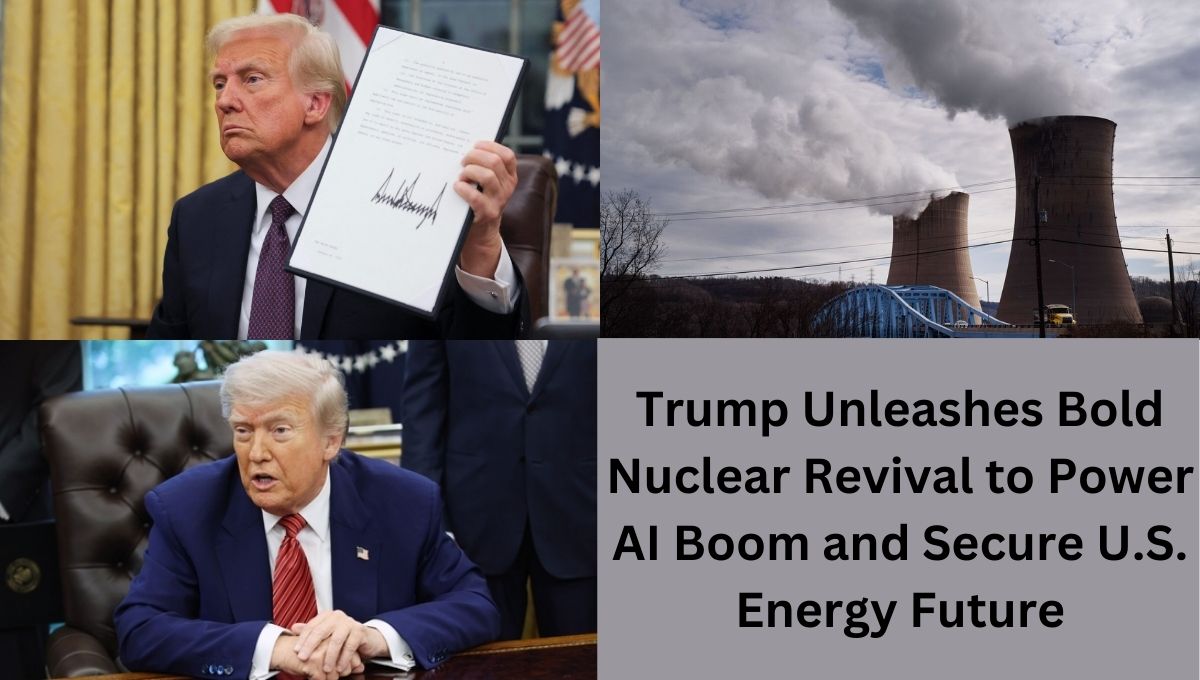
In a sweeping set of executive orders signed at the White House, Trump Unleashes Bold Nuclear Revival to Power AI Boom and Secure U.S. Energy Future. President Donald Trump unveiled a bold vision to resurrect and supercharge the U.S. nuclear energy industry. Standing alongside tech and energy leaders, Trump declared, “It’s time for nuclear,” pledging to reestablish American leadership in atomic energy.
Trump Unleashes Bold Nuclear Revival to Power AI Boom and Secure U.S. Energy Future
Trump Launches Ambitious Nuclear Plan to Meet AI and Energy Demands
“Very safe and clean…We’re going to get it very fast and very safe. We are going to get the people in and out…it is time for nuclear and we are going to do it very big,” Trump said after signing the order, ANI reported citing Reuters.
He was addressing the skyrocketing electricity demand driven by artificial intelligence and data center growth.
With a direct appeal to national energy independence and technological supremacy, Trump’s orders target accelerated deployment of next-generation reactors, revitalization of domestic uranium mining, and a fundamental overhaul of the Nuclear Regulatory Commission (NRC).
Nuclear Power to Fuel the AI Revolution
At the heart of Trump’s energy agenda is the urgent need to power the rapidly expanding AI sector.
Advanced artificial intelligence and data centers require massive, uninterrupted electricity a demand current U.S. infrastructure struggles to meet.
Trump’s plan positions nuclear power as the foundation for this energy-intensive revolution. With zero-carbon emissions and high reliability, nuclear energy offers a promising solution.
Analysts from Wedbush Securities noted, “Our confidence in the AI revolution data center buildout is increasing under the Trump administration. Nuclear energy will play a key role in powering data centers.”
Fast-Tracking Small Modular Reactors (SMRs)
A major pillar of the plan is the rapid deployment of small modular reactors (SMRs) compact, next-generation nuclear plants praised for their safety, efficiency, and scalability.
Unlike traditional nuclear reactors, SMRs are faster to build and ideal for localized power generation.
Trump’s orders set an aggressive target: three new SMRs must be operational by July 4, 2026.
This move appeals to tech giants like Amazon, Google, and Microsoft, which are all seeking clean, reliable power for their growing AI and cloud operations.
Slashing Nuclear Licensing Timelines
Perhaps the most dramatic change comes in the form of nuclear licensing reform. The executive orders instruct the NRC to cut approval times from more than a decade to just 18 months.
This includes restructuring the agency’s internal processes and reducing what Trump described as “an overly risk-averse culture.”
“This is the most significant pro-nuclear policy shift in a generation,” said Michael Kratsios, Director of the White House Office of Science and Technology Policy.
The initiative aims to remove regulatory bottlenecks while maintaining safety standards a point critics strongly contest.
Reinvigorating Uranium Mining and Enrichment
With nuclear energy set to expand, Trump also moved to address America’s dependence on foreign uranium.
The U.S. currently imports the majority of its nuclear fuel, but Russian supplies were banned in 2024 due to the ongoing Ukraine conflict.
Using the Defense Production Act, Trump’s executive orders prioritize uranium mining and enrichment within the U.S.
The goal is to reestablish a domestic supply chain and secure materials necessary for both civilian and military energy needs.
Controversial NRC Overhaul Raises Safety Concerns
Trump’s nuclear licensing reform is accompanied by a significant restructuring of the Nuclear Regulatory Commission (NRC).
The plan includes staff reductions, procedural streamlining, and an internal shakeup aimed at aligning the agency with new development timelines.
Critics warn that weakening the NRC could compromise reactor safety. Former NRC Chairman Gregory Jaczko condemned the move, calling it “a guillotine to the nation’s nuclear safety system.”
Nuclear safety advocates fear rushed decisions could lead to untested reactor designs and increased public risk.
Reopening Shuttered Plants and Utilizing Federal Land
The orders also instruct the Departments of Energy and Defense to evaluate the reopening of shuttered nuclear plants, such as Three Mile Island, and to prioritize reactor deployment on federal lands and military bases.
These sites are seen as ideal for cutting through red tape and launching new nuclear infrastructure rapidly.
Additionally, the Energy Secretary is granted expanded authority to approve reactor designs shifting power away from the independent NRC and toward more centralized executive control.
Boosting Financial Incentives and Market Response
Trump’s nuclear revival includes a financial package aimed at supporting private sector participation.
The Department of Energy’s Loan Programs Office is now directed to prioritize funding for new reactors, restarts of shuttered sites, and technology upgrades.
Despite broader rollbacks of green energy subsidies, tax credits for nuclear energy remain in place at least until 2028.
In response to the announcement, nuclear energy stocks surged. Companies like Oklo, Nano Nuclear Energy, and Energy Fuels saw double-digit gains, signaling strong investor confidence in Trump’s energy pivot.
Industry Applause and Expert Skepticism
Many industry leaders praised the orders. Jacob DeWitte, CEO of Oklo, called them “historic,” while Tori Shivanandan of Radiant Nuclear described the moment as a “watershed” for advanced nuclear energy.
However, nuclear experts caution that expanding nuclear output fourfold in 25 years is a steep challenge.
Edwin Lyman of the Union of Concerned Scientists noted, “Nuclear power will fail if safety is not made a priority,” warning that deregulation could backfire without proper oversight.
Global Nuclear Race Heats Up
Trump’s announcement comes amid a growing international competition in nuclear technology. China, Russia, and Canada are aggressively investing in nuclear infrastructure.
Canada recently began construction on a fleet of SMRs, while China continues to dominate in nuclear research and deployment.
Isaiah Taylor, CEO of Valar Atomics, emphasized the urgency: “This gives us the boost we need to compete globally.”
Conclusion: A High-Stakes Bet on America’s Energy Future
President Trump’s nuclear energy revival marks one of the most ambitious U.S. energy policy shifts in decades.
By aligning nuclear power with national security, AI innovation, and energy independence, the administration hopes to ignite a true American nuclear renaissance.
Whether this gamble will pay off remains to be seen. Success will hinge on balancing speed with safety, innovation with responsibility, and domestic goals with global leadership.
But one thing is certain: nuclear energy is no longer in the background it’s center stage in America’s energy future.
Also Read: South Africa Advances Starlink Approval Amid Trump-Ramaphosa Diplomatic Tensions
Also Read: Here’s How We Can Power the AI Boom Without Building a Ton of New Gas Plants
Related Posts:
- 5 Powerful Highlights as Trump Lands Second Nobel…

- 7 Powerful Measures: Trump Sanctions Russian Oil…

- In 8 Moves, EU Targets China-Linked Refineries and…

- Can the EU and NATO Impose Tariffs on India and…

- Trump’s 2025 Gaza Peace Plan Signing and Historic…

- Dramatic Moments Behind Trump’s Gaza Peace Push and…
