In a major policy shift with global implications, Trump Slaps 19% Tariff on Philippine Goods in Bold New Trade Deal. U.S. President Donald Trump has unveiled a sweeping US-Philippines trade deal that imposes a 19% tariff on Philippine exports while eliminating all tariffs on American goods entering the Southeast Asian nation.
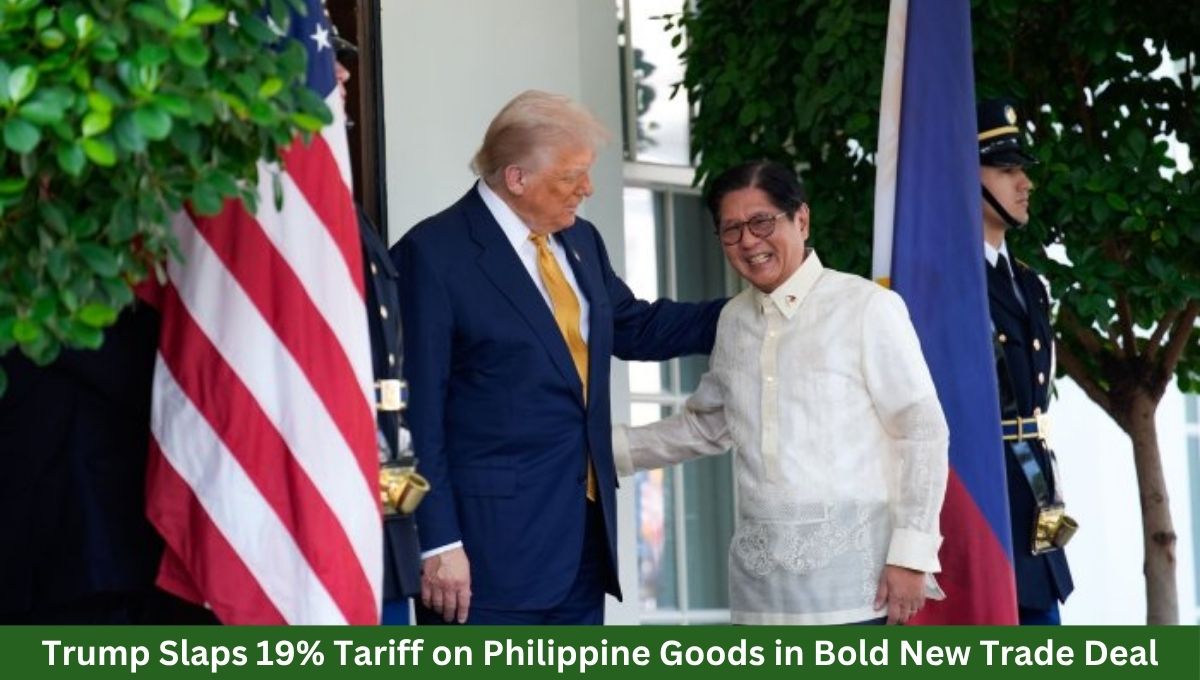
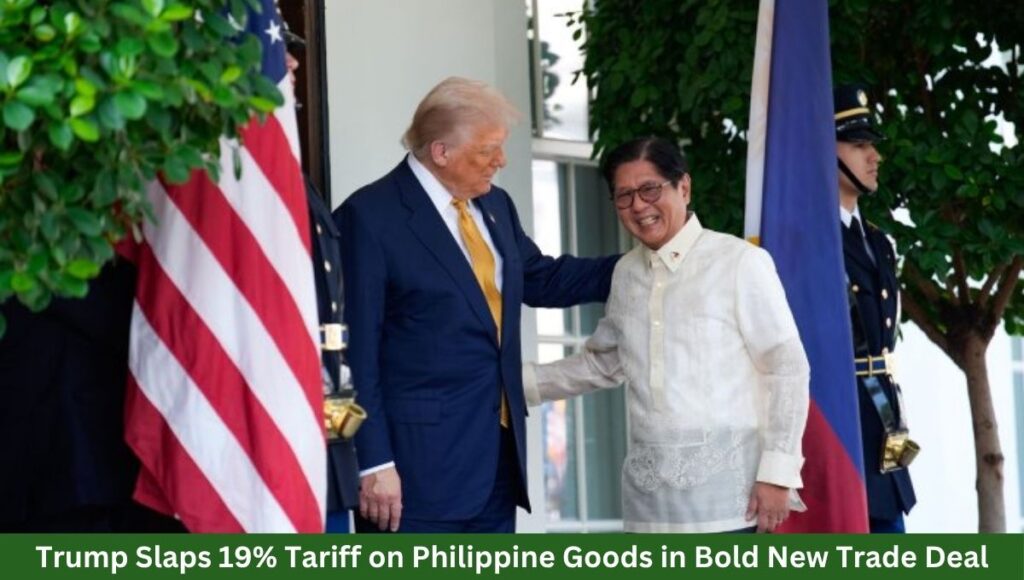
The announcement came following a high-profile meeting between Trump and Philippine President Ferdinand “Bongbong” Marcos Jr. at the White House on July 23, 2025. This landmark agreement, which reflects Trump’s continued “America First” approach, also signals a deepening of military cooperation between the two allies, positioning the Philippines as a critical strategic partner amid growing South China Sea tensions and broader Indo-Pacific strategy realignments.
Trump Slaps 19% Tariff on Philippine Goods in Bold New Trade Deal
A One-Sided Deal: What’s in It for the U.S.?
Under the newly brokered US-Philippines trade deal, Philippine goods entering the U.S. will be subjected to a 19% import duty up from earlier proposals of 17% but slightly below Trump’s original threat of 20%.
In return, U.S. exports to the Philippines will face zero tariffs, providing American companies unfettered access to a market of over 115 million people.
President Trump described the outcome on Truth Social:
“It was a beautiful visit, and we concluded our Trade Deal. The Philippines is going OPEN MARKET with the United States, and ZERO Tariffs. The Philippines will pay a 19% tariff.”
The zero-tariff provision on U.S. goods represents a significant win for sectors like agriculture, pharmaceuticals, and automotive manufacturing, reinforcing Trump’s long-held belief in bilateral deals that heavily favor American interests.
Marcos Jr.’s Response: A Symbolic Yet Strategic Concession
Philippine President Ferdinand Marcos Jr., while acknowledging the heavy tariff burden, called the outcome a “significant achievement,” emphasizing that the 1% reduction from the threatened 20% rate mattered both symbolically and diplomatically.
“One percent might seem like a very small concession. However, when you put it in real terms, it is a significant achievement,” Marcos said during a press briefing.
The Philippines exported $14.2 billion worth of goods to the U.S. in 2024, including semiconductors, electronics, coconut oil, and automotive parts all of which now face the stiffest U.S. tariffs in the region.
Despite this, Marcos stressed that the deal secures American economic cooperation and military backing at a critical geopolitical juncture.
Expanding Defense Ties: A Military Dimension to Trade
While the trade terms dominate headlines, the agreement is equally rooted in military cooperation.
Trump and Marcos confirmed plans to expand joint military exercises, enhance weapons modernization efforts, and possibly station U.S. missile systems on Philippine soil.
Defense Secretary Pete Hegseth reiterated America’s commitment to the Mutual Defense Treaty, calling it “the bedrock of our alliance.” Marcos referred to the pact as the “cornerstone” of the two countries’ security strategy.
Recent clashes between Chinese and Filipino ships in the Scarborough Shoal area have heightened the urgency of military cooperation.
As Beijing continues to assert its claims in the South China Sea, Washington is using economic leverage to solidify Manila’s loyalty.
Optics and Nostalgia: A Visit Laced with History
President Marcos Jr.’s state visit carried symbolic significance. He stayed at Blair House, the same residence his parents occupied during a 1980s visit hosted by President Ronald Reagan.
Trump, who has long admired the Marcos family’s legacy, welcomed him warmly.
“A great family, great family legacy and highly respected in this country. I know that because I have many friends in the Philippines,” Trump said.
He also reportedly opened an earlier call with the question, “How’s Imelda?” a nod to the former first lady’s infamy and ties to American elites.
Vintage photos from the 1990s show Trump seated beside Imelda Marcos at a New York party, reinforcing personal ties that go beyond policy.
Philippine Concessions: Open Market for U.S. Goods
In exchange for avoiding the full 20% tariff, the Philippines has agreed to:
- Remove all tariffs on American automobiles
- Increase imports of U.S. agricultural goods
- Open its pharmaceutical market to U.S. companies
Ambassador Jose Manuel Romualdez, who played a key role in facilitating the agreement, called it an “evolving good deal” that could improve over time.
But critics argue the Philippines has conceded too much, too quickly especially given the devastating impact a 19% tariff could have on its export-driven industries.
Trade Protests and Immigration Concerns
Not everyone welcomed the deal. Protests erupted outside the White House, with demonstrators demanding that Marcos address concerns of Filipino Americans and migrant workers.
Many carried signs criticizing the immigration raids under Trump’s administration that have impacted overseas Filipino workers (OFWs).
The White House maintained that the visit focused on mutual interests, including economic growth, defense, and preserving a free and open Indo-Pacific.
But the lingering legacy of the Marcos name and current social tensions surrounding immigration cast a shadow over the fanfare.
Ripple Effects: U.S. Companies Hit by Tariffs Elsewhere
While the Philippines is now facing higher duties, American firms are also struggling under Trump’s global tariff campaign.
Companies like General Motors and Stellantis reported combined losses exceeding $1.3 billion due to increased costs on raw materials and components from other trade partners.
These domestic repercussions highlight the complex calculus behind Trump’s trade policies: short-term political wins and strategic gains versus long-term economic disruption at home.
Strategic Pivot: Undermining China’s Influence
The geopolitical subtext of the trade deal is unmistakable. Trump’s comment “The country was maybe tilting toward China, but we un-tilted it very, very quickly” speaks volumes about his broader Indo-Pacific strategy.
By locking the Philippines into a tighter trade and defense framework, Washington is seeking to neutralize Beijing’s growing influence in Southeast Asia.
Chinese Foreign Ministry spokesperson Guo Jiakun responded by cautioning that such alliances “should not harm third parties,” a veiled reference to China’s interests in the region.
A Framework Deal with Global Implications
The US-Philippines trade deal is more than a bilateral arrangement; it’s a strategic blueprint. By imposing a 19% tariff on imports while securing zero-tariff access for its own goods, the U.S. has set a precedent for future trade negotiations with Canada, the EU, and Brazil, all of whom are still in tariff limbo.
Meanwhile, China is reportedly preparing for a “landmark” Trump visit later this year, which could reshape global trade alignments yet again.
Conclusion: Opportunity or Overreach?
As the dust settles, analysts remain divided. On one hand, the deal cements a critical military and economic alliance at a time of rising global instability. On the other, it imposes a heavy price on Philippine exporters and does little to ease tensions for American industries hurt by broader tariff policies.
Whether this agreement becomes a turning point in US-Philippines relations or a cautionary tale of uneven trade diplomacy remains to be seen. But what is certain is that the personal bonds between leaders and the legacies they carry continue to shape the course of 21st-century geopolitics.
Also Read: Trump’s 10% Tariff Threat on BRICS: Can India’s Reform Drive Lead a Global Shift?
Also Read: Trump’s 19% tariff on Philippine imports: What it means for Manila