President Trump announced US to Withdraw from UNESCO by 2026 Over Anti-Israel Bias, “Woke Agenda” Cited. In a controversial move that redefines America’s role in global cultural diplomacy, the Trump administration has announced that the United States will withdraw from UNESCO the United Nations Educational, Scientific and Cultural Organization by December 31, 2026. The decision marks the third time the US has pulled out of the organization and underscores the administration’s focus on an “America First” foreign policy, aimed at reducing US involvement in multilateral institutions.
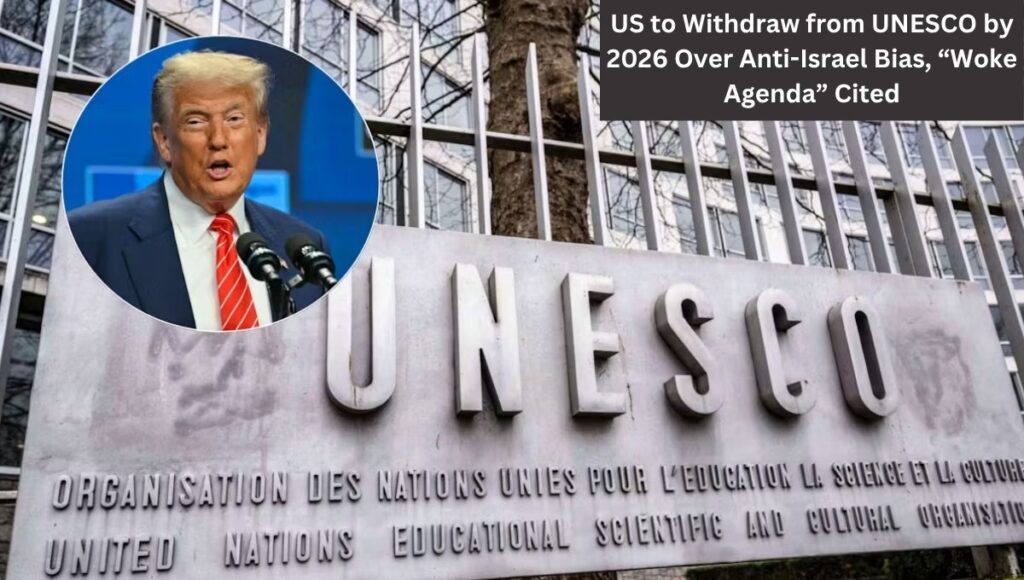
US to Withdraw from UNESCO by 2026 Over Anti-Israel Bias, “Woke Agenda” Cited
A Return to Trump’s Foreign Policy Doctrine
This marks the second time President Donald Trump has initiated a UNESCO withdrawal, the first being in 2017.
At the heart of this latest decision are accusations that the agency promotes anti-Israel bias, a pro-China orientation, and a “woke, divisive cultural agenda” that the White House says conflicts with American values.
State Department spokesperson Tammy Bruce stated that continued US participation in UNESCO “is not in our national interest,” citing the agency’s alignment with UN Sustainable Development Goals (SDGs) as part of a “globalist, ideological agenda.”
Anti-Israel Sentiment: A Core Issue
One of the most prominent points of contention remains Palestine’s admission as a full UNESCO member in 2011.
The United States and Israel view this move as both premature and politically charged, claiming it opened the door for anti-Israel rhetoric across UN institutions.
Bruce reinforced the administration’s stance, calling Palestine’s membership “highly problematic” and accusing UNESCO of facilitating narratives that delegitimize Israel.
The Israeli government welcomed the announcement, with Foreign Minister Gideon Sa’ar calling it a “necessary step to promote justice and Israel’s right to fair treatment.”
He urged the broader UN system to undertake fundamental reforms to end what he described as institutional bias against Israel.
UNESCO Pushes Back: “Prepared for the Outcome”
In response to the US announcement, UNESCO Director-General Audrey Azoulay expressed “deep regret” but said the organization had “prepared for it.”
Azoulay rejected claims of bias, highlighting UNESCO’s involvement in Holocaust education, combating antisemitism, and preserving Jewish heritage sites.
“These claims contradict the reality of UNESCO’s work,” Azoulay stated. “The reasons put forward by the United States are the same as seven years ago, even though the situation has changed profoundly.”
Azoulay stressed that political tensions have diminished, and UNESCO now serves as a “rare forum for consensus on concrete and action-oriented multilateralism.”
Budgetary and Operational Impacts on UNESCO
Although the United States was once UNESCO’s largest financial backer contributing up to 22% of its budget that number has dropped significantly due to funding diversification efforts following the 2011 funding freeze.
Currently, the US accounts for only about 8% of the total UNESCO budget. Azoulay confirmed that no staff layoffs are planned and said the agency remains committed to its mission “with inevitably reduced resources.”
Voluntary contributions from other nations have more than doubled since 2018, providing some cushion against the financial impact of another US exit.
France, China, and Global Leaders React
French President Emmanuel Macron quickly expressed support for UNESCO, calling it a “universal protector of cultural heritage and multilateralism.”
France, which hosts UNESCO’s headquarters in Paris, emphasized that the agency’s mission remains vital despite American disengagement.
China, now UNESCO’s largest financial contributor, sharply criticized the US decision, calling it “irresponsible behavior.”
Chinese Foreign Ministry spokesperson Guo Jiakun noted that China has always “firmly supported” UNESCO and accused the US of abandoning its duties as a global leader.
“This is not the action that a responsible major country should take,” Guo added.
Domestic and International Critics Voice Concerns
Critics in the US, including former diplomats and members of Congress, argue that the withdrawal undermines American soft power and global influence.
Democratic Senator Jeanne Shaheen described the move as “short-sighted” and warned that it cedes space to China and other rivals.
“By walking away, we’re giving our adversaries more room to shape international norms,” Shaheen stated, citing China’s growing role in global cultural diplomacy through UNESCO.
UNESCO’s global programs include designating World Heritage Sites, promoting freedom of the press, preserving indigenous languages, and supporting education in conflict zones.
Many fear that the US withdrawal sends a signal of disengagement from shared global priorities.
Trump’s Broader Exit from Multilateralism
The UNESCO withdrawal is part of a broader strategy by the Trump administration to retreat from international cooperation.
Since returning to office in January 2025, President Trump has:
- Withdrawn from the World Health Organization (WHO)
- Severed funding to the UN Human Rights Council
- Sanctioned judges from the International Criminal Court (ICC)
- Cut foreign aid to multilateral development programs
- Launched a review of US participation in all UN bodies
White House Deputy Spokesperson Anna Kelly emphasized that international agencies must reflect US national interests or risk being defunded.
She cited UNESCO’s support for climate change, gender equity, and cultural inclusion as “out of touch with American values.”
“Woke Agenda” and Alleged Pro-China Leanings
The administration has increasingly criticized what it terms the “woke cultural agenda” of international organizations.
Kelly said UNESCO supports policies that promote “global standards that do not reflect the will of the American people.”
A senior White House official accused UNESCO of favoring China’s geopolitical interests, alleging the agency has become a platform for Beijing to expand its influence in global standard-setting, especially in science and technology.
Gaza Conflict Adds Tension to US-Israel-UN Relations
The announcement also comes amid escalating criticism of Israel’s military operations in Gaza, where over 59,000 Palestinians have been reported killed since October 2023, according to Palestinian health authorities.
UN experts have called the military actions “consistent with genocide,” while the Trump administration has continued to sanction UN experts investigating potential war crimes by Israel and the United States.
This geopolitical backdrop has further polarized the US-Israel-UNESCO relationship, deepening the administration’s resolve to exit from international organizations it views as hostile to Israel.
UNESCO Keeps the Door Open
Despite the formal exit planned for 2026, Azoulay emphasized that UNESCO will continue to collaborate with American universities, NGOs, and private institutions.
The agency maintains ongoing partnerships within the US educational and cultural sectors, regardless of government participation.
“UNESCO’s mission is to bring nations together in peace, science, and culture,” Azoulay reiterated. “The door remains open for the United States.”
What’s Next for US Diplomacy and Global Engagement?
While the withdrawal won’t take effect until December 2026, the announcement is a clear signal that the Trump administration intends to reshape US global diplomacy by prioritizing bilateralism and nationalist interests.
Observers say the long-term implications are still unfolding. Will the next administration rejoin UNESCO again, continuing the political whiplash? Or will the United States redefine its global role outside traditional institutions?
With pressing global challenges climate change, cultural preservation, education access, digital ethics some experts argue that global cooperation, not withdrawal, is the key to advancing American interests.
Final Thoughts: A Pivotal Moment in Global Diplomacy
The US withdrawal from UNESCO reignites long-standing debates over America’s engagement with international institutions. While proponents argue it’s a principled stand against bias and global overreach, critics see it as a retreat from leadership that risks empowering rival nations like China.
As the world becomes increasingly interdependent, decisions like this will shape not only global cultural policy but also the United States’ diplomatic legacy for decades to come.
Also Read: France to Recognize Palestine at UN: A Diplomatic Earthquake Ahead of September Summit
Also Read: US withdraws from UNESCO again, this time due to its support for ‘woke’ causes