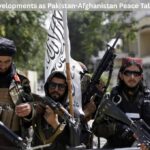
5 Key Takeaways as Pakistan–Afghanistan Peace Talks Hit Deadlock amid “Open War” warnings.Peace talks between Pakistan and Afghanistan have reportedly hit a deadlock, with Islamabad accusing the Taliban of taking an “illogical and detached” position on key security issues, particularly on cooperation in counterterrorism efforts.
The second round of negotiations, held in Istanbul on Saturday, came a week after initial discussions in Doha, which followed an October 16 ceasefire ending the deadliest border clashes since the Taliban’s return to power in Kabul in 2021. Pakistani media reports suggest that Islamabad presented “clear, evidence-based and solution-oriented” demands to the Taliban aimed at curbing cross-border militancy.
However, sources cited by Geo News said the Taliban’s inflexibility and “illogical arguments” have cast serious doubts on their willingness to cooperate.

5 Key Takeaways as Pakistan–Afghanistan Peace Talks Hit Deadlock
Talks in Istanbul: Focus on Border Security and Trade
According to Radio Pakistan, the Istanbul round centered on creating a joint monitoring and oversight mechanism to limit militant movement across the Pakistan–Afghanistan border and to ease trade restrictions that have worsened since the clashes.
Discussions also explored the possibility of a long-term political framework to stabilize bilateral ties, with mediators Turkey and Qatar urging both sides to exercise restraint.
Sources told Geo News that “the Taliban have remained unwilling to cooperate or acknowledge ground realities,” prompting Turkish diplomats to press the Afghan delegation to “understand the seriousness of Pakistan’s concerns.”
Pakistan has reportedly presented its “final position,” warning that any continued tolerance for militant sanctuaries targeting its territory would be unacceptable. “Islamabad pressed the Taliban to take firm, verifiable action against terrorist networks operating from Afghan soil,” the report stated.
Pakistan’s Final Position and Counterterrorism Demands
During the Istanbul talks, Pakistan’s delegation—led by Defence Minister Khawaja Asif—submitted its final position paper to the Taliban delegation, calling for verifiable, time-bound action against the Tehreek-e-Taliban Pakistan (TTP) and allied networks.
A senior Pakistani official quoted by Dawn said the negotiations, which stretched past midnight, saw Islamabad convey that “patronage of terrorists by the Afghan Taliban is unacceptable.”
Pakistan’s proposed framework included:
- Joint verification and intelligence-sharing on militant sanctuaries.
- Prevention of cross-border infiltration through mutual observation.
- Rehabilitation and repatriation of TTP-linked armed groups.
- Creation of a bilateral coordination cell for real-time communication during security incidents.
“The message in Istanbul was blunt and unambiguous—peace cannot be unilateral,” the official added.
Defence Minister Khawaja Asif Warns of ‘Open War’
Speaking to reporters in Sialkot before departing for Turkey, Defence Minister Khawaja Asif warned that failure to reach an agreement could lead to “open war.”
“We have the option, if no agreement takes place, we have an open war with them,” Asif said. “But I saw that they want peace.”
Asif noted that the ceasefire brokered in Doha had largely held for several days, with no major border clashes reported and 80 percent of points from the first-round agreement already implemented.
His remarks underscored Islamabad’s growing frustration with what it perceives as Kabul’s failure to act decisively against militant groups using Afghan territory to launch attacks into Pakistan.
Ceasefire Background: Doha to Istanbul
Earlier this month, Qatar and Turkey helped broker a fragile truce after border skirmishes in mid-October left dozens dead and hundreds wounded on both sides, including civilians and militants.
The clashes, among the deadliest in years, followed Pakistani airstrikes inside Afghanistan, which Islamabad claimed targeted TTP hideouts. Kabul accused Pakistan of violating its sovereignty.
Following the ceasefire agreed on October 15, renewed on October 17 and October 19, both sides entered successive negotiation rounds—first in Doha, now in Istanbul—seeking to transform the truce into a sustainable political settlement.
Pakistan’s Core Agenda: ‘No Compromise on Terror From Afghan Soil’
In Istanbul, Pakistan’s delegation reportedly advanced a one-point agenda: there would be no compromise on eliminating terrorism emanating from Afghan soil.
“This is a litmus test of Afghanistan’s sincerity,” said one senior Pakistani diplomat. “Cooperation on trade, refugees, or border control will only move forward once Kabul shows tangible action against terrorist groups.”
Pakistani negotiators emphasized that the talks represented proactive diplomacy, not capitulation. “We are willing to cooperate with Afghanistan as a partner, not an adversary—but responsibility lies equally with Kabul,” said a senior official.
Taliban’s Response: ‘Respect Our Borders’
According to Afghan media outlet Tolo News, the Taliban have rejected Pakistan’s accusations as “illogical and contrary to ground realities.”
The Taliban reportedly set two conditions for a long-term ceasefire:
- Pakistan must refrain from violating Afghan airspace and borders, and
- Islamabad must not allow opposition groups to operate from its soil.
In response, Pakistani officials said the Taliban appeared to be “following someone else’s agenda,” a veiled reference to India. “Such a stance is not in the interest of Afghanistan, Pakistan, or the region,” one Pakistani official told Dawn.
Proposal to Involve TTP Rejected
Taliban negotiators are said to have proposed involving the TTP in future dialogue with Islamabad—a suggestion Pakistan flatly rejected.
Officials reaffirmed that Pakistan will not negotiate with any group it designates as terrorist. “It is the Taliban’s responsibility to curb TTP activity on Afghan soil,” the Pakistani delegation stressed.
The Tehreek-e-Taliban Pakistan, distinct from the Afghan Taliban but ideologically aligned, seeks to overthrow the Pakistani state and impose its own interpretation of Islamic law. The group has orchestrated numerous deadly attacks inside Pakistan and continues to operate from bases within Afghanistan.
Trump Pledges to Mediate Pakistan–Afghanistan Conflict
In a surprising diplomatic development, U.S. President Donald Trump—speaking during the signing of the Thailand–Cambodia peace deal on the sidelines of the ASEAN Summit in Malaysia—offered to mediate between Islamabad and Kabul.
“We’re averaging one war a month. There’s only one left, although I heard that Pakistan and Afghanistan have started up. But I’ll get that solved very quickly. I know them both,” Trump said.
The president described both the Pakistan Field Marshal and Prime Minister Shehbaz Sharif as “great people,” expressing confidence that the issue could be resolved soon.
Trump added that if he could “take time and save millions of lives,” mediation would be “a great thing.”
Earlier this month, Sharif had called Trump “a man of peace” during the Gaza Peace Summit, crediting him for defusing tensions between India and Pakistan after the April 22 Pahalgam terror attack.
While New Delhi has rejected any suggestion of third-party mediation, Trump’s remarks underscore Washington’s renewed interest in South Asia’s evolving security dynamics.
Mediation by Turkey and Qatar: Regional Diplomacy at Work
Turkey and Qatar, both maintaining cordial ties with Islamabad and Kabul, have emerged as key mediators.
Turkish diplomats said their goal is to “prevent another cycle of instability in the region,” while Qatar’s foreign ministry reaffirmed its “commitment to facilitating dialogue rooted in mutual respect.”
Saudi Arabia also welcomed the ongoing talks, emphasizing regional stability and backing the Pakistan–Afghanistan ceasefire.
Observers say this reflects a broader shift toward regional conflict-management frameworks, where Middle Eastern states seek to prevent escalation without direct Western involvement.
Also Read: Pakistan–Afghanistan Ceasefire 2025: What to Know About the Qatar-Mediated Deal
Regional and Economic Implications
The border closures following the clashes have severely impacted trade. Afghanistan’s Chamber of Commerce and Industry estimated losses in the millions of dollars daily as key crossings remained sealed.
Ibraheem Bahiss of the International Crisis Group said intelligence-sharing on armed groups remains a key agenda point. “Instead of Pakistan carrying out strikes, Afghanistan would be expected to take action against identified TTP fighters or commanders,” he explained.
Economic analysts in Islamabad warn that prolonged instability could threaten cross-border trade, regional supply chains, and humanitarian cooperation. “Peace is not just a political priority—it’s an economic necessity,” said Karachi-based economist Dr. Khalid Mahmood.
Khawaja Asif’s Emotional Appeal: ‘Peace With Dignity’
At his Istanbul briefing, Defence Minister Asif delivered an emotional appeal to Afghanistan’s leadership.
He reminded them that Pakistan hosted millions of Afghan refugees over four decades, providing education and livelihoods.
“Three generations of Afghans grew up here,” Asif said. “It is deeply painful that a country that stood by you could be targeted by terrorism emanating from your soil.”
Asif reiterated that Pakistan does not seek war but accountability. “Peace must be founded on mutual respect and mutual security,” he said.
Stalemate Persists Despite Mediation Efforts
By Monday, as talks entered their third day, no agreement had been reached. Diplomats from both sides accused each other of undermining progress, with officials privately acknowledging that the negotiations could end in a stalemate.
A senior Pakistani source told Geo News that “the Taliban delegation’s refusal to accept Pakistan’s verifiable monitoring proposal is the main sticking point.”
Despite long hours of negotiation and multiple drafts exchanged, “the gap remains wide,” one Turkish official said, adding that Ankara and Doha “remain hopeful” but “realistic” about the challenges.
Expert Analysis: What’s at Stake
Security analysts describe the Istanbul negotiations as a critical turning point in Pakistan–Afghanistan relations.
“Pakistan’s red line is clear—no tolerance for cross-border terrorism,” said retired diplomat Aizaz Ahmad Chaudhry. “But diplomacy must continue; war would be disastrous for both nations.”
Regional experts note that militancy in Afghanistan threatens not only Pakistan but also China’s Belt and Road investments and Central Asian energy corridors.
“Stability along the Durand Line is vital for the region’s economic integration,” said Turkish analyst Dr. Mehmet Yildiz. “That’s why Ankara and Doha are so deeply engaged.”
Looking Ahead: Dialogue or Division
As the Istanbul talks pause for internal consultations, the outlook remains uncertain. Pakistan insists that all cooperation—on trade, refugees, or infrastructure—depends on verifiable counterterrorism progress.
“The future of bilateral ties rests on Kabul’s willingness to act, not just promise,” a senior Pakistani diplomat said.
The Taliban leadership, meanwhile, continues to demand respect for Afghanistan’s sovereignty, warning that any unilateral action by Pakistan would “undermine trust and escalate conflict.”
For now, both sides remain under growing pressure—from regional allies, international mediators, and domestic constituencies—to prevent the fragile peace from collapsing.
Also Read: Have Pak-Afghan Istanbul Talks Failed? Deadlock Over Refugee Repatriation, Guarantees Persists
Conclusion: The Road to Peace or Renewed Conflict
The Istanbul round marks a defining moment in the Pakistan–Afghanistan relationship. With Turkey and Qatar mediating, and Washington signaling cautious engagement through Trump’s comments, the coming days could determine whether the region moves toward reconciliation or renewed confrontation.
Pakistan’s message remains firm:
- No compromise on national security
- No tolerance for cross-border terrorism
- No cooperation without trust
For Afghanistan’s Taliban leadership, the challenge lies in balancing sovereignty claims with regional expectations. Whether this fragile dialogue can transform into lasting peace—or slide back into hostility—will depend on tangible steps from both capitals.
As Khawaja Asif summed up in Istanbul: “Pakistan wants peace with dignity, security with sovereignty, and cooperation with reciprocity. The ball is now in Kabul’s court.”
Related Posts:
- Pakistan’s Bold Airstrikes in Kabul: Af-Pak Crisis…

- Pakistan–Afghanistan Border Conflict 2025: Ceasefire…

- Afghanistan–Pakistan War 2025: Inside the 48-Hour Ceasefire

- Afghanistan–Pakistan Border Clashes 2025: Key Facts…

- Pakistan–Afghanistan Ceasefire 2025: Breakthrough…

- 7 Major Developments as Pakistan-Afghanistan Peace…