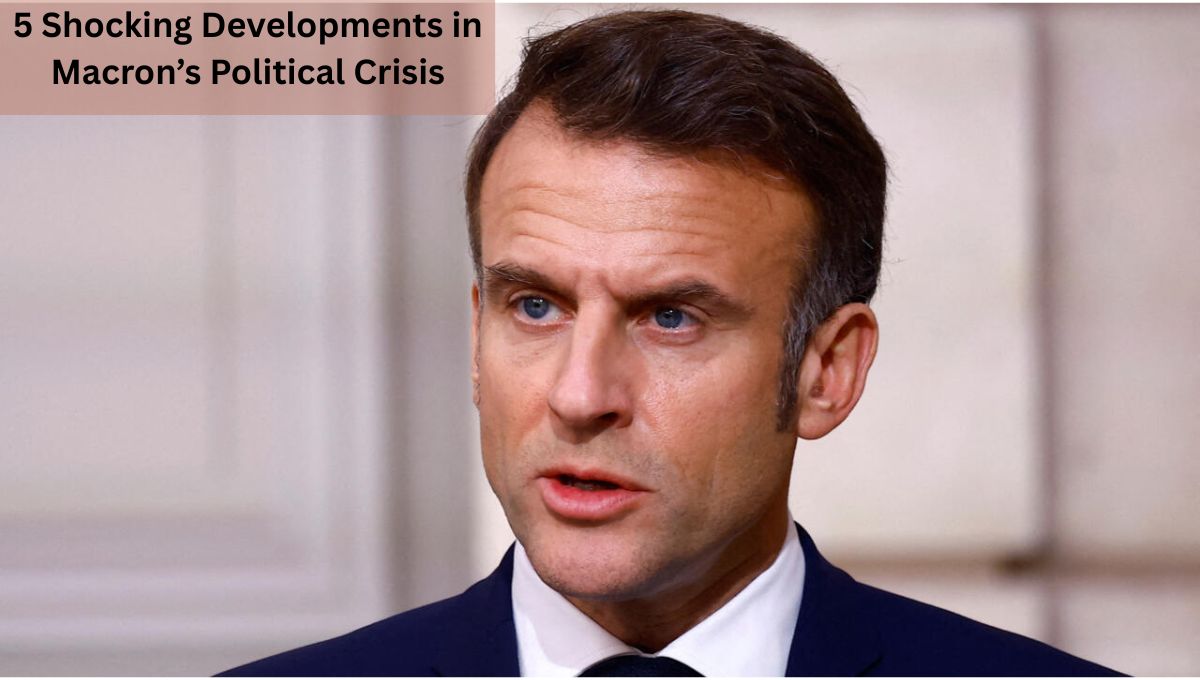
5 Shocking Developments in Macron’s Political Crisis: Plunging France deeper into challenges. After eight years in office, French President Emmanuel Macron finds himself at a crossroads. Once hailed as the “maître des horloges” or master of timing in French politics, his ability to navigate complex political waters now appears strained.
With the resignation of Prime Minister Sébastien Lecornu—his fifth prime minister in three years—Macron faces escalating pressure from all sides. Opinion polls indicate that almost three-quarters of French voters believe Macron should step down, while key allies suggest he consider early elections.
Yet, the president has repeatedly ruled out resignation, leaving France on the brink of a deeper political and economic crisis. In this article, we explore the latest developments in Macron’s political turmoil, the underlying causes of instability, and the potential paths forward for the French government.

5 Shocking Developments in Macron’s Political Crisis
The Sudden Resignation of Sébastien Lecornu
Prime Minister Sébastien Lecornu’s resignation has plunged France further into political uncertainty. Appointed less than a month ago, Lecornu stepped down after only 26 days in office, making his tenure the shortest in modern French history since the Fifth Republic was established in 1958.
Lecornu, formerly France’s minister of armed forces, blamed opposition parties for refusing to compromise and allowing his government to function. In an emotional television address, he lamented:
“The conditions were not fulfilled for me to carry out my function as prime minister. One must always put one’s country before one’s party.”
Following his resignation, Macron requested Lecornu to remain in office for 48 hours as a caretaker, engaging in last-ditch negotiations with political parties to stabilize the government. However, it remains unclear whether these discussions will yield a viable solution.
The Coalition Collapse
Lecornu’s government fell apart almost immediately after its announcement. The conservative Republicans (LR), led by Bruno Retailleau, withdrew support over the appointment of Bruno Le Maire as finance minister—a choice seen as representing Macron’s pro-privatisation economic policies.
Retailleau stated that Lecornu had failed to maintain the promised ideological break from Macronism, prompting the Republicans to abandon the coalition just 14 hours after it was announced. This abrupt collapse highlights the deep divisions within France’s fragmented parliament.
Also Read: France in fresh political crisis as PM Lecornu quits after 26 days
How Did France Reach This Point?
The political crisis traces back to Macron’s decision to call snap parliamentary elections in June 2024. Intended to strengthen his centrist coalition, the elections instead produced a hung parliament.
Macron’s allies lost their majority, forcing the president to seek alliances with both left- and right-wing parties—a delicate balance that has proven nearly impossible to maintain.
Analysts point to several factors contributing to the deadlock:
- Hung Parliament: Macron’s centrist bloc holds only 210 of 577 seats, while the left and far-right together control more than 320.
- Ideological Divisions: Opposition parties refuse compromise, each aiming to maximise gains ahead of the 2027 presidential election.
- Public Debt Crisis: France’s debt reached €3.4 trillion in early 2025—almost 114% of GDP—creating urgency for a workable budget.
The Debt Dilemma
National debt and fiscal responsibility have been at the core of each prime minister’s challenges. Former PMs Michel Barnier and François Bayrou failed within months due to opposition to austerity budgets intended to tackle deficits.
Lecornu did not even reach the point of presenting a budget before resigning, underscoring the difficulty of governance in today’s polarized climate.
Key Figures in the Crisis
The political stalemate involves multiple players across France’s ideological spectrum:
- Marine Le Pen (Far-right National Rally): Advocates for snap elections, seeing an opportunity to strengthen her party’s influence.
- Jordan Bardella (National Rally): Supports Le Pen’s call for elections, criticizing Macron’s inaction.
- Jean-Luc Mélenchon (France Unbowed – Radical Left): Pushes for Macron’s impeachment, backed by the Greens.
- Olivier Faure (Socialist Party): Engages in conditional discussions, advocating a left-wing government.
- Gabriel Attal (Macron’s Renaissance Party): Criticizes Macron’s leadership, suggesting the president’s decisions are increasingly disconnected.
- Bruno Retailleau (Republicans – Centre-right): Initially aligned with Macron, withdrew support over ideological conflicts.
- Édouard Philippe (Former PM, Macron Ally): Urges Macron to appoint a technocrat PM and call early elections.
Macron’s Options
With Lecornu gone and political factions unwilling to compromise, Macron faces three primary paths:
- Appoint a New Prime Minister: A seventh PM in his mandate could attempt to form a government, but prospects are dim given the fractured parliament.
- Call Snap Parliamentary Elections: New elections could reshape the legislature, but results are uncertain and could empower the far-right National Rally.
- Resign: Although Macron has repeatedly ruled this out, pressure is mounting from both opposition and allies, making it a topic of serious speculation.
Even a temporary compromise—such as passing a limited budget without forming a stable government—remains difficult in France’s current political culture, which is not known for compromise.
Public Discontent and Political Fatigue
Macron’s political challenges are compounded by public dissatisfaction. Large-scale protests in recent years—triggered by fuel tax hikes, pension reforms, and austerity measures—have eroded his popularity. Raising the retirement age from 62 to 64 in 2023 drew widespread backlash despite Macron’s insistence on reforms.
Analysts warn that voter frustration may translate into a referendum-style backlash if elections are called, particularly on divisive issues such as immigration, EU membership, and economic policy.
“There is a numb anger in the voter base, a sense that politicians are playing around, and a huge part of the French electorate is disgusted,” noted France expert Jacob Ross.
International Implications
France, as the EU’s second-largest economy, faces significant international scrutiny. Political instability could impact Macron’s influence in European Union decisions, especially on economic policy, security, and foreign affairs.
Investors have already reacted: the CAC 40 index experienced a 2% drop after Lecornu’s resignation, reflecting concerns about fiscal stability and governance.
Macron’s Leadership Under Scrutiny
The resignation of five prime ministers in three years casts a shadow over Macron’s legacy. Even allies like Gabriel Attal and Édouard Philippe have openly criticized his handling of the crisis, urging decisive action to stabilize the country.
Philippe, who served as Macron’s longest-tenured prime minister, described the current situation as a “distressing political game” and recommended an orderly early presidential election.
Despite mounting pressure, Macron remains determined to complete his term, leaving France in a state of uncertainty.
The Road Ahead
As the political crisis unfolds, France faces a turbulent period with high stakes for both governance and elections. Key scenarios include:
- Caretaker Government: Lecornu may continue talks to form a temporary coalition, but success appears unlikely.
- New Elections: Snap parliamentary elections could take place as early as November, reshaping the balance of power.
- Budget Challenges: With a projected deficit of 5.4% of GDP, passing a viable budget is urgent to avoid financial instability.
The next 18 months could redefine France’s political landscape, with the potential rise of far-right or left-wing influence and an uncertain path for Macron’s legacy.
Conclusion
Emmanuel Macron’s presidency, once marked by confidence and political acumen, now faces one of its most severe crises. With parliamentary deadlock, public dissatisfaction, and internal dissent mounting, the French president must navigate a labyrinth of political, economic, and social challenges.
The resignation of Sébastien Lecornu has intensified the urgency for solutions, leaving Macron with difficult choices: appoint another prime minister, call snap elections, or confront mounting calls for his resignation.
As France watches, the question remains: can Macron restore stability to his government, or is the era of the “master of clocks” drawing to a close?
Related Posts:
- Macron Reappoints Lecornu as PM 2025 – Triggers…

- France’s PM Resigns: 5 Days of Political Turmoil

- France’s Political Crisis 2025: Macron’s Next Move

- France in Turmoil as ‘Block Everything’ Protests…

- French PM François Bayrou Ousted in Confidence Vote,…

- 5 Key Takeaways as Zohran Mamdani Wins Historic New…