

In a dramatic surge of the ongoing Israel Hamas war, Israel Expands Ground Offensive in Gaza as Global Condemnation Grows and Ceasefire Talks Intensify. Israel has launched its most expansive ground operation in Gaza to date while simultaneously exploring a potential ceasefire deal with Hamas. The dual approach marks a turning point in the conflict merging military might with active diplomacy in a bid to bring the war to a close on Israel’s terms.
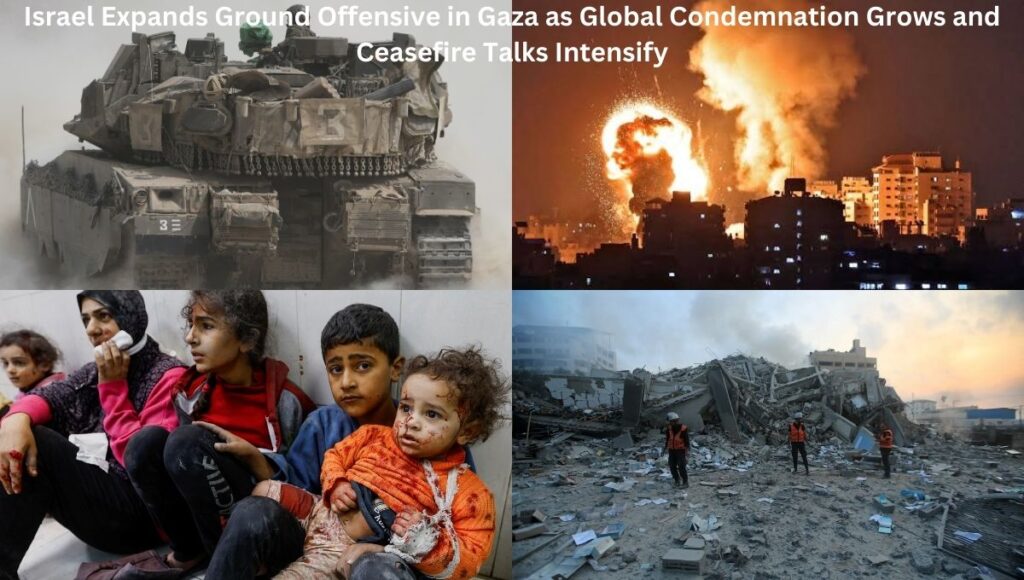
Israel Expands Ground Offensive in Gaza as Global Condemnation Grows and Ceasefire Talks Intensify
Operation Gideon’s Chariots: Largest IDF Deployment Since October 2023
On Monday, May 19, 2025, the Israel Defense Forces (IDF) initiated Operation Gideon’s Chariots, deploying five divisions across northern and southern Gaza.
The mission is being described by military officials as the largest Israeli ground campaign since the start of the conflict in October 2023.
According to IDF Chief of Staff Lt. Gen. Eyal Zamir, the objective is to eliminate Hamas’s military infrastructure, liberate remaining hostages, and re-establish Israeli control over aid corridors.
Over the last 48 hours, Israeli air raids have targeted more than 670 Hamas sites. Dozens of tanks and armored units have pushed into densely populated urban centers, prompting mass displacement. The IDF asserts that this offensive is critical to ensuring long-term regional security.
Humanitarian Crisis Worsens as Hospitals Collapse
While the military campaign intensifies, the humanitarian situation in Gaza is rapidly deteriorating. The Gaza Health Ministry reports that all public hospitals in northern Gaza have ceased operations.
Key facilities like the Indonesian Hospital have been forcibly evacuated amid continuous shelling, with medical staff and patients fleeing under fire.
On Tuesday alone, Israeli airstrikes killed at least 60 Palestinians. Residential homes, shelters, and even a school in northern Gaza were hit.
Fatalities were also reported in Deir al-Balah, Nuseirat refugee camp, and Khan Younis, compounding an already dire toll.
Since the beginning of the war, over 53,000 Palestinians have been killed, according to Gaza’s health ministry, which includes both civilians and combatants.
Netanyahu Open to Full Ceasefire in Shift of Strategy
In a significant political development, Israeli Prime Minister Benjamin Netanyahu signaled for the first time a willingness to consider a comprehensive ceasefire agreement.
Previously adamant about continuing military operations until “total victory”, Netanyahu now acknowledges ongoing negotiations in Doha that could result in a broader peace deal.
The talks are based on the Witkoff framework, initially proposing a 45-day ceasefire in exchange for the release of 10 hostages.
Netanyahu’s office now indicates openness to a full cessation of hostilities if Hamas disarms, releases all hostages, and accepts demilitarization of Gaza.
“This is a war of civilisation over barbarism,” Netanyahu said in a public statement. “Israel will continue to defend itself by just means unless the path of peace becomes achievable.”
The Hostage Dilemma: 58 Still Held by Hamas
The hostage crisis remains a core issue driving both Israel’s military strategy and diplomatic efforts. Since the October 7, 2023 Hamas-led attack, which saw 251 people abducted, Israel has managed to secure the release of 197 hostages through limited ceasefires and exchanges.
However, 58 captives remain in Gaza, with only 23 confirmed alive. The emotional and political toll of this crisis has galvanized Israeli public opinion and is a key factor in the government’s current push for both aggressive military action and high-stakes diplomacy.
Britain, Canada, France Condemn Israel’s “Egregious” Gaza Actions
As Israeli forces press deeper into Gaza, international condemnation is mounting. On Monday, the leaders of Britain, Canada, and France Prime Ministers Keir Starmer, Mark Carney, and President Emmanuel Macron issued a powerful joint statement denouncing Israel’s continued strikes, humanitarian blockade, and rhetoric suggesting mass Palestinian displacement.
The leaders warned of “concrete actions” if Israel fails to end its military offensive and restore humanitarian access.
“We will not stand by while the Netanyahu government pursues these egregious actions,” the statement read.
They also reaffirmed their commitment to recognizing a Palestinian state, signaling a growing shift in global diplomatic sentiment in favor of a two-state solution.
Gaza Aid Blockade Sparks Global Outrage
International frustration is being amplified by the worsening Gaza aid blockade. Since March 2, Israel has restricted nearly all humanitarian deliveries.
Only on Monday did it permit the entry of five trucks with limited supplies far from the 600 trucks that entered daily during earlier ceasefires.
UN humanitarian chief Tom Fletcher called the move insufficient: “It’s a drop in the ocean of what is urgently needed.”
With nearly two million people trapped inside Gaza under worsening conditions, aid organizations warn that famine and disease could soon claim more lives than the bombs.
Deadly Night Strikes: 60 More Palestinians Killed
While diplomatic tensions escalate, Israeli airstrikes overnight into Tuesday killed at least 60 Palestinians across the strip.
A school-turned-shelter in northern Gaza was bombed, killing 22, many of them women and children. Additional strikes in Deir al-Balah, Nuseirat, and Khan Younis claimed more lives.
The Israeli military maintains it targets Hamas militants and blames the high civilian death toll on Hamas’s operations within densely populated areas.
However, human rights organizations argue that Israel’s tactics risk breaching international humanitarian law.
Leaked Map Hints at Gaza’s Post-War Division
Further controversy was sparked over the weekend by a leaked map published by The Sunday Times, allegedly showing Israel’s post-war plan for Gaza.
The map outlines a division into three civilian zones, four IDF-controlled military areas, and 12 international humanitarian hubs.
While unconfirmed, the map has drawn criticism for suggesting fragmented governance and the potential erosion of Palestinian sovereignty a move many fear could lead to a prolonged occupation rather than peace.
Israel’s Two-Track Strategy: War Through Negotiation?
Israel’s current strategy a combination of full-scale military offensive and simultaneous diplomatic negotiation reflects the complex nature of asymmetric modern warfare.
Lt. Gen. Zamir described the negotiations as a “strategic extension of military efforts,” stating that any hostage deal would be viewed as “a battlefield success, not a concession.”
Critics argue, however, that continued bombardments could erode the trust necessary to achieve a lasting ceasefire, especially as civilian casualties mount and Gaza’s infrastructure collapses.
Conclusion: The Tipping Point in the Gaza War?
As Gaza burns and ceasefire talks continue, the Israel Hamas war is reaching a critical juncture. Netanyahu’s cautious diplomatic overtures, combined with the largest IDF deployment in over a year, suggest that Israel seeks to negotiate the end of the war from a position of overwhelming strength.
Yet the humanitarian catastrophe, mounting international pressure, and deepening civilian suffering may soon compel all sides to reconsider the cost of continued conflict.
Whether peace comes through diplomacy or exhaustion, the coming days will be pivotal in shaping the future of Gaza, Israel, and the broader Middle East.
Also Read: Israeli Right-Wing Leaders Blast Netanyahu Over Gaza Aid Resumption Amid Mounting Famine Crisis
Also Read: Hamas says new Gaza truce talks under way as Israel expands ground assault
Related Posts:
- Israel’s Gaza Takeover Plan: What’s Been Achieved…

- Trump’s 20-Point Gaza Peace Plan Gains Urgent Global…

- Israel–Hamas Ceasefire Under Strain: 4 More Hostage…

- 3 Explosive Conditions Iran Sets to End War with US…

- 5 Key Developments as Israel Confirms Hamas Handed…

- Dramatic Moments Behind Trump’s Gaza Peace Push and…
