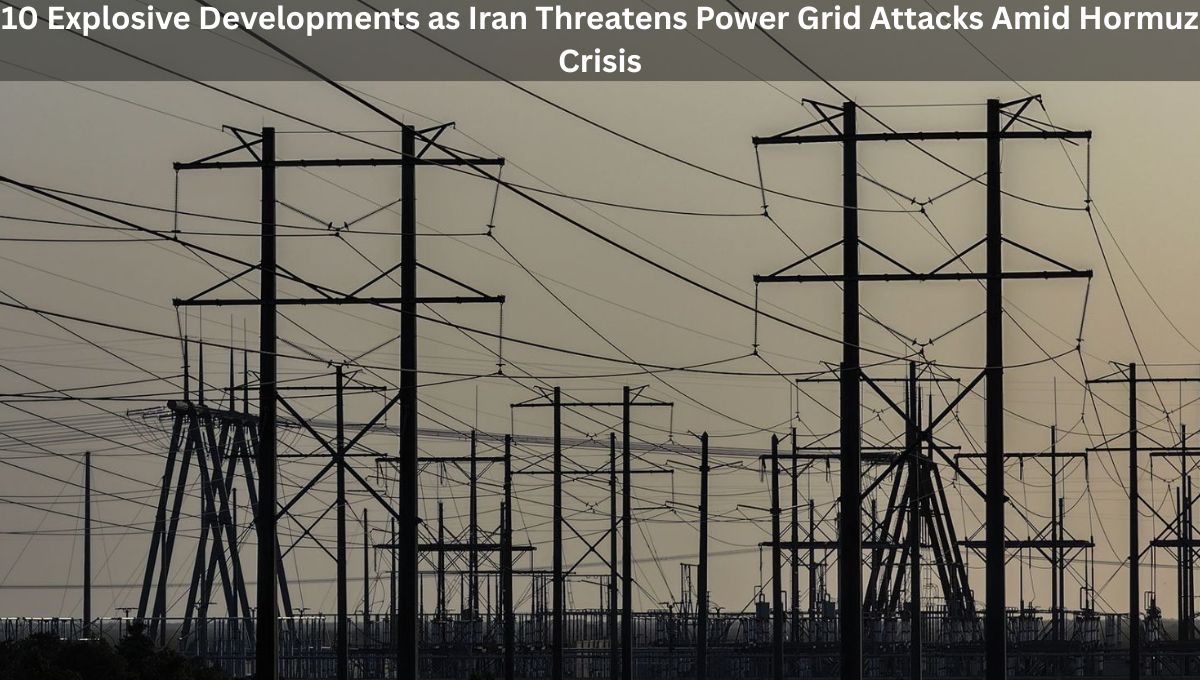
10 Explosive Developments as Iran Threatens Power Grid Attacks Amid Hormuz Crisis — dangerous new phase. The ongoing conflict involving Iran, the United States, and regional allies has entered a deeply volatile and dangerous phase. In a stark escalation, Iran has threatened to target power plants and critical infrastructure across West Asia—especially those supplying electricity to U.S. military bases—if its own energy grid comes under attack.
Thank you for reading this post, don't forget to subscribe!This warning comes as tensions peak over the Strait of Hormuz, a vital global energy chokepoint, and follows a 48-hour ultimatum issued by U.S. President Donald Trump demanding the waterway be fully reopened.
The situation now presents a high-risk scenario involving potential attacks on civilian infrastructure, global energy disruption, and a widening regional war.
10 Explosive Developments as Iran Threatens Power Grid Attacks Amid Hormuz Crisis
10 Explosive Developments Driving the Crisis
1. Iran Threatens Regional Power Infrastructure
Iran’s Revolutionary Guard has declared that any attack on its power plants will trigger retaliation targeting:
- Israeli energy infrastructure
- Power plants in Gulf nations supplying U.S. bases
- Economic and industrial facilities linked to American interests
The message is clear:
“If you hit electricity, we hit electricity.”
2. Trump Issues 48-Hour Ultimatum
The United States warned Iran that failure to reopen the Strait of Hormuz would result in:
- Direct strikes on Iranian power plants
- Targeting of major energy facilities
- Escalation to broader military action
This ultimatum significantly raised stakes by explicitly threatening civilian-linked infrastructure.
3. Strait of Hormuz at the Center of the Crisis
The Strait of Hormuz carries:
- Nearly 20% of global oil supply
- A major share of liquefied natural gas (LNG)
Iran has effectively restricted access, allowing only select vessels to pass, creating a partial blockade that has already shaken global markets.
4. Global Energy Markets in Turmoil
The near-closure of the Strait has triggered:
- Oil prices surging past $100 per barrel
- Gas prices spiking across Europe and Asia
- Increased volatility in global financial markets
Analysts warn this could become the worst energy crisis since the 1970s.
5. Threats Extend to Water Infrastructure
Iran initially warned it could also target:
- Water desalination plants
- Information technology infrastructure
- Regional utilities linked to U.S. operations
This is particularly alarming because Gulf countries depend heavily on desalination for drinking water.
6. Gulf Countries Face Catastrophic Risk
Countries like:
- Bahrain (100% desalinated water)
- Qatar (100% desalinated water)
- UAE (over 80%)
- Saudi Arabia (around 50%)
are extremely vulnerable to disruptions in electricity and water infrastructure.
7. Military Escalation Intensifies
Recent developments include:
- Iranian missile strikes on Israeli cities
- Israeli airstrikes targeting Iranian infrastructure
- Missile launches toward Gulf capitals
- U.S. military deployments in the region
The conflict is no longer contained—it is expanding across multiple fronts.
8. Civilian Impact Mounts
The human cost continues to rise:
- Thousands killed across Iran, Israel, and Lebanon
- Civilian areas hit in multiple cities
- Hospitals and residential zones affected
This raises serious concerns about violations of international humanitarian law.
9. Strait Closure Threat Becomes Leverage
Iran has warned:
- The Strait will be completely closed if attacked
- It will remain shut until damaged infrastructure is rebuilt
This transforms the waterway into a strategic bargaining tool with global consequences.
10. Global Economic Shock waves
The crisis is already impacting:
- Inflation worldwide
- Supply chains and shipping routes
- Insurance costs for maritime transport
- Currency stability in energy-importing nations
Major economies like India, China, and Japan are especially vulnerable.
Why the Strait of Hormuz Matters So Much
The Strait of Hormuz is one of the most strategically critical waterways in the world.
Any disruption here affects:
- Global oil supply
- LNG exports
- Energy security of major economies
Even partial restrictions have already:
- Reduced tanker traffic dramatically
- Increased shipping costs
- Forced rerouting of vessels
A full closure could trigger a historic economic shock.
Infrastructure Warfare: A Dangerous Escalation
Targeting energy infrastructure marks a significant shift in modern warfare.
Unlike traditional military targets, these facilities:
- Power hospitals and homes
- Support water supply systems
- Sustain entire economies
Experts warn that attacks on such infrastructure could:
- Cause widespread civilian suffering
- Lead to humanitarian crises
- Potentially constitute war crimes under international law
Market Reaction: A ‘Ticking Time Bomb’
Financial analysts describe the situation as:
A “48-hour ticking time bomb of elevated uncertainty”
Markets are reacting with:
- Sharp volatility
- Falling stock indices
- Rising commodity prices
Investors are bracing for further escalation depending on whether military action follows.
India and Global South: High Exposure
Countries heavily dependent on imported energy face:
- Rising fuel costs
- Currency pressure
- Increased inflation
India, in particular, could see:
- Higher petrol and diesel prices
- Trade imbalances widening
- Economic growth slowing
Military Strategy vs Political Signaling
The current standoff reflects:
- Strategic signaling by both sides
- Attempts to deter escalation
- Efforts to control narrative and leverage
However, rapid escalation increases the risk of miscalculation, potentially triggering:
- Direct U.S.-Iran confrontation
- Wider regional war
- Disruption of global alliances
What Happens Next? Key Scenarios
Scenario 1: Limited Strikes
- U.S. targets select Iranian facilities
- Iran retaliates proportionally
- Conflict remains contained
Scenario 2: Full Escalation
- Wide-scale attacks on infrastructure
- Strait of Hormuz fully closed
- Severe global economic crisis
Scenario 3: Diplomatic Breakthrough
- Backchannel negotiations
- Temporary reopening of Hormuz
- De-escalation of military threats
Global Response: Calls for Restraint
International organizations and governments are urging:
- De-escalation
- Protection of civilian infrastructure
- Diplomatic resolution
There is growing concern that continued escalation could:
- Destabilize global energy systems
- Trigger long-term geopolitical realignment
Conclusion: A Crisis with Global Consequences
The current standoff between Iran and the United States is no longer just a regional conflict—it is a global crisis with far-reaching implications.
From threats against power plants and water systems to the potential closure of one of the world’s most critical energy routes, the risks are unprecedented.
As both sides harden their positions, the coming days will be decisive.
Whether this crisis escalates into a broader conflict or moves toward de-escalation will shape global security, economic stability, and energy markets for years to come.
Also Read: 7 Critical Moves as 22 Nations Pressure Iran to Reopen Strait of Hormuz
Also Read: Iran Threatens to Close Strait of Hormuz ‘Completely’ if Trump Attacks Power Plants