In a significant diplomatic statement, Indonesia Offers Diplomatic Recognition of Israel If Palestine Gains Statehood. Indonesian President Prabowo Subianto announced on Wednesday that Indonesia is ready to recognize Israel provided that Israel first recognizes an independent Palestinian state.
The announcement came during Prabowo’s high-level meeting in Jakarta with French President Emmanuel Macron, as both leaders emphasized renewed momentum toward the long-stalled two-state solution.
This marks a potential policy shift for Indonesia, the world’s largest Muslim-majority nation, which has historically refused formal diplomatic ties with Israel and consistently championed Palestinian statehood.
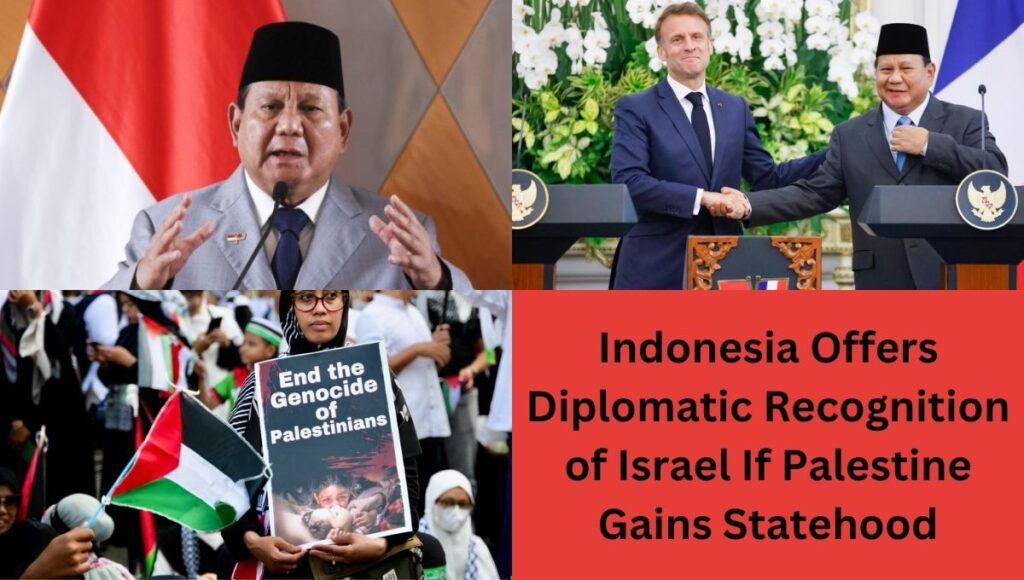
Indonesia Offers Diplomatic Recognition of Israel If Palestine Gains Statehood
A Conditional Diplomatic Opening
“On various occasions, I have said that Indonesia sees the two-state solution and the freedom of Palestine as the only way to achieve true peace,” President Prabowo told reporters at the joint press conference.
He added, “We must acknowledge and guarantee Israel’s rights as a sovereign country that must be respected and its security ensured.”
The president stated unequivocally that once Israel formally recognizes Palestine as a sovereign state, Indonesia will reciprocate with full diplomatic recognition of Israel.
The move, if realized, would be a dramatic realignment of regional diplomacy and could pave the way for other Muslim-majority nations to reconsider ties with Israel under similar conditions.
Joint Commitment to the Two-State Solution
During their joint appearance, Prabowo and Macron issued a joint statement reaffirming their countries’ support for mutual recognition between Israel and Palestine. Both leaders committed to co-chairing an international conference next month in Paris aimed at revitalizing the two-state solution.
“The conference should restore a political prospect for a peaceful settlement of this conflict, paving the way for an irreversible path towards the realization of a Palestinian state and mutual recognition between Israel and Palestine,” the statement read.
The upcoming France-Saudi co-hosted summit, scheduled for June 17–20 at the United Nations headquarters in New York, is expected to be a pivotal moment in international diplomacy regarding the Middle East peace process.
France Pushes for a New Diplomatic Framework
French President Emmanuel Macron has become increasingly vocal in support of recognizing a Palestinian state, especially amid growing international concern over the Gaza conflict and settlement expansions in the West Bank.
“Only a political solution will make it possible to restore peace and build for the long term,” Macron said during his Jakarta visit.
He added that France, in collaboration with Saudi Arabia, will soon organize a high-level conference on Gaza, intended to give fresh impetus to recognizing both a Palestinian state and Israel’s right to exist peacefully.
According to the French embassy in Israel, the conference’s four focus areas include:
- Recognition of a Palestinian state
- Normalization and regional integration of the State of Israel
- Reforms within Palestinian governance
- Disarmament of Hamas and its exclusion from future governments
France has also formed eight international working groups to develop practical plans on state-building, security, humanitarian aid, and enforcement of international law.
Indonesia’s Staunch Public Support for Palestine
Indonesia’s strong support for the Palestinian cause is deeply ingrained in its public and political spheres. In 2023, the country lost its hosting rights for the FIFA Under-20 World Cup after prominent Indonesian leaders called for Israel’s exclusion from the tournament.
The controversy highlighted the political sensitivity surrounding any form of normalization with Israel. Despite this, President Prabowo’s comments reflect a willingness to explore diplomatic pathways that might lead to peace, if built upon mutual recognition and concrete steps toward Palestinian statehood.
Macron’s Balancing Act and International Fallout
While Macron pushes forward with his diplomatic initiative, he faces a complex balancing act. French officials have indicated that Macron is leaning toward unilateral recognition of a Palestinian state potentially making France the first Western power to do so.
But experts caution that without additional measures such as sanctions or trade bans, such recognition could be seen as symbolic and deepen divides within the European Union and between France and the United States.
Israel has responded with fierce opposition. Prime Minister Benjamin Netanyahu has condemned the move as a “prize for terror,” linking it to Hamas’ October 7, 2023, attacks.
Israeli officials have warned of possible retaliatory measures, including the annexation of parts of the West Bank and scaling back security cooperation with European allies.
The International Criminal Court and Legal Risks
Compounding tensions, the International Criminal Court (ICC) is reportedly preparing to expand its legal actions against Israeli officials.
Arrest warrants have already been issued for Prime Minister Netanyahu and former Defense Minister Yoav Gallant, and further charges are being considered against far-right Israeli ministers for encouraging West Bank settlements.
Critics argue that the ICC’s actions are based on the assumption that a Palestinian state already exists, thereby complicating legal interpretations under international law.
They warn that hasty recognition could provide a legal basis for extensive prosecutions and damage Israel’s ability to defend itself.
Will the Conference Deliver Peace or Political Posturing?
While Macron’s vision for the conference paints it as a historic opportunity for peace, some analysts remain skeptical. Critics argue that the initiative is more about international image-building and applying pressure on Israel than facilitating genuine negotiations.
A Politico report suggested France has already had to “downgrade expectations,” as no Arab states are currently prepared to recognize Israel in return. Without reciprocal steps from Arab nations and real political traction on Palestinian reforms, the summit risks becoming a diplomatic gesture rather than a turning point.
Conclusion: Hope Amid Uncertainty
President Prabowo’s statement presents a rare opening in the Israel-Indonesia diplomatic freeze and signals Jakarta’s willingness to be a constructive player in Middle East peace efforts provided Palestinian statehood becomes a reality.
Whether the upcoming France-Saudi summit will bring real progress or become mired in political gridlock remains to be seen.
But one thing is clear:
the momentum toward a renewed push for a two-state solution is building, and Indonesia is signaling that it’s ready to play its part if all sides come to the table.
Also Read: France to Recognize Palestine at UN: A Diplomatic Earthquake Ahead of September Summit
Also Read: Indonesia says ready to set up diplomatic relations with Israel if Tel Aviv recognises Palestine