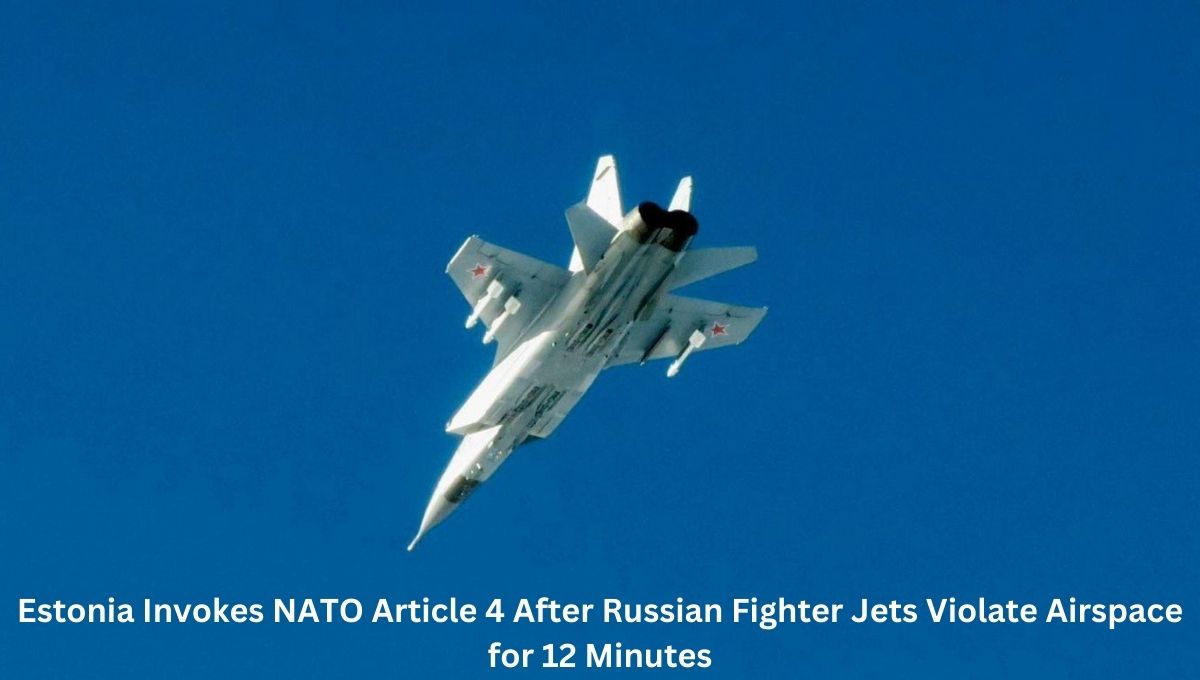
An unprecedented incursion has heightened tensions in Europe, as Estonia Invokes NATO Article 4 After Russian Fighter Jets Violate Airspace for 12 Minutes. On a tense Friday morning, Estonia reported one of the most serious airspace violations in its modern history. Three Russian MiG-31 fighter jets intruded into Estonian skies near Vaindloo Island in the Gulf of Finland, staying for 12 minutes before being forced to retreat by NATO aircraft.
The Baltic nation’s government swiftly condemned the incursion as “unprecedentedly brazen”, summoned Moscow’s chargé d’affaires, and invoked NATO’s Article 4 — a rare move reserved for moments when a member feels its territorial integrity or security is under threat.
This latest act of aggression has triggered global alarm, with U.S. President Donald Trump warning Russia of “big trouble” and European leaders calling it a dangerous provocation. The incident comes amid a string of Russian drone and jet violations in Poland and Romania, signaling a dangerous escalation in Moscow’s confrontation with NATO.
Estonia Invokes NATO Article 4 After Russian Fighter Jets Violate Airspace for 12 Minutes
What Happened Over Estonian Airspace?
At approximately 8:30 AM local time, radar systems picked up three unidentified aircraft approaching Estonian airspace from the northeast. Moments later, it was confirmed: three Russian MiG-31 fighter jets had crossed into Estonian skies.
- No flight plans were filed.
- Transponders were turned off.
- No radio communication was established with Estonian air traffic control.
The jets hovered for 12 minutes — an eternity in terms of aerial defense — before NATO scrambled Italian F-35 jets from Ämari Air Base, alongside Swedish and Finnish aircraft, forcing the Russian fighters to withdraw.
Estonian Prime Minister Kristen Michal declared:
“The border violation took place over the Gulf of Finland. Russian fighter jets remained in Estonian airspace for a total of 12 minutes. NATO fighters responded, and the Russian aircraft were forced to withdraw.”
Why This Violation Is Different
This was not the first time Russia violated Estonia’s skies. In fact, 2025 has already seen four such incidents. However, the Estonian government stressed that this breach was far more serious for several reasons:
- Scale of the violation – Three fighter jets, not just one, entered together.
- Duration – The aircraft stayed for 12 full minutes.
- Pattern of escalation – Coming just days after Russian drones violated Polish and Romanian airspace, the move seems calculated to test NATO’s resolve.
Foreign Minister Margus Tsahkna labeled the incursion as:
“Unprecedentedly brazen… Russia’s increasingly extensive testing of boundaries and growing aggressiveness must be met with a swift increase in political and economic pressure.”
NATO’s Immediate Response
NATO confirmed the incident through spokesperson Allison Hart, who emphasized that:
“Earlier today, Russian jets violated Estonian airspace. NATO responded immediately and intercepted the Russian aircraft. This is yet another example of reckless Russian behaviour and NATO’s ability to respond.”
Key details of the response:
- Italian Air Force F-35 jets scrambled from Ämari Air Base.
- Finnish and Swedish jets also mobilized under NATO’s extended air policing mission.
- NATO called the action a “reckless provocation”.
This interception is part of NATO’s Baltic Air Policing Mission, which maintains round-the-clock readiness against unannounced flights — most often from Russia.
Estonia Invokes NATO Article 4
In the wake of the violation, Estonia invoked Article 4 of the North Atlantic Treaty.
What is Article 4?
Article 4 states:
“The Parties will consult together whenever, in the opinion of any of them, the territorial integrity, political independence or security of any of the Parties is threatened.”
It does not automatically trigger military action but initiates urgent consultations among NATO allies to determine collective responses.
Estonia’s move underscores the seriousness of the incursion. NATO’s North Atlantic Council is set to convene next week to discuss the issue.
Trump, Macron, and Global Leaders React
The violation prompted swift international reactions.
Donald Trump’s Warning
Speaking from Washington, U.S. President Donald Trump told reporters:
“I don’t love it. I don’t like when that happens. Could be big trouble.”
Trump added he would be briefed later but stressed that such actions by Russia were deeply concerning.
Macron’s Condemnation
French President Emmanuel Macron declared:
“I strongly condemn the incursions of Russian aircraft into Estonia. They represent yet another step in Russia’s accumulation of provocations and irresponsible actions. I extend my full support to the Estonian authorities.”
EU and NATO Voices
- EU foreign policy chief Kaja Kallas: “An extremely dangerous provocation. We must show no weakness.”
- NATO Secretary General Mark Rutte: “Quick and decisive response by NATO jets demonstrates our readiness.”
- Romanian FM Oana Toiu: “Russia is trying to undermine NATO’s coherence, but they’re achieving the exact opposite.”
Also Read: Zelensky Warns Russia Seeks to Expand War to NATO After Drone Breaches Romanian Airspace
Russia’s Denial
Predictably, Moscow rejected the claims. Russia’s Ministry of Defence insisted:
- The MiG-31s were on a “scheduled flight” from Karelia to Kaliningrad.
- They remained over neutral Baltic waters, never crossing Estonian borders.
- The planes were at least 3 kilometers away from Vaindloo Island.
This narrative directly contradicts Estonia’s radar data and NATO’s confirmation.
Regional Tensions Already High
The Estonian violation comes amid a chain of escalating provocations:
- Poland shot down multiple Russian drones earlier this month.
- Romania scrambled F-16s after detecting Russian drones near its borders.
- Polish border guard reported Russian fighter jets making low passes over oil platforms in the Baltic Sea.
Each incident reinforces fears that Russia is deliberately testing NATO’s red lines to gauge the alliance’s unity and willingness to respond.
Why This Matters for NATO
A Strategic Pressure Point
Estonia and the Baltic states are geographically vulnerable, wedged between Russia and its Kaliningrad exclave. Any breach in their security could quickly spiral into a direct NATO-Russia confrontation.
Article 4’s Rare Use
Article 4 has only been invoked a handful of times in NATO history, including:
- By Turkey during the Syrian conflict.
- By Poland after Russian drone incursions earlier this month.
Estonia’s invocation highlights just how serious this violation is viewed.
Also Read: Nato intercepts three Russian jets that entered Estonian airspace
Expert Perspectives
Military analysts suggest Russia’s actions may be part of a broader strategy:
- Testing NATO readiness – forcing constant scrambles of fighter jets.
- Shifting focus from Ukraine – drawing Western attention away from the battlefield.
- Psychological pressure – normalizing provocations to push boundaries further.
Estonian Defence Forces spokesperson Maj. Taavi Karotamm speculated:
“The reason for the border violation is unknown, but it may have been to shift NATO’s focus onto defending itself rather than bolstering Ukrainian defense.”
Could This Escalate the Ukraine War?
The risk is clear:
- If NATO aircraft had engaged the Russian MiGs, it could have triggered a direct confrontation.
- If violations continue, NATO may be forced to strengthen its eastern defenses even further, escalating military presence near Russia’s borders.
Ukrainian President Volodymyr Zelensky warned:
“This is part of a systematic Russian campaign directed against Europe, against NATO, against the West.”
Europe’s Security Posture Going Forward
In response to repeated violations, NATO is reinforcing its Eastern Sentry Operation, which integrates air and ground defenses into a coherent defensive posture.
European Commission President Ursula von der Leyen has called for:
- A new round of sanctions against Russia.
- Investment in a stronger eastern flank.
- “Responding to every provocation with determination.”
Meanwhile, Lithuania’s Defence Minister Dovile Sakaliene urged allies to deploy more air defense capabilities directly to front-line states.
Conclusion: A Dangerous New Phase
The 12-minute incursion into Estonian airspace is more than just another border violation. It represents a calculated Russian move to:
- Undermine NATO’s credibility.
- Divert attention from Ukraine.
- Intimidate smaller European states.
Yet, far from weakening the alliance, the incident has galvanized NATO unity. Estonia’s invocation of Article 4 ensures that the issue will remain at the very top of NATO’s agenda in the coming days.
As NATO leaders prepare to meet, the world watches closely:
- Will Russia escalate further?
- Will NATO’s response remain limited to consultation, or could this mark a turning point toward direct confrontation?
For now, one thing is certain: Estonia’s skies have become the latest flashpoint in the growing standoff between Russia and the West.
Related Posts:
- Poland Invokes NATO Article 4 After Russian Drone…
- 7 Critical Reasons Kharg Island Is Iran’s Oil “Crown…

- Poland Shoots Down Russian Drones in Its Airspace,…
- Denmark Airport Drone Shutdowns: Aalborg Closure,…

- Germany Probes Russian ‘Shadow Fleet’ as Drone…
- 7 Shocking Moments as Trump Invokes Pearl Harbor…