
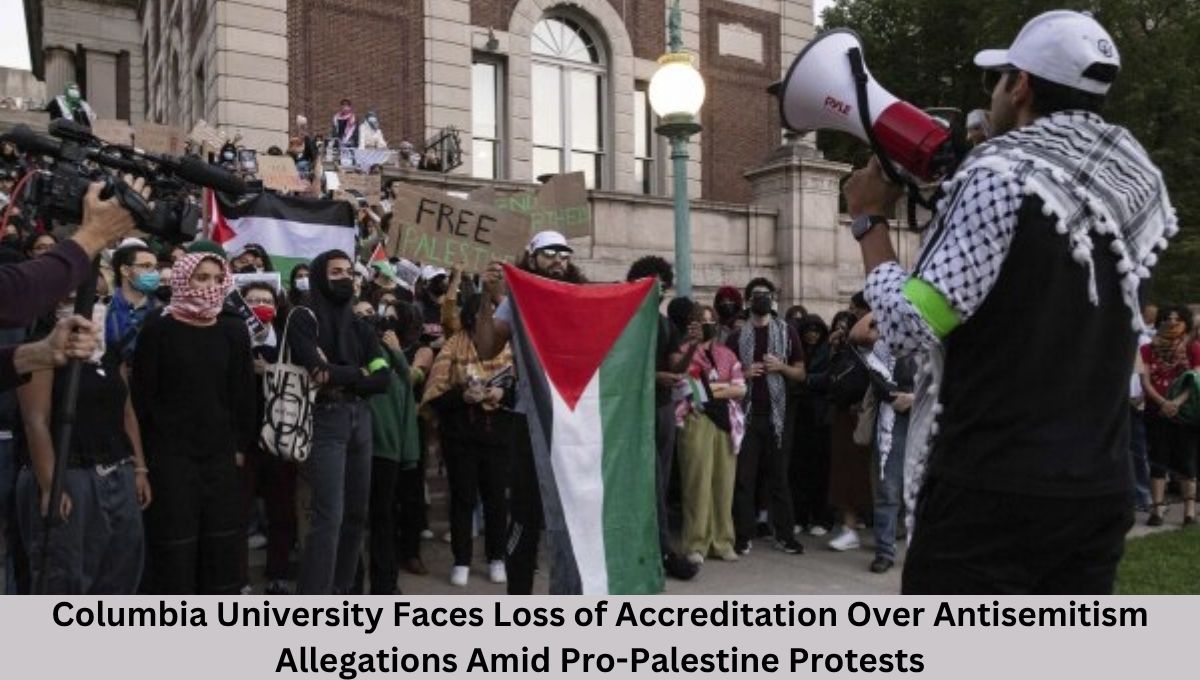
In a major escalation of tensions, Columbia University Faces Loss of Accreditation Over Antisemitism Allegations Amid Pro-Palestine Protests. The U.S. Department of Education has formally notified Columbia University’s accrediting agency that the university is in violation of federal anti-discrimination laws.
The department concluded that Columbia “acted with deliberate indifference” toward the harassment of Jewish students on campus during recent pro-Palestinian protests, putting its accreditation and hundreds of millions in federal funding at risk.

Columbia University Faces Loss of Accreditation Over Antisemitism Allegations Amid Pro-Palestine Protests
Federal Warning to Columbia Sparks Institutional Crisis
The Education Department’s announceme on June 4, signals that Columbia University may no longer meet the standards for accreditation set by the Middle States Commission on Higher Education (MSCHE). This rare rebuke could threaten Columbia’s access to federal student loans and Pell Grants, which support nearly half of its 36,000 students.
Education Secretary Linda McMahon issued a scathing statement: “Columbia University’s leadership failed to meaningfully protect Jewish students after the October 7, 2023, Hamas attack on Israel, acting with deliberate indifference in the face of rising campus harassment.”
The department’s Office for Civil Rights (OCR), along with the Department of Health and Human Services, found Columbia in violation of Title VI of the Civil Rights Act, which mandates that no student face discrimination in programs receiving federal assistance.
Accreditation at Stake: What It Means for Columbia
Accreditation is not merely symbolic. It determines a university’s eligibility to receive federal funds, including student aid programs such as Pell Grants and subsidized loans. Without accreditation, Columbia degrees may become less valuable, credits non-transferable, and research partnerships jeopardized.
If Columbia fails to come into compliance within the timeframe mandated by federal law, MSCHE could revoke its accreditation an outcome that would have severe repercussions for the Ivy League school’s prestige, enrollment, and finances.
According to 34 C.F.R. § 602.20(a), accreditors must ensure noncompliant institutions submit a corrective plan. Columbia, currently under MSCHE’s 2024–25 review, now faces pressure to produce such a plan.
Trump Administration Steps Up Pressure on Elite Universities
The Trump administration has seized on the wave of pro-Palestinian protests sweeping U.S. campuses as a political flashpoint. Labeling them as breeding grounds for antisemitism, President Trump has made Columbia and Harvard University the focal points of his campaign to overhaul higher education policy.
In February, the administration froze $400 million in federal funding to Columbia. Despite the university’s subsequent cooperation including changes in admissions, faculty hiring, and a restructuring of its Middle Eastern Studies department the White House has not restored the funding.
During a recent Oval Office meeting, Trump contrasted Columbia with Harvard:
“I think Columbia wants to get to the bottom of the problem. They’ve acted very well. But Harvard is trying to be a big shot.” Despite this measured praise, the administration is moving forward with an effort to strip Columbia of its accreditation.
University Response: Columbia Caught Between Cooperation and Autonomy
Acting Columbia President Claire Shipman responded cautiously in an April 14 statement, saying:
“While Columbia intends to seek constructive dialogue with the government, we will reject any agreement that would require us to relinquish our independence and autonomy as an educational institution.”
The university has thus far declined to comment further on the Education Department’s recent findings, but insiders report that Columbia is preparing a compliance plan to submit to MSCHE in the coming weeks.
Legal and Political Fallout Looms Large
The Trump administration’s aggressive moves have drawn sharp reactions from both sides of the political aisle. Advocates for Jewish student safety have welcomed the scrutiny, citing repeated incidents of antisemitic rhetoric and threats during campus protests.
Civil liberties groups, however, warn that the crackdown risks stifling free speech and academic independence. Columbia is not alone.
Harvard University is also facing a parallel federal investigation, with its own accreditation and federal funding under review. In both cases, the Trump administration is using Title VI of the Civil Rights Act as a legal foundation for unprecedented federal intervention in campus affairs.
What Happens Next? Timelines and Consequences
The road ahead for Columbia is fraught with uncertainty. MSCHE must now initiate a formal review to determine whether Columbia remains in compliance with accreditation standards. The university will likely be asked to implement specific changes, submit a compliance report, and possibly undergo site inspections.
If Columbia fails to meet MSCHE’s conditions, the school could lose accreditation within 12 to 18 months a development that would dramatically impact current students, faculty hiring, alumni donations, and future enrollment, especially from international applicants.
Conclusion: A Defining Moment for Higher Education
The clash between Columbia University and the Trump administration reflects a broader ideological battle over the role of higher education in American society. With its accreditation and funding on the line, Columbia now finds itself navigating one of the most serious institutional crises in its 270-year history.
As elite campuses across the country face growing political scrutiny, the outcome of Columbia’s case may set a precedent for how far federal authorities can go in regulating academic environments under the banner of civil rights enforcement.
Final Thoughts
The implications of the Columbia accreditation case stretch well beyond a single university. It challenges the boundaries between federal oversight and campus autonomy, civil rights and protest rights, and the evolving role of government in shaping educational institutions. Observers, students, and administrators across the nation will be watching closely as the Middle States Commission decides whether one of America’s most prestigious universities still meets the standard it has held since 1921.
Also Read: Columbia University Settles Antisemitism Claims for $221M, Ends DEI Policies
Also Read: Not just Harvard and Columbia—these 60 universities are now on the Trump administration’s radar
Related Posts:
- Columbia University Settles Antisemitism Claims for…

- 5 Powerful Takeaways from Claudia Sheinbaum’s…

- Trump DOJ Targets George Washington University Over…

- Massive Nationwide Protests Demand 'Hands Off!' from…
- Trump vs. Harvard: Federal Funding Cut Sparks Clash…

- Harvard’s SEVP Certification Revoked: What This…
