
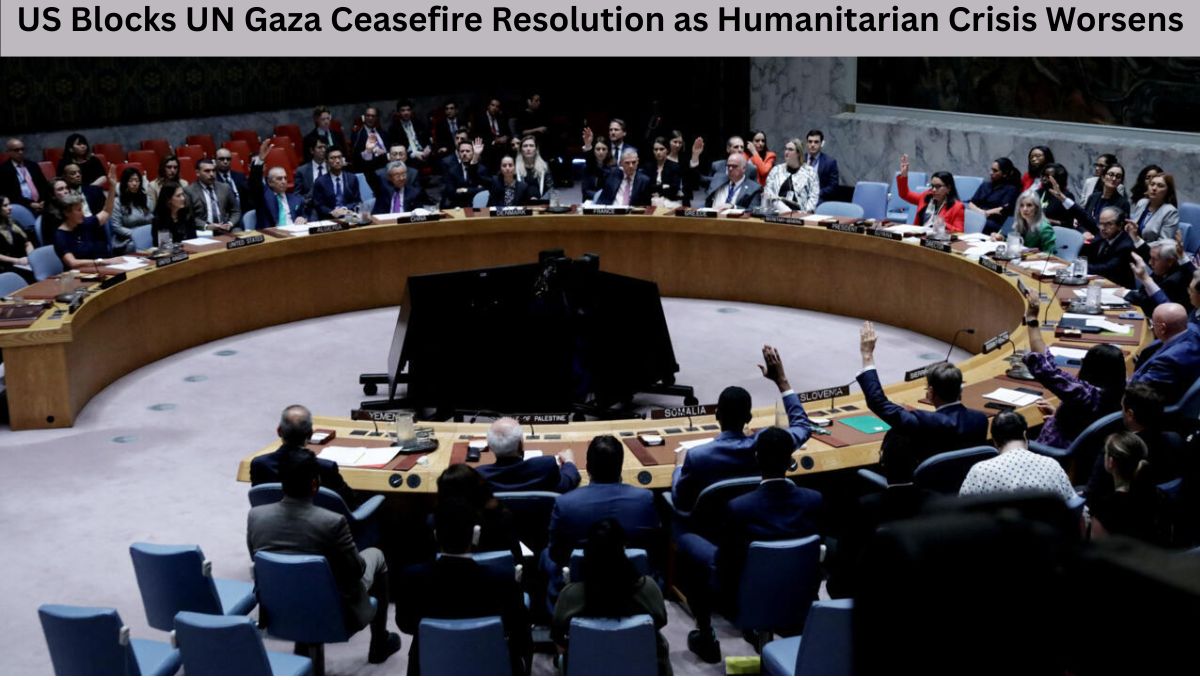
In a move that has intensified global scrutiny, US Blocks UN Gaza Ceasefire Resolution as Humanitarian Crisis Worsens. The United States on Wednesday vetoed a United Nations Security Council resolution calling for an “immediate, unconditional, and permanent ceasefire” in Gaza. The resolution, supported by all 14 other council members, also demanded unhindered humanitarian aid access and the release of all hostages held by Hamas.
The veto Washington’s fifth on Gaza since the October 2023 conflict began comes as humanitarian agencies warn that Gaza is on the brink of famine, with over 54,000 Palestinians reported killed and aid still largely blocked from reaching civilians.
US Blocks UN Gaza Ceasefire Resolution as Humanitarian Crisis Worsens
US Justifies Veto, Faces Global Backlash
Acting U.S. Ambassador to the U.N. Dorothy Shea defended the veto, saying the resolution lacked key elements: it did not condemn Hamas, and failed to demand the group disarm and withdraw from Gaza.
“We will not support any measure that does not address the root cause of this war,” Shea said, referring to Hamas’ October 7 attack, which left 1,200 Israelis dead and 251 kidnapped.
Israel’s U.N. Ambassador Danny Danon lashed out at council members who backed the resolution, accusing them of “appeasement and submission” that would lead “only to more terror.” Israel maintains that any ceasefire must be contingent on Hamas’s total removal from Gaza.
But critics argue that the U.S. and Israeli positions ignore the staggering civilian death toll and the deepening humanitarian catastrophe. China’s Ambassador Fu Cong condemned Israel’s actions as violating “every red line of international humanitarian law,” and accused the U.S. of obstructing justice.
Aid Distribution: Militarized and Deadly
The veto comes amid rising controversy over the U.S.- and Israel-backed Gaza Humanitarian Foundation (GHF) a newly formed aid distribution network that bypasses traditional U.N. agencies. Launched in late May, GHF claims to have delivered over 7 million meals.
But rights groups say the system militarizes aid, displaces civilians, and has already led to deadly chaos. At least 100 Palestinians have been killed at or near GHF distribution points, often by Israeli troops firing at crowds.
The Israeli military claims it only targeted “suspects” leaving designated routes, but eyewitnesses and humanitarian workers describe scenes of starving civilians being shot while seeking food. Due to security concerns, GHF paused operations this week and is demanding clearer safety protocols from the Israeli military.
UN and Aid Groups Call for Access
U.N. humanitarian chief Tom Fletcher reiterated calls for full aid access and demilitarized distribution, urging Israel to open all crossings and allow the U.N. to resume its operations.
“We have the plan, the supplies, and the experience,” Fletcher said. “What we don’t have is access.” He also denounced the use of food as a weapon, adding: “Enough is enough.”
While the U.S. claims the GHF is a more secure alternative, major aid organizations including UNICEF, the Red Crescent, and the World Food Programme have refused to participate, citing violations of neutrality and international law.
Mounting Civilian Toll and Fading Diplomacy
The humanitarian situation in Gaza continues to worsen. Health officials report that entire families are perishing under rubble, and hospitals are overwhelmed by malnourished children and burn victims. UNICEF’s James Elder described teenage boys “in tears, showing me their ribs.”
Although Israel lifted part of its blockade last month under international pressure, aid remains scarce and inconsistent. Gaza’s local food production has been destroyed, and more than 2 million people remain trapped without reliable access to water, electricity, or medical care.
The U.S. has proposed a ceasefire and hostage deal, but Hamas has requested amendments that Washington has called “totally unacceptable.” Meanwhile, civilian suffering intensifies with no clear end in sight.
Next Steps: General Assembly and Global Pressure
With the Security Council deadlocked, diplomats say a similar resolution is expected to be introduced at the U.N. General Assembly, where no nation holds veto power. Such a measure would likely pass, but would be nonbinding.
As international condemnation grows including from traditional allies like the UK Washington risks deeper isolation over its unwavering support for Israel’s military campaign.
Conclusion: A Test of Global Resolve
The U.S. veto marks a pivotal moment in the Gaza crisis. With mass casualties mounting, aid blocked, and diplomacy stalled, the international community faces a crucial test: Will it act to stop the suffering or remain divided by political calculations?
As pressure builds from civil society, rights groups, and even within the U.S. Congress, the Biden administration faces growing calls to reassess its approach before Gaza’s humanitarian crisis spirals beyond repair.
Also Read: Israel Accepts US-Backed Gaza Ceasefire Proposal; Hamas Still Wary of Truce Terms
Also Read: US vetoes UNSC Gaza ceasefire resolution as Israeli strikes kill 95
Related Posts:
- 5 Key Developments as Israel Confirms Hamas Handed…

- Israel–Hamas Ceasefire Under Strain: 4 More Hostage…

- Trump’s 20-Point Gaza Peace Plan Gains Urgent Global…

- Trump’s Historic Gaza Ceasefire Deal 2025: A…

- 5 Major Takeaways from the US Supreme Court's…

- Trump’s Breakthrough Gaza Ceasefire Deal 2025: Key Insights
