In a new strategy Trump Administration Eyes 15% Global Tariffs for 150 Days Amid Legal Setbacks. The Trump administration is weighing a new strategy to sustain its aggressive tariff agenda after a recent legal defeat.
Following a court decision that declared President Donald Trump overstepped his authority by imposing broad tariffs under emergency economic powers, the administration is now exploring a rarely used trade law provision that allows for short-term duties.
According to a report from The Wall Street Journal, the administration is considering temporary global tariffs of up to 15% for 150 days under Section 122 of the Trade Act of 1974. This provision has never been used in such a sweeping manner but may serve as a stopgap while Trump’s team develops a longer-term legal plan.
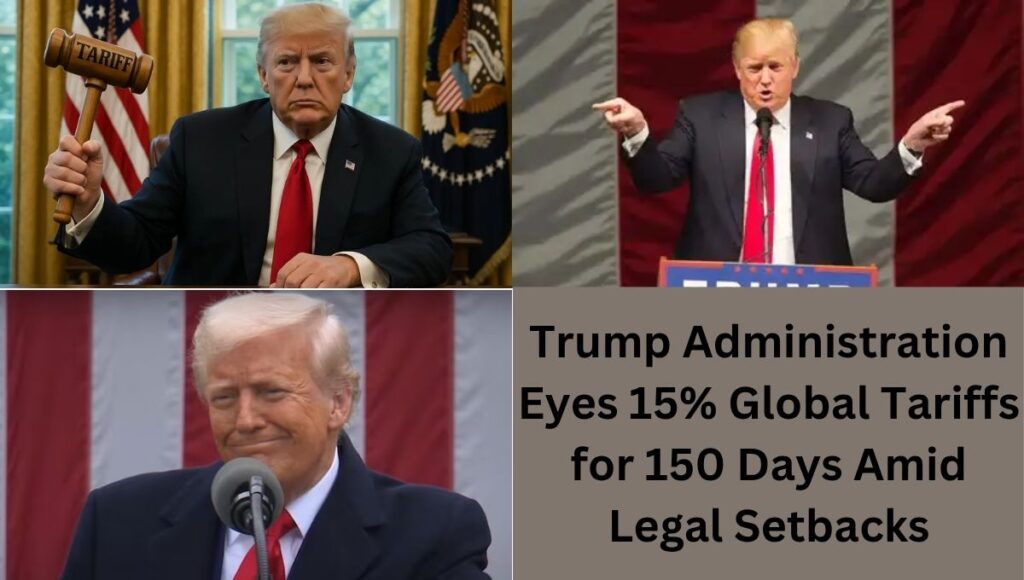
Trump Administration Eyes 15% Global Tariffs for 150 Days Amid Legal Setbacks
Court Ruling Sparks Urgent ‘Plan B’
Earlier this week, the U.S. Court of International Trade ruled that the president did not have the legal authority to impose wide-ranging tariffs under the International Emergency Economic Powers Act (IEEPA).
The three-judge panel stated that the IEEPA does not give the executive branch unlimited power to alter trade policy without congressional consent.
The ruling delivered a sharp blow to Trump’s tariff campaign, which has targeted imports from China, Europe, and several other countries under the guise of national security and economic urgency.
In a temporary win for the administration, however, the Court of Appeals for the Federal Circuit has paused the lower court’s ruling, allowing the current tariffs to remain while the administration appeals the decision.
Section 122: A Temporary Legal Loophole
Sources familiar with the matter told the Wall Street Journal that Trump’s trade team is preparing to invoke Section 122 of the Trade Act of 1974, which permits the president to impose up to 15% tariffs for 150 days in response to balance-of-payment imbalances or unfair trade practices.
While this provision has never been used as broadly as currently proposed, it represents a more legally defensible route than the IEEPA-based strategy previously used. This “Plan B” would serve as a stopgap measure, buying the administration time to devise more targeted tariffs under Section 301, which requires a formal notice-and-comment process.
White House: Other Legal Avenues on the Table
White House Press Secretary Karoline Leavitt confirmed the administration is exploring several legal options to continue pursuing its trade goals while the appeal process unfolds. While she declined to share specific strategies, she emphasized that maintaining tariff leverage is a top priority.
“We are reviewing our options to ensure American trade interests are protected,” Leavitt told reporters. “We remain committed to rebalancing global trade in favor of the United States.”
Two-Step Strategy: Stopgap Tariffs, Then Tailored Duties
According to the WSJ, the Trump administration is contemplating a two-pronged approach: first, implementing the short-term 15% tariffs across a broad swath of imports to stabilize trade while the legal landscape is navigated.
The second phase would involve a longer-term, more customized tariff regime built under Section 301 of the Trade Act an authority previously used during Trump’s first term to target Chinese goods. Unlike the emergency powers approach struck down by the court, Section 301 has been successfully used by past administrations and is seen as more robust in court.
Peter Navarro, Trump’s senior counselor for trade and manufacturing, appeared on Bloomberg TV to discuss additional legal avenues. He floated the possibility of using the Smoot-Hawley Tariff Act of 1930, which allows the U.S. to impose retaliatory tariffs on countries that engage in discriminatory trade practices against the United States.
Navarro also emphasized that the administration may increasingly lean on national security justifications to implement tariffs, similar to earlier moves under Section 232 of the Trade Expansion Act.
Legal Experts Say Section 122 is More Defensible
Trade lawyers and analysts agree that Section 122 offers a stronger legal footing than the IEEPA-based strategy previously employed. While the provision has been used sparingly in the past, legal scholars say its explicit authorization for temporary tariffs provides a clearer statutory basis for action.
Still, experts caution that deploying it on a massive scale could invite new legal challenges, especially from U.S. trade partners and domestic industries that rely on global supply chains.
What’s at Stake for Global Trade?
If enacted, the proposed 15% tariffs could have a significant impact on global markets. They would affect a wide range of imports, potentially escalating trade tensions with major economies such as China, the European Union, and Mexico.
Some analysts suggest that this legal shakeup could paradoxically open the door for U.S.–EU trade negotiations, as the original tariffs had long been a sticking point in bilateral talks. By shifting legal frameworks and temporarily easing pressure, the U.S. might reset discussions under a new structure.
No Official Announcement Yet, But Preparations Are Underway
Though no official announcement has been made, administration insiders confirmed that contingency plans are well underway. With legal uncertainties still looming, the Trump administration appears determined to keep its trade war momentum alive.
Whether or not the short-term tariff plan is implemented, the Trump team is clearly focused on preserving tariff continuity as a key pillar of its “America First” economic strategy.
Conclusion: A Fluid Trade Landscape Ahead
As the Trump administration faces intensifying legal scrutiny and mounting global trade pressure, the outcome of this legal and economic standoff remains unpredictable. However, what’s clear is that the president is not backing down.
With tools like Section 122 and Section 301 in hand, Trump is poised to push forward on tariffs, even as the courts and trade partners push back. Whether this leads to broader trade conflicts or opens the door to new deals, the next few months will be critical for the future of U.S. trade policy.
Also Read: Trump Considers Temporary 15% Tariffs Amid Legal Battle Over Trade Authority