Trump Always Chickens Out or TACO Trump: Viral Meme Exposes a Pattern of Tariff Flip-Flops and Political Retreat. A new phrase is taking Wall Street and social media by storm, TACO Trump, an acronym for “Trump Always Chickens Out.” Originally coined by Financial Times columnist Robert Armstrong, the term has become more than a viral jab; it now reflects a pattern investors recognize and exploit. As former President Donald Trump intensifies his tariff threats in his second term, market watchers have begun treating his moves with a strategic eye and sometimes a smirk.
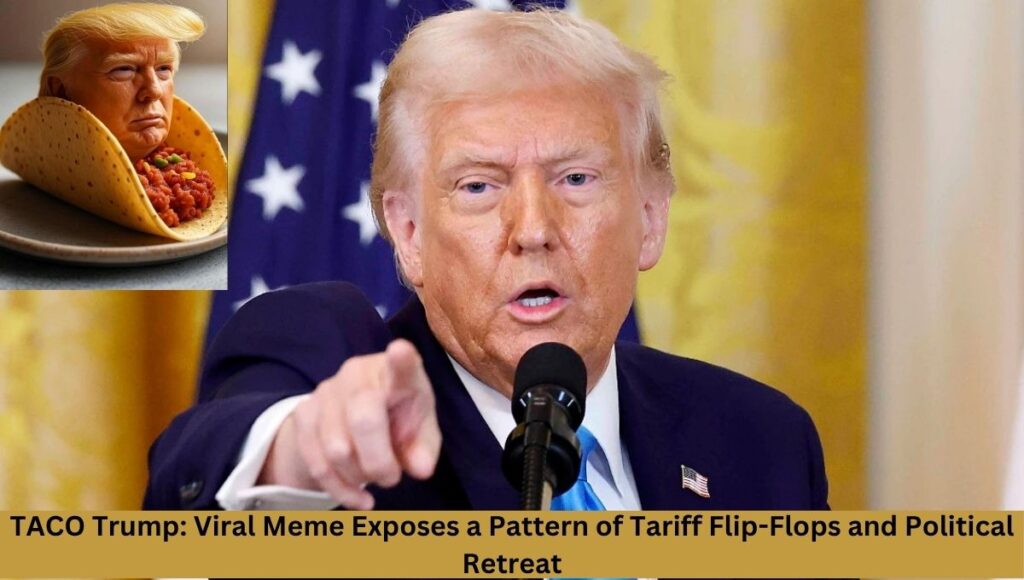
TACO Trump: Viral Meme Exposes a Pattern of Tariff Flip-Flops and Political Retreat
What Is the TACO Trade?
The TACO Trade isn’t just a catchy nickname it’s a framework for understanding Trump’s trade behavior. The theory outlines a predictable four-step cycle:
- Tariff Threat: Trump announces bold, often severe tariffs on imports.
- Market Reaction: Markets panic stocks dive, bond yields surge.
- Trump Retreats: The administration walks back the policy, delays implementation, or reduces the tariff.
- Market Rebound: Investors recover, stocks bounce back, and the pattern starts over.
This recurring cycle tough talk followed by retreat is what led analysts to dub Trump’s tactics the “TACO Trade.”
Real-World Examples of TACO Trump in Action
The TACO Trump label isn’t without merit. Recent tariff threats have followed the cycle precisely. For instance:
- April 2: Trump announces a 26% tariff on Indian imports.
- April 9: After significant market losses, he pauses the tariffs for 90 days to allow for “negotiations.”
Similarly:
- Late May: Trump unveils a 50% tariff on EU goods set for June 1.
- May 28: The policy is delayed until July 9, keeping only a 10% base tariff for now.
Perhaps the most dramatic shift came with China: Trump’s tariffs surged to 145%, only to fall back to 30% following global market disruptions.
Trump Fires Back: “It’s Called Negotiation”
Trump hasn’t taken the TACO label lightly. When CNBC’s Megan Cassella questioned him about it during a White House press briefing, he responded with visible irritation.
“You call that chickening out? It’s called negotiation,” he said. “Don’t ever say what you said that’s a nasty question.”
Trump defended his method of starting with inflated tariffs as a deliberate bargaining tactic, not a sign of indecision or weakness. But for Wall Street, the pattern is all too familiar and predictable.
Wall Street’s Take: Predictable Volatility
Market experts aren’t laughing they’re strategizing. Steve Sosnick of Interactive Brokers notes that the TACO Trade is “a nonpolitical way of the markets calling the administration’s bluff.” Sam Burns of Mill Street Research adds that traders now pause instead of panic when Trump makes tariff threats.
This muted response to aggressive announcements signals that investors expect eventual backpedaling. When Trump most recently threatened new EU tariffs, stocks barely moved, showing just how normalized the TACO cycle has become.
The Meme Heard Around the World
After Armstrong’s column and Cassella’s question, the term TACO Trump exploded online. Memes featuring tacos with Trump’s face, animated chickens, and rhyming punchlines took over Twitter, TikTok, and Instagram.
Popular captions included:
- “There are no trade deals. Because Trump Always Chickens Out.”
- “Donald Trump may be losing his clout. His tariffs will reveal… he loses every deal.”
The memes aren’t just humorous they reflect real frustration from Americans, global markets, and political observers weary of volatile policymaking.
Tariff Turnarounds Fuel the Narrative
Trump’s recent trade maneuvers have only reinforced the meme:
- EU Tariffs: Announced, delayed, renegotiated.
- China Tariffs: Raised to extremes, then scaled back.
- India: Aggressive posturing followed by diplomatic retreats.
This pattern fuels the idea that Trump’s tariff policies are more about performance than enforcement a view the TACO Theory encapsulates with biting simplicity.
Trump’s Presidency Under Siege
The TACO Trump meme points to deeper issues within Trump’s second term. Legal challenges are mounting:
- A trade court ruled Trump’s latest tariffs violated executive authority.
- His attempt to block foreign student admissions at Harvard was struck down.
These defeats underscore a broader decline in unilateral power. Trump’s governance, once seen as forceful, is increasingly viewed as erratic and constrained.
Global Allies Pushing Back
Internationally, Trump’s influence is also waning:
- His Russia-Ukraine peace efforts have stalled.
- Iran and India openly question the effectiveness of U.S. trade talks.
- China, rather than buckling, is pivoting toward new economic alliances.
Despite lofty rhetoric, Trump’s hardline trade approach has produced more gridlock than gains another reason the TACO Trump narrative resonates globally.
Elon Musk’s Exit: A Crumbling Inner Circle
One of the biggest blows to Trump’s credibility came from within: Elon Musk has exited his advisory role, publicly criticizing Trump’s massive spending proposals. Musk quipped:
“A bill can be big or beautiful, but not both.” Musk’s departure signals a loss of support from influential allies, compounding Trump’s political and strategic isolation.
A Presidency in Retreat
What’s unfolding isn’t a singular scandal, but a gradual erosion of power. Trump’s second term, once billed as a comeback, is increasingly defined by:
- Legal defeats
- Global diplomatic pushback
- Market skepticism
- Viral public mockery
The TACO Trump meme has gone from social media joke to symbol of presidential fatigue—capturing the essence of a leader whose threats no longer strike fear but spark laughter.
Conclusion: TACO Trump Is No Joke
While TACO Trump began as a punchline, it now defines a repeatable political and economic pattern. Trump’s habit of dramatic threats followed by sudden reversals has become so routine that markets expect it and memes predict it.
In a world where memes can shape public discourse and financial strategies, TACO Trump has become more than a trend. It’s a sign that Trump’s political tactics are losing both their shock value and their strategic impact.
As voters, investors, and world leaders recalibrate their expectations, the question is no longer whether Trump will follow through but when he’ll back down again.
Also Read: US Court Blocks Trump’s Sweeping Import Tariffs in Landmark Ruling
Also Read: Investors are calling Trump a chicken – here’s why that matters