
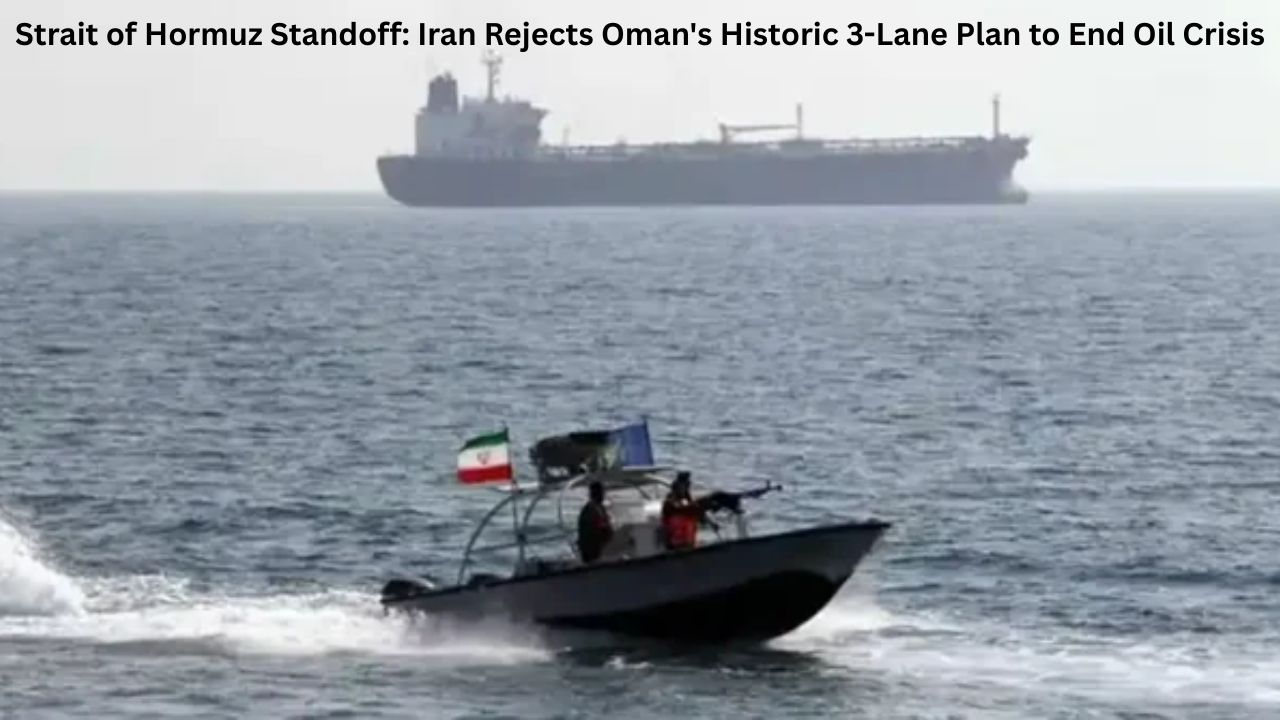
Strait of Hormuz Standoff: Iran Rejects Oman’s Historic 3-Lane Plan to End Oil Crisis, seeking an equal division of the waterway. One of the world’s most important oil corridors remains gridlocked in diplomatic limbo.
Oman has put forward a Gulf-backed proposal designed to reopen the Strait of Hormuz to normal shipping traffic, offering Iran a way to collect voluntary fees from passing vessels without seizing outright control of the waterway.
Iran, however, has rejected the plan in its current form, insisting on a bigger share of authority over one of the planet’s most critical energy chokepoints.
The disagreement, playing out through back-channel diplomacy between Muscat, Tehran, and several Gulf capitals, carries consequences far beyond the region.
Roughly a fifth of the world’s oil and liquefied natural gas normally passes through the strait, and the disruption caused by the ongoing US-Israeli war with Iran has already pushed global energy prices sharply higher.
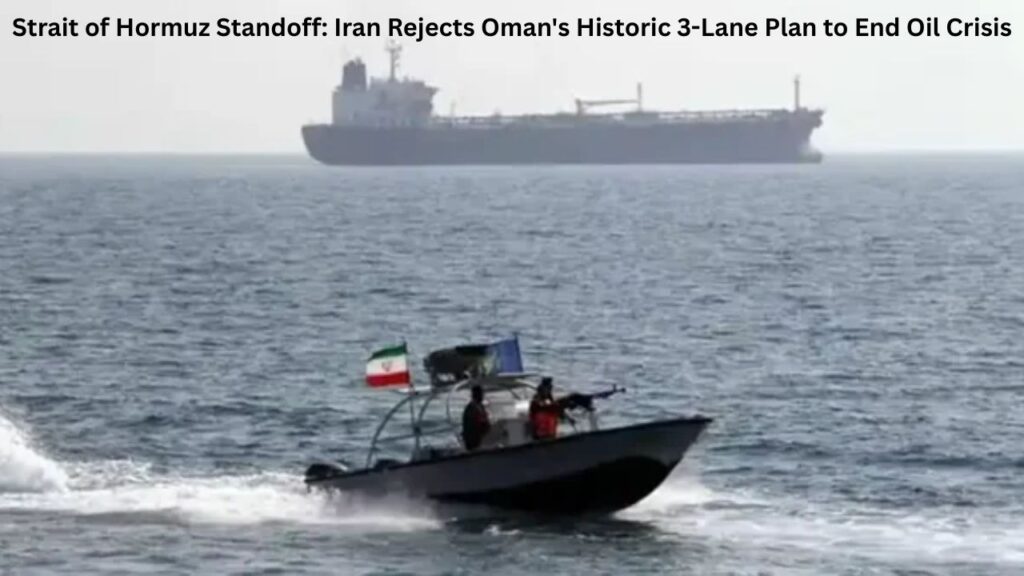
Strait of Hormuz Standoff: Iran Rejects Oman’s Historic 3-Lane Plan to End Oil Crisis
Quick Facts: The Strait of Hormuz Standoff
- What’s happening: Oman has proposed a Gulf-backed plan to manage shipping through the Strait of Hormuz using voluntary fees
- Iran’s response: Tehran has rejected the specific proposal for an equal division of the strait with Oman
- The model: Based on the Strait of Malacca system, where ships voluntarily contribute toward navigation and safety services
- Why it matters: The strait normally carries about one-fifth of the world’s oil and gas supply
- Backdrop: The US-Israeli war on Iran began February 28, 2026, and effectively shut down normal shipping through the strait
- Recent development: The US paused a two-week bombing campaign against Iran over the weekend, with Trump citing “good talks” but warning strikes could resume
What Is the Strait of Hormuz Standoff About?
The Strait of Hormuz, a narrow waterway separating Iran from Oman at the mouth of the Persian Gulf, has functioned for decades as one of the most important arteries in global energy trade.
Since the United States and Israel launched their war against Iran on February 28, Tehran has effectively closed the strait to most vessels other than its own, sending oil prices soaring and disrupting supply chains around the world.
Washington resumed an intense bombing campaign against Iran earlier this month specifically aimed at breaking Tehran’s grip on the waterway.
That campaign ran for roughly two weeks before President Trump abruptly called it off over the weekend, a move he described as being based on advice from military commanders that the strategy had achieved its objectives.
Trump has since said “good talks” are underway with Iran, though he has also warned that strikes could resume if negotiations don’t produce results.
Iranian officials, for their part, have denied that they are seeking to restart talks with Washington.
Oman’s Voluntary Fee Proposal Explained
Into this standoff has stepped Oman, which controls the opposite shore of the strait and has long served as a quiet diplomatic bridge between Iran and the West.
According to Gulf and Western officials briefed on the matter, Muscat has presented Tehran with a plan — now backed by other Gulf states — that would let Iran collect voluntary fees from ships passing through the strait, while stopping short of giving Tehran sole control over the waterway.
Under the proposal, shipping traffic would reportedly be organized into three lanes:
one running through Iranian territorial waters, one through an international corridor, and one through Omani waters.
Iran would also be expected to take responsibility for clearing mines from the strait as part of any arrangement, according to reporting from the region.
The Strait of Malacca Model
Oman’s plan draws directly from an existing arrangement used in Asia’s Strait of Malacca, the busy shipping corridor connecting the Indian and Pacific Oceans.
There, Indonesia, Malaysia, and Singapore invite vessels to make voluntary contributions that help fund navigation aids, environmental protection, and search-and-rescue operations, rather than charging mandatory tolls.
One Western diplomat familiar with the Hormuz talks compared the concept to the voluntary carbon offset option airlines sometimes offer travelers:
shipping companies could choose to contribute, but nothing would compel them to pay.
Analysts note the scale involved is strikingly different from what Iran has floated.
The Malacca system raises roughly $70 million a year in voluntary contributions, while Tehran has reportedly proposed a mandatory “service fee” of as much as $1 million per ship, a scheme that could theoretically generate tens of billions of dollars annually if fully enforced.
Iran Says No — For Now
Despite the regional backing behind Oman’s plan, Iran has rejected the specific proposal for an even split of authority over the strait.
A senior Iranian official, deputy foreign minister Kazem Gharibabadi, said publicly that Tehran does not accept an arrangement dividing transit routes equally between Iran and Oman, arguing that such a plan fails to address Iran’s security concerns.
Instead, Gharibabadi said Iran had proposed that Tehran manage shipping through its own side of the strait, while Oman would oversee only part — not all — of the opposite lane.
He reiterated that Iran has no plans to negotiate directly with the United States, even as talks with Oman continue on a step-by-step basis.
Notably, he also warned that Iran would consider “any action” necessary to maintain control over the strait, language that includes the possibility of a return to open conflict.
Still, some regional reporting suggests the public rejection may not be the final word.
Journalists covering the talks from Tehran have noted that despite the tough official statements, Iranian negotiators appear to be showing a degree of flexibility behind closed doors, even as they publicly hold their ground.
Where Iran and Oman Still Disagree
Several sticking points remain unresolved between the two sides.
Beyond the core question of how much authority each country would hold, negotiators are also wrestling with the exact trajectory ships would be required to follow, how any fees would actually be calculated and collected, who would have final say over the rules governing the waterway, and how the extensive mine-clearing operation would be organized and funded.
A Gulf Cooperation Council video conference among foreign ministers took place Tuesday specifically to coordinate the bloc’s response to these developments, according to Qatar’s Foreign Ministry, underscoring how seriously the region’s governments are treating the standoff.
Academic observers have offered a cautiously optimistic read.
Paul Musgrave, a professor at Georgetown University’s campus in Qatar, described Oman’s initiative as a genuinely positive step, though he cautioned that its success ultimately depends on whether hardline factions within Iran’s government are willing to accept any compromise at all.
The US and Global Oil Industry Push Back
Even if Iran and Oman eventually reach an understanding, the plan faces resistance from another direction entirely:
the American oil industry and the US government itself. Mike Sommers, chief executive of the American Petroleum Institute, the top US oil industry trade group, said his organization opposes any new tolling authority over the strait, particularly one introduced under the shadow of renewed military strikes.
Washington’s official position has been even more categorical.
US officials, including Secretary of State Marco Rubio, have previously stated that no country is permitted to charge tolls or fees on an international waterway under existing international law, and that the United States expects a full return to the pre-war status quo, where ships transited freely without any payment at all.
That fundamental disagreement — a voluntary fee system that both Oman and Gulf states appear willing to accept, versus a US position that rejects any fee structure whatsoever — remains one of the biggest obstacles to a lasting resolution.
Why the Strait of Hormuz Matters to the World
It’s difficult to overstate how central the Strait of Hormuz is to the global economy.
Before the war began, more than 100 ships passed through the strait daily, carrying close to a fifth of the world’s oil and liquefied natural gas supply.
Traffic has fallen sharply since fighting escalated, and the resulting supply disruption has been a major factor pushing global oil prices well above typical levels in recent months.
For countries around the world, from major economies in Asia and Europe to emerging markets that rely heavily on Gulf energy imports, any resolution — or continued stalemate — over how ships move through Hormuz carries direct consequences for fuel costs, inflation, and broader economic stability.
A Fragile Pause in the Fighting
The backdrop to all of this diplomacy remains an active, if currently paused, military conflict.
The US campaign of strikes against Iran, which continued for roughly two weeks before Trump’s abrupt halt over the weekend, was explicitly aimed at forcing Tehran to loosen its grip on the strait.
While the pause has created space for Oman’s diplomatic effort to move forward, Trump’s repeated warnings that strikes could resume if talks fail mean the ceasefire remains fragile rather than settled.
Iran’s own rhetoric has echoed that uncertainty.
Even as its officials engage with Omani counterparts on possible arrangements, Tehran has simultaneously signaled it is prepared to take further military action if it feels its control over the waterway is threatened.
What Happens Next
For now, all sides appear to be treating the Omani proposal as a starting point for further negotiation rather than a finished deal.
Iran has yet to formally respond to the full terms of the Gulf-backed plan, and gaps remain over authority, fees, and the practical mechanics of reopening the strait safely.
With Gulf states coordinating their position, Washington firmly opposed to any fee structure, and Iranian hardliners still skeptical of compromise, the path back to normal shipping through Hormuz looks likely to be gradual rather than immediate.
Conclusion
The Strait of Hormuz standoff captures, in miniature, just how tangled the aftermath of the US-Israeli war with Iran has become.
A genuinely creative diplomatic proposal from Oman has won broad regional backing, yet it still runs headlong into Iran’s demand for greater control, the Trump administration’s firm rejection of any tolling scheme, and the wider uncertainty of a fragile, unofficial pause in hostilities.
Until those gaps close, one of the world’s most vital energy corridors will likely keep operating well below capacity, with real consequences for oil markets and economies far beyond the Gulf.
Also Read: 8 Explosive Developments as Trump Plans Long Hormuz Blockade Amid Iran Crisis
Also Read: Strait of Hormuz standoff: Can a wider war be averted?…
Related Posts:
- 10 Explosive Signals Trump Says Iran War Could End…
- 7 Critical Reasons Kharg Island Is Iran’s Oil “Crown…

- 12 Explosive Claims as Donald Trump Says Iran War…
- 7 Critical Ways Iran’s Yuan Oil Plan Could Shake the…
- 10 Explosive Updates: US Destroys 16 Iranian…
- 10 Explosive Strikes: Israel Bombs Tehran Oil Depots…
