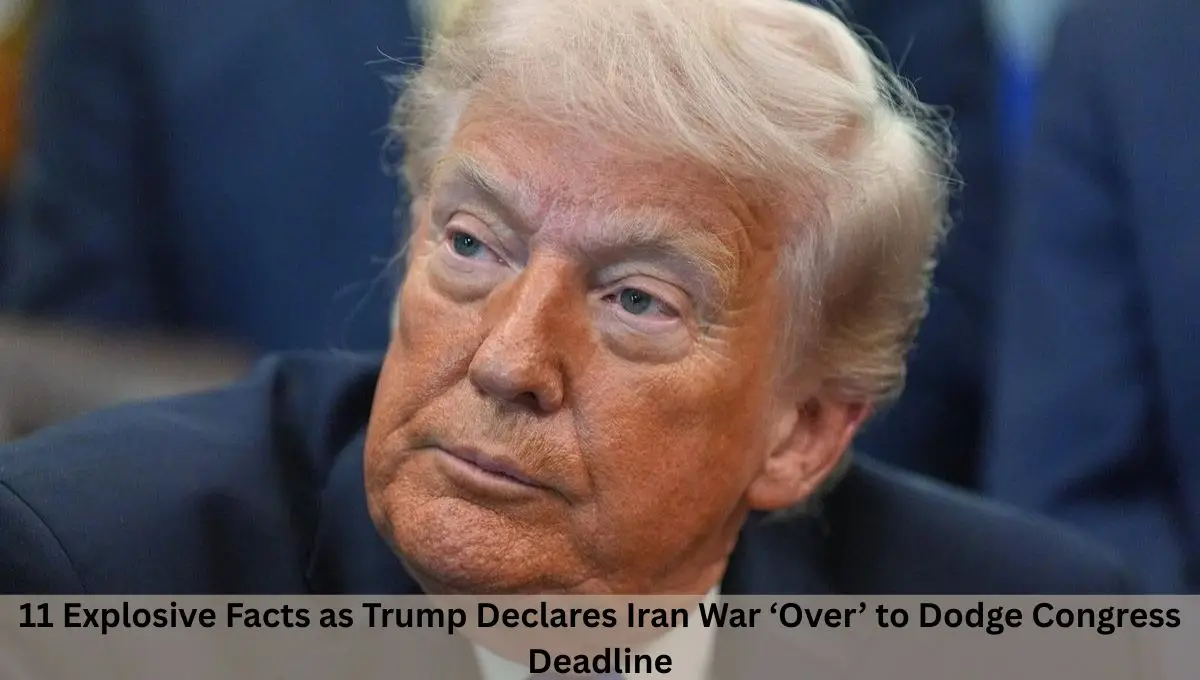
11 Explosive Facts as Trump Declares Iran War ‘Over’ to Dodge Congress Deadline and claims hostilities ‘terminated’. In a dramatic and controversial move, the Trump administration has declared that hostilities in the Iran conflict are “terminated”—just hours before a critical legal deadline that could have forced the White House to seek congressional approval or end military operations.
The statement has triggered intense political, legal, and global debate.
At the heart of the controversy is a fundamental question:
Can a war be declared over simply because guns have fallen silent temporarily?
With a fragile ceasefire in place, rising oil prices, escalating geopolitical tensions, and deep divisions within Washington, the situation has evolved into one of the most complex crises of recent times.
11 Explosive Facts as Trump Declares Iran War ‘Over’ to Dodge Congress Deadline
What the Trump Administration Actually Said
“Hostilities Have Terminated”
A senior official from the administration stated:
“For War Powers Resolution purposes, the hostilities that began on February 28 have terminated.”
This claim is based on one key argument:
- No direct exchange of fire between US and Iranian forces since early April
- A ceasefire has been holding for over three weeks
A Strategic Legal Interpretation
The administration is essentially arguing:
- The war is no longer active
- Therefore, the War Powers clock no longer applies
- Congressional approval is not required
This interpretation could allow the White House to bypass legal obligations under US law.
Understanding the War Powers Resolution
What Is the 60-Day Rule?
The War Powers Resolution of 1973 requires:
- The president must notify Congress within 48 hours of military action
- Military operations must end within 60 days
- Or Congress must authorize continued action
- A 30-day extension is allowed under specific conditions
Why This Deadline Matters
The Iran conflict timeline:
- February 28: US-Israel strikes on Iran begin
- March 2: Congress notified
- May 1: 60-day deadline
Without approval, the law requires the president to:
- End military operations
or - Seek authorization
The Ceasefire Argument—A Legal Loophole?
Administration’s Position
Defense Secretary Pete Hegseth argued:
- The ceasefire “pauses” the war
- The 60-day clock stops during a truce
Critics Push Back
Legal experts and Democrats strongly disagree:
- No provision exists for pausing the clock
- A ceasefire does not equal the end of hostilities
- Ongoing blockades still count as military action
One expert called the interpretation:
“A significant stretch of legal reasoning.”
“We Are Not at War” – Trump’s Messaging Strategy
War vs Military Operation
Donald Trump has repeatedly said:
- “I don’t call it a war”
- “It’s a military operation”
This distinction is crucial because:
- War requires congressional oversight
- Military operations can be framed as temporary actions
Political Framing
By avoiding the word “war,” the administration:
- Reduces legal pressure
- Maintains flexibility
- Controls public perception
Congress Divided—And Powerless?
Democrats Push Back
Democrats argue:
- The president is bypassing constitutional authority
- Congress must approve prolonged military action
Senator Adam Schiff said:
“That deadline is not a suggestion; it is a requirement.”
Republicans Stand Firm
Most Republicans:
- Support Trump’s approach
- Oppose war-limiting resolutions
However, cracks are emerging:
- Some Republicans demand clearer strategy
- Others question legal interpretations
Failed Votes and Political Gridlock
Senate Rejects War Powers Resolution
A recent vote:
- 47 in favor
- 50 against
Outcome:
- Efforts to limit the war failed again
House Also Blocks Action
Earlier:
- Resolution failed by just one vote
This reflects:
- Deep partisan divisions
- Limited Congressional influence
The Iran Conflict—How It Started
February 28 Strikes
The conflict began with:
- Joint US-Israel airstrikes
- Targets across Iranian territory
Iran’s Response
Iran retaliated with:
- Missile strikes on US bases
- Attacks on Israel
- Blocking the Strait of Hormuz
The Strait of Hormuz Crisis
A Global Economic Flashpoint
The Strait of Hormuz:
- Handles a significant portion of global oil supply
- Is critical for international trade
Iran’s blockade has:
- Disrupted shipping
- Increased global energy fears
Oil Prices Surge Worldwide
Markets React to Uncertainty
Oil prices have surged dramatically:
- Brent crude exceeded $126 per barrel
- Continued volatility in futures markets
Why Prices Are Rising
Key factors:
- War fears
- Shipping disruptions
- Uncertainty over ceasefire stability
A Fragile Ceasefire
Temporary Calm
The ceasefire began:
- April 7
- Initially for two weeks
- Later extended
Risks of Collapse
Despite calm:
- Military plans remain active
- Threats continue from both sides
Iran has warned of:
“Long and painful strikes” if attacks resume
Behind the Scenes—Military Plans Continue
Pentagon Prepared for Escalation
Reports indicate:
- Plans for “short and powerful” strikes exist
- Strategy aimed at forcing negotiations
Strategic Pressure
The US is using:
- Naval blockades
- Economic pressure
- Military readiness
Global Diplomatic Fallout
Allies Concerned
The conflict has strained:
- US-European relations
- NATO coordination
Middle East Stability at Risk
Regional tensions:
- Iran vs Israel
- Proxy conflicts
- Rising instability
Public Opinion Turning Against the War
Growing Frustration
Polls show:
- Increasing opposition among Americans
- Concern over costs and risks
Economic Impact
Rising fuel prices:
- Affect daily life
- Influence political sentiment
Constitutional Clash Brewing
Who Has the Power to Declare War?
The US Constitution states:
- Congress declares war
- President commands military
A Long-Running Conflict
This tension has existed since:
- Vietnam War era
- Creation of War Powers Act
Legal Experts Weigh In
“No Basis for Pausing the Clock”
Experts argue:
- The law is clear
- Ceasefires do not reset deadlines
Potential Consequences
If challenged:
- Could trigger legal battles
- Set new precedent
What Happens Next?
Possible Scenarios
- Trump ignores deadline
- Seeks 30-day extension
- Congress pushes back
- Conflict resumes
Most Likely Outcome
Analysts expect:
- Status quo to continue
- Legal ambiguity to persist
The Bigger Picture—A War Without a Name
Strategic Ambiguity
By calling it a “military operation”:
- The administration avoids constraints
- Maintains strategic flexibility
Risks of This Approach
However, it:
- Weakens oversight
- Creates uncertainty
- Raises accountability concerns
Impact on Global Energy and Economy
Ripple Effects
The conflict has:
- Disrupted markets
- Increased inflation pressures
Long-Term Risks
If tensions escalate:
- Energy crisis could deepen
- Global recession risks rise
Why This Moment Matters Globally
This is not just a US issue.
It affects:
- Global energy markets
- International law
- Regional stability
Conclusion: A War Redefined
The Trump administration’s claim that the Iran war is “terminated” marks a critical turning point—not necessarily in the conflict itself, but in how modern warfare is defined and governed.
At stake is more than a legal technicality.
It is about:
- The balance of power between branches of government
- The definition of war in the 21st century
- The global consequences of strategic ambiguity
As the deadline passes, one thing is clear:
The conflict may be paused—but the crisis is far from over.
Final Thought
In today’s world, wars are no longer defined solely by bullets and bombs—but by narratives, interpretations, and political strategy. And in that sense, this conflict is still very much alive.
Also Read: 9 Explosive Claims as Trump Says US Winning Iran War
Also Read: Exclusive: US spy agencies examine how Iran would react to Trump declaring victory
Related Posts:
- 3 Explosive Conditions Iran Sets to End War with US…
- 11 Explosive Warnings as Trump Vows to ‘Knock the…

- 10 Explosive Signals Trump Says Iran War Could End…
- 10 Explosive Signals: Trump Rates Iran War “15/10”…
- 10 Explosive Warnings as Donald Trump Calls Iran…
- 9 Explosive Claims as Trump Says US Winning Iran War