
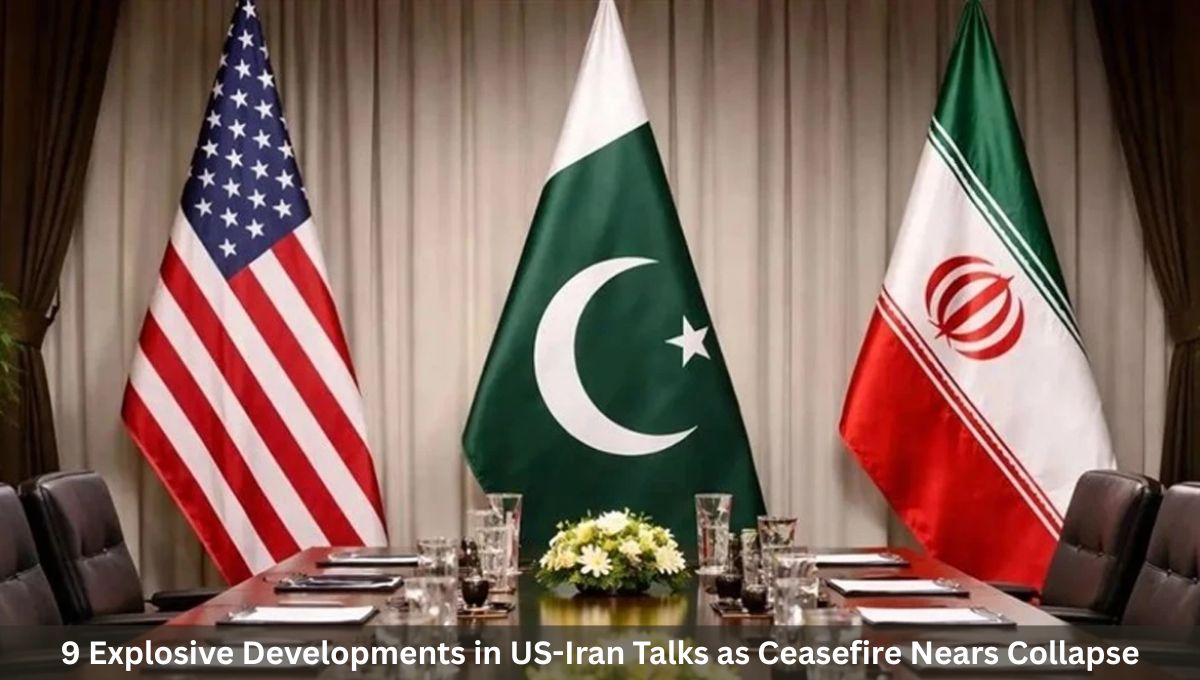
9 Explosive Developments in US-Iran Talks as Ceasefire Nears Collapse, casting doubt on peace. Tensions between the United States and Iran have surged once again as a fragile ceasefire approaches its expiration, with diplomacy hanging by a thread.
Thank you for reading this post, don't forget to subscribe!Iran’s sharp accusation that recent US naval actions amount to “piracy at sea” and “state terrorism” has cast serious doubt over the prospects of renewed peace talks in Pakistan.
With just hours left before the truce deadline, uncertainty dominates every aspect of the crisis—from whether negotiations will even take place to whether the region is on the brink of renewed war.
9 Explosive Developments in US-Iran Talks as Ceasefire Nears Collapse
Iran’s Strong Reaction: “Piracy” and “State Terrorism”
Iran’s Foreign Ministry delivered one of its strongest statements yet, condemning the US interception and boarding of Iranian-linked vessels.
Tehran described the move not merely as a hostile act but as a violation of international norms.
Officials accused Washington of undermining diplomacy at a critical moment, raising questions about the sincerity of US intentions.
This rhetoric marks a significant escalation in tone.
By framing the incident as “state terrorism,” Iran is signaling that it views the naval action as more than a tactical maneuver—it sees it as a direct assault on its sovereignty.
The language also serves a strategic purpose:
strengthening Iran’s negotiating position while justifying hesitation in engaging with the US.
Talks in Limbo: Will Iran Show Up?
At the center of the crisis is a simple but crucial question—will Iran attend the next round of talks?
So far, Tehran has not committed.
Iranian officials have openly stated that no final decision has been made regarding participation in negotiations scheduled in Islamabad.
This uncertainty has left mediators scrambling and has raised the stakes dramatically.
Pakistan, which is facilitating the dialogue, has confirmed it is still waiting for a formal response from Iran.
Despite ongoing communication, there is no clear indication that a delegation will arrive.
This hesitation reflects deeper mistrust. Iran has made it clear that it will not negotiate under pressure, especially while military actions and blockades continue.
Pakistan’s Diplomatic Balancing Act
Pakistan finds itself in a delicate position as mediator between two deeply adversarial powers.
On one hand, Islamabad is pushing forward with preparations for talks, signaling optimism and readiness.
On the other, it must navigate escalating tensions that threaten to derail diplomacy altogether. Security measures in Islamabad have already been tightened.
Parts of the city have been locked down, and high-level arrangements are in place to host delegations—despite uncertainty over whether the talks will even occur.
Pakistan’s role is crucial, but its influence is limited. Ultimately, the success of mediation depends on the willingness of both Washington and Tehran to engage constructively.
The Vessel Seizure That Changed Everything
The immediate trigger for the latest escalation was the US boarding of a sanctioned oil tanker linked to Iran.
The operation, described by US officials as smooth and “without incident,” was part of a broader effort to enforce sanctions and disrupt illicit networks.
However, from Iran’s perspective, the incident crossed a red line. The tanker, reportedly carrying millions of barrels of crude, was intercepted in international waters.
Tehran views this as an illegal act, reinforcing its narrative that the US is using coercion rather than diplomacy.
This single event has had outsized consequences—casting doubt on talks, hardening positions, and increasing the risk of confrontation.
Ceasefire Deadline Confusion Adds to Chaos
As tensions rise, even the timeline of the ceasefire has become unclear.
Different interpretations from Washington and Islamabad have created confusion over when exactly the truce expires.
While some officials point to one deadline, others suggest a slightly extended timeline. This ambiguity is not trivial.
In high-stakes conflicts, timing is everything. A misunderstanding or miscalculation could lead to unintended escalation, especially when military forces remain on high alert.
The lack of a unified timeline reflects broader coordination issues and highlights the fragile nature of the ceasefire.
Trump’s Hardline Messaging Raises Stakes
US President Donald Trump has adopted an increasingly aggressive tone as the deadline approaches.
While expressing hope for a deal, he has simultaneously warned of severe consequences if negotiations fail. His statements suggest that military action remains a very real possibility.
Trump has indicated that he does not favor extending the ceasefire, emphasizing urgency and pressure on Iran to act quickly.
Such messaging serves a dual purpose:
- It signals strength and resolve to domestic and international audiences
- It attempts to force Iran into negotiations under tight timelines
However, it also risks backfiring by reinforcing Iran’s reluctance to engage under perceived threats.
Strait of Hormuz: The Strategic Battleground
The crisis cannot be understood without considering the Strait of Hormuz.
This narrow waterway is one of the most critical arteries of global energy supply. Any disruption here has immediate global consequences.
Iran’s actions to restrict access, combined with US enforcement measures, have effectively turned the strait into a geopolitical flashpoint.
Shipping routes remain uncertain, insurance costs have surged, and energy markets are reacting nervously. For Iran, control over the strait provides leverage.
For the US, maintaining freedom of navigation is a strategic priority. This fundamental clash ensures that Hormuz will remain at the center of tensions.
Four Possible Scenarios: What Happens Next?
With diplomacy uncertain and tensions high, several scenarios could unfold:
1. Talks Proceed and Yield a Temporary Deal
If Iran agrees to participate, negotiations could produce a limited agreement—perhaps a framework or memorandum that extends the ceasefire.
This would not resolve core issues but could stabilize the situation temporarily.
2. Talks Happen but Fail to Deliver Results
Negotiations may occur but end without a breakthrough. In this case, both sides might still extend the ceasefire to avoid immediate conflict.
However, underlying tensions would remain unresolved.
3. No Talks, But Ceasefire Extended
Even without formal negotiations, a last-minute decision could prolong the truce.
This would buy time but offer no long-term solution, leaving the region in a state of uncertainty.
4. Talks Collapse and Conflict Resumes
The most dangerous scenario involves a complete breakdown of diplomacy.
If the ceasefire expires without agreement, military action could resume rapidly, potentially targeting critical infrastructure and triggering wider regional escalation.
Iran’s Strategic Calculus
Iran’s current stance reflects a careful balancing act.
On one hand, it wants relief from economic pressure and sanctions. On the other, it is unwilling to appear weak or concede under pressure.
By delaying its decision on talks, Tehran is:
- Maintaining leverage
- Testing US intentions
- Managing internal political divisions
This approach allows Iran to keep options open while avoiding immediate commitments.
US Objectives: Pressure and Leverage
For the United States, the strategy appears centered on maximizing leverage.
The combination of military readiness, economic pressure, and diplomatic outreach is designed to push Iran toward concessions.
Key US goals include:
- Preventing Iran from developing nuclear weapons
- Stabilizing global oil markets
- Reasserting strategic dominance in the region
However, achieving these objectives without triggering escalation is a complex challenge.
Global Impact: Markets on Edge
The crisis is not confined to the Middle East—it has global implications.
Energy markets are particularly sensitive to developments in the Strait of Hormuz. Even minor disruptions can lead to significant price volatility.
Investors are closely watching the situation, with financial markets reacting to every new development.
A prolonged crisis could:
- Drive up oil prices
- Disrupt supply chains
- Slow global economic growth
For many countries, especially energy importers, the stakes are extremely high.
War of Words Escalates
Beyond physical actions, the conflict is increasingly defined by rhetoric.
Both sides have exchanged sharp accusations, with Iran warning of retaliation and the US emphasizing its readiness for military action.
This war of words serves multiple purposes:
- Signaling resolve
- Shaping public perception
- Influencing negotiation dynamics
However, it also increases the risk of miscalculation, as strong language can limit diplomatic flexibility.
Nuclear Issue Remains a Core Dispute
At the heart of the conflict lies the issue of Iran’s nuclear program.
The US insists that Iran must not retain the capability to develop nuclear weapons, including limiting uranium enrichment.
Iran, meanwhile, maintains that its program is peaceful and rejects demands that it sees as excessive.
This fundamental disagreement remains one of the biggest obstacles to any lasting agreement.
Rising Risk of Miscalculation
With military forces active, shipping routes contested, and rhetoric escalating, the risk of miscalculation is high.
A single incident—whether at sea or on land—could quickly spiral into broader conflict.
This risk is compounded by:
- Unclear communication channels
- Conflicting timelines
- High political pressure on both sides
Managing this risk will require careful coordination and restraint.
Conclusion: A Critical Moment for Diplomacy
The coming hours represent a decisive moment in the US-Iran conflict.
Iran’s accusation of piracy has deepened mistrust, while uncertainty over talks and the ceasefire deadline has heightened tensions.
Diplomacy remains possible—but increasingly fragile. Whether the situation moves toward negotiation or escalation will depend on decisions made in the immediate future.
For now, the world watches as two adversaries stand at a crossroads, with consequences that extend far beyond the region.
Also Read: 7 Explosive Reasons Iran Rejected US Talks Amid Naval Blockade Crisis
Also Read: Trump wants to extend Iran ceasefire, until negotiations conclude
Related Posts:
- 9 Explosive Claims as Trump Says US Winning Iran War

- Afghanistan–Pakistan War 2025: Inside the 48-Hour Ceasefire

- 3 Explosive Conditions Iran Sets to End War with US…
- 5 Major Takeaways from the US Supreme Court's…

- 7 Powerful Facts About Ayatollah Ali Khamenei’s…

- Trump’s 20-Point Gaza Peace Plan Gains Urgent Global…
