Despite mounting political challenges Bangladesh’s Muhammad Yunus Decides to Stay Amid Political Turmoil and Calls for Reform. Nobel laureate Muhammad Yunus, the interim chief adviser of Bangladesh’s caretaker government, has decided to stay in office. Rumors about his resignation surfaced recently due to the political deadlock and slow progress on reforms.
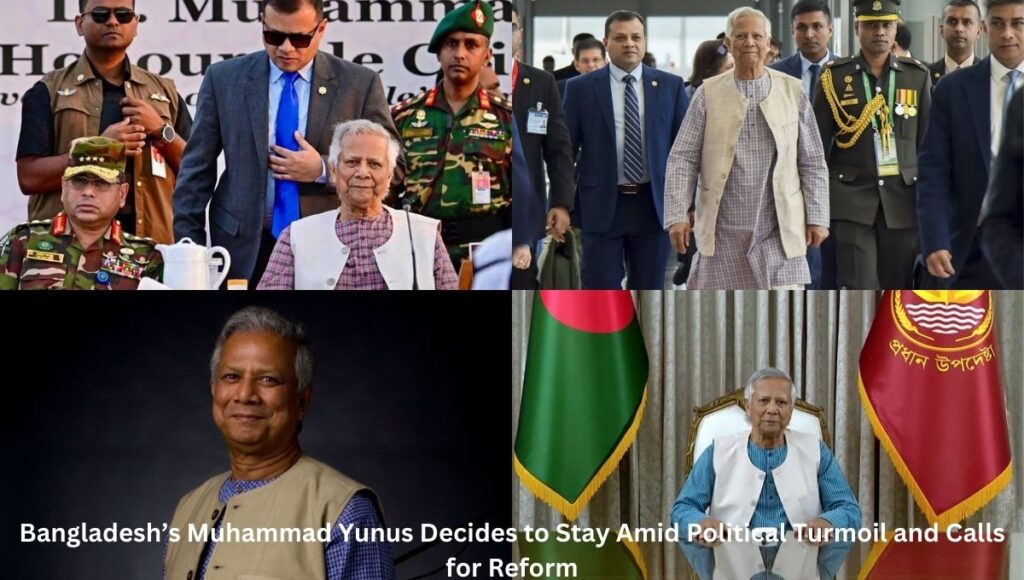
Bangladesh’s Muhammad Yunus Decides to Stay Amid Political Turmoil and Calls for Reform
Interim Chief Adviser Muhammad Yunus Stays Firm
Planning Adviser Wahiduddin Mahmud clarified that Yunus remains fully committed to leading the country through these difficult times.
Yunus’s choice to remain signals his determination to help Bangladesh achieve a peaceful democratic transition, even amid a deeply divided political environment and ongoing unrest.
After Hasina’s exit, Yunus promised major reforms in various sectors, but growing political disagreement and a lack of progress have put his administration in a tight spot.
Political Deadlock and Rising Pressure from Opposition Parties
Since the mass uprising in August 2024 that led to former Prime Minister Sheikh Hasina’s exile, Bangladesh’s political scene has been unstable. The interim government under Yunus was formed with promises of reform and election preparation. However, political parties remain sharply divided on the way forward.
The Bangladesh Nationalist Party (BNP), led by Khaleda Zia, is pushing for elections by December 2025. BNP leaders argue that further delays threaten democracy and political stability. Jamaat-e-Islami and others also demand a clear election plan alongside reforms.
Yunus’s government faces the tough task of balancing electoral demands with the need for political reforms a challenge complicated by resistance from some political factions.
Military’s Call for December Elections Adds Pressure
Adding to the political tensions, Bangladesh’s Army Chief General Waker-Uz-Zaman publicly called for elections by December 2025. He stressed that while the military’s role is to defend national security, civilian law enforcement should be handled by an elected government.
General Waker’s statement reflects growing impatience within the military over the prolonged interim government.
Disagreements between the military and government over policies including humanitarian aid corridors into Myanmar and foreign management of Chattogram Port have also intensified concerns about Bangladesh’s sovereignty.
The Struggle for Reform Amid Growing Public Impatience
Nahid Islam, head of the National Citizen Party (NCP), a student-led political group born from last year’s protests, shared that Yunus is visibly frustrated by political deadlock and competing demands from factions and the public.
Islam pointed out that the uprising was about systemic reform not just leadership change. He warned that holding elections without real reforms would only bring back old problems.
Despite these challenges, Yunus’s advisers encourage him to stay in office, emphasizing the importance of a stable transition. Special adviser Faiz Ahmad Taiyeb dismissed resignation rumors and reaffirmed Yunus’s commitment.
Advisory Council Meeting Reaffirms Yunus’s Leadership
After an unscheduled advisory council meeting, which included 19 advisers acting as ministers, Yunus reassured his team and the public of his commitment to the role.
Planning Adviser Wahiduddin Mahmud confirmed Yunus is “definitely staying” and emphasized the government’s responsibility to the nation amid provocations.
The council discussed three pillars of the interim government: free and fair elections, reforms, and justice. Despite ongoing political disruptions, the government vowed to prioritize the country’s interests over party politics.
Disputes and Uncertainty Over Election Timeline
Yunus has suggested elections might be delayed until mid-2026 to allow time for necessary reforms. This has angered the BNP, which demands elections by December 2025 and wants a caretaker-style government to manage the process.
The BNP has also called for the removal of certain student advisers and security officials they consider partisan. On the other hand, groups like the National Citizen Party and Islamist parties insist reforms must come first to restore trust and prevent future crises.
Civil-Military Relations: A Delicate Balance
Tensions between the interim government and the military remain high. General Waker-Uz-Zaman’s criticisms of some government policies have fueled fears of a “cold war” between the civilian leadership and army, which threatens political stability.
There are reports of a failed attempt by Yunus’s administration to remove the army chief, highlighting serious internal conflicts. Managing this civil-military relationship is a key challenge for Yunus’s government.
Public Mobilization and Political Activism
Yunus still enjoys strong support from students and reform advocates who led last year’s uprising. Supporters have organized campaigns with slogans like “Reforms First, Elections Later” and planned a major rally called “March for Yunus” in Dhaka.
However, critics accuse Yunus of using these protests to justify prolonging his stay, which has increased suspicions among opposition parties and the military.
Challenges Ahead: Reform, Justice, and Unity
Besides elections, Yunus’s government is pushing for justice and accountability. Trials are underway against former Awami League leaders accused of crimes against humanity a sign of the government’s tougher stance.
Reform efforts, such as restructuring the National Board of Revenue, face resistance from entrenched officials, reflecting the difficulties of making systemic changes.
Conclusion: Bangladesh’s Path Forward
Bangladesh is at a critical juncture, with political unrest, civil-military tensions, and pressure for reforms and elections all converging. Muhammad Yunus’s decision to stay as interim chief adviser offers some stability but also places a heavy burden on him to steer the country through this storm.
The coming months will be decisive for Bangladesh’s democratic transition. Will the nation be able to hold free and fair elections, implement long-needed reforms, and restore political stability? Yunus’s leadership will be crucial in shaping this future.
Also Read: Bangladesh Bans Sheikh Hasina’s Awami League Under Anti-Terrorism Act Amid War Crimes Trial
Also Read: Prof Yunus considering resignation: Nahid tells BBC Bangla after meeting CA