8 Shocking Developments in the Pakistan–Afghanistan Conflict After Deadly Kabul Airstrikes, civilian casualties surge. The long-simmering tensions between Pakistan and Afghanistan have escalated dramatically in recent weeks, culminating in overnight airstrikes on Kabul and multiple Afghan provinces. Afghan authorities say the strikes killed civilians and damaged residential areas, while Pakistan maintains the operations targeted militants linked to the Tehreek-e-Taliban Pakistan (TTP).
The latest attacks represent one of the most serious military confrontations between the neighboring countries in years. Cross-border artillery exchanges, airstrikes, drone attacks, and ground clashes have intensified along the nearly 2,600-kilometer border known as the Durand Line.
According to Afghan officials, Pakistani aircraft struck locations in Kabul, Kandahar, Paktia, and Paktika, killing several people and injuring more than a dozen. Pakistan insists the operations were aimed at militant groups responsible for attacks inside its territory.
The situation has quickly evolved into a complex regional crisis involving accusations of terrorism, sovereignty violations, humanitarian consequences, and growing fears of a broader war.
This article examines eight major developments shaping the Pakistan–Afghanistan conflict, from airstrikes and drone retaliation to the humanitarian crisis unfolding along the border.
8 Shocking Developments in the Pakistan–Afghanistan Conflict After Deadly Kabul Airstrikes
Background: Why Pakistan and Afghanistan Are Clashing
The Roots of the Border Dispute
The Pakistan–Afghanistan relationship has been marked by tension for decades, largely centered on the Durand Line, the disputed border drawn during the British colonial period.
Afghanistan historically refused to recognize the Durand Line as a permanent border, arguing that it divided ethnic Pashtun communities across both countries.
Although the dispute has existed for more than a century, recent conflicts are driven primarily by security concerns.
Pakistan accuses the Afghan Taliban government of allowing militant groups to operate from Afghan territory.
Afghan authorities deny these allegations and argue that Pakistan uses the accusations as justification for cross-border attacks.
This unresolved dispute has repeatedly sparked violence along the frontier.
1. Pakistan Launches Airstrikes on Kabul and Afghan Provinces
Overnight Attacks Shake the Afghan Capital
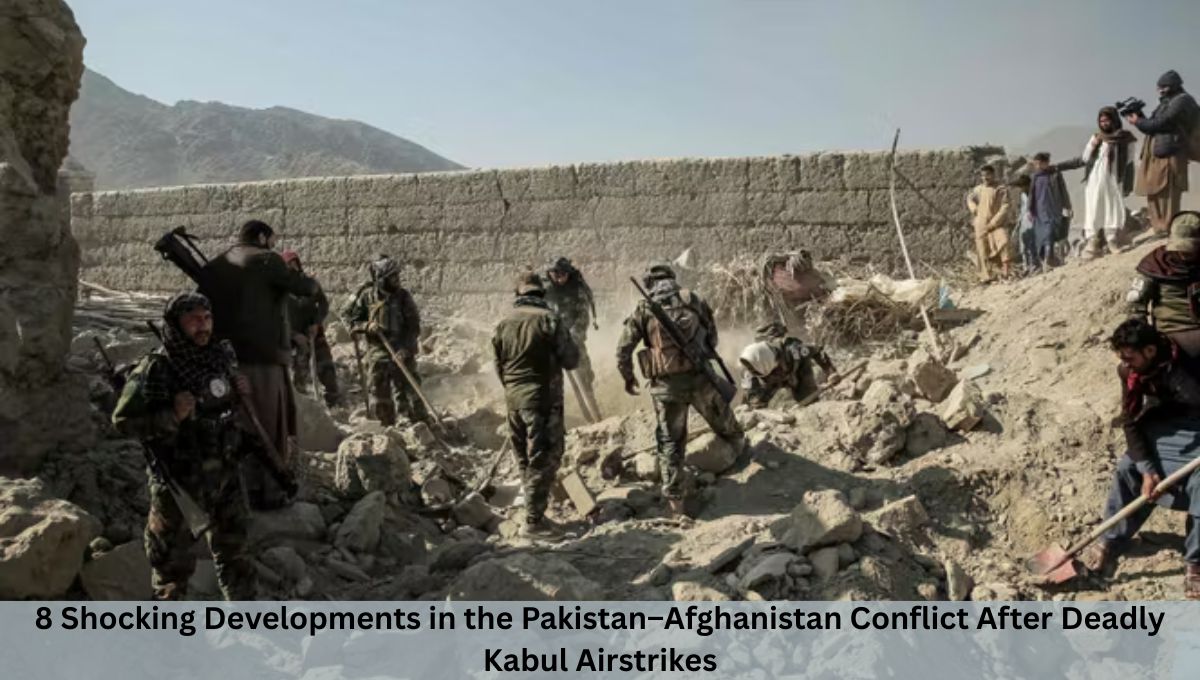
Afghan officials reported that Pakistani aircraft carried out airstrikes in several parts of the country, including the capital Kabul.
Kabul police spokesperson Khalid Zadran confirmed that residential areas were hit, resulting in casualties and property damage.
According to Afghan authorities, at least four people were killed and 15 others injured in the strikes.
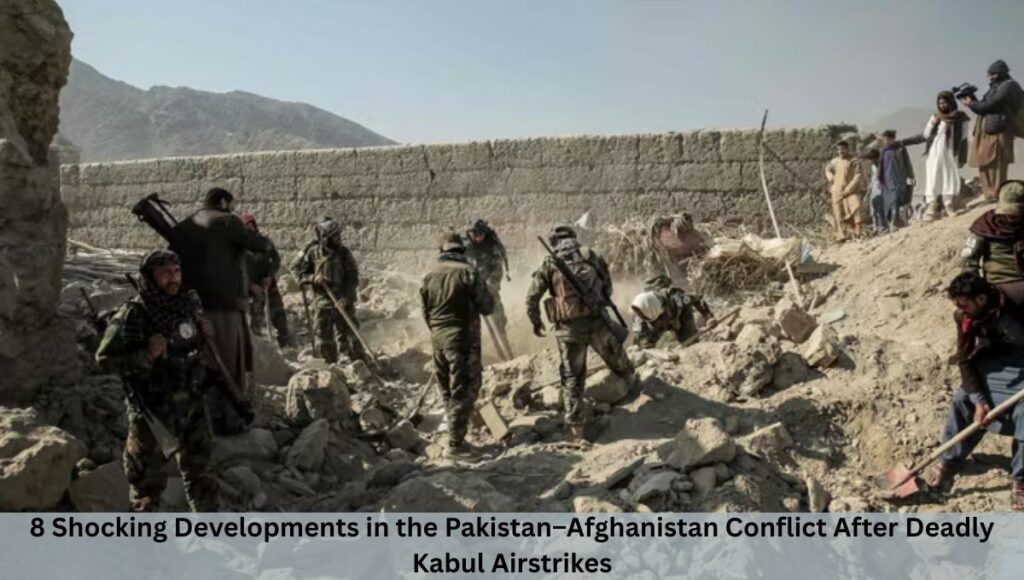
Emergency services responded quickly, transporting the injured to hospitals while rescue teams searched damaged homes for survivors.
Residents described scenes of panic as explosions rocked neighborhoods in the early hours of the morning.
Afghan officials also reported strikes in several other provinces, including:
- Kandahar
- Paktia
- Paktika
These regions lie near the border with Pakistan and have been flashpoints in the ongoing conflict.
2. Pakistan Says Strikes Targeted TTP Militants
Islamabad Frames Operations as Counter-Terrorism
Pakistani officials have defended the airstrikes as part of a broader campaign against the Tehreek-e-Taliban Pakistan (TTP), a militant group responsible for numerous attacks inside Pakistan.
The TTP shares ideological ties with the Afghan Taliban but operates independently.
According to Pakistani security sources, the strikes targeted militant hideouts and infrastructure used by TTP fighters.
Pakistan claims that militants use Afghan territory as a safe haven to plan attacks against Pakistani security forces and civilians.
Officials say the operations were carefully planned to avoid civilian casualties.
However, Afghan authorities strongly dispute these claims, insisting that Pakistan’s actions violate Afghanistan’s sovereignty and harm civilians.
3. Taliban Accuse Pakistan of Killing Civilians
Women and Children Among the Victims
The Taliban government in Afghanistan has condemned the airstrikes, accusing Pakistan of targeting civilian homes and infrastructure.
Taliban spokesperson Zabihullah Mujahid said that women and children were among those killed in the attacks.
Afghan officials also reported that a fuel depot belonging to private airline Kam Air near Kandahar airport was bombed.
The facility reportedly supplies fuel to civilian airlines and United Nations aircraft.
Taliban leaders described the strikes as “aggression” and warned that the attacks would not go unanswered.
Despite these claims, Pakistan maintains that its operations were directed exclusively at militant targets. Independent verification of the casualty figures remains difficult.
4. Cross-Border Fighting Intensifies Along the Durand Line
Ground Clashes Between Forces
The airstrikes are only one part of a wider conflict unfolding along the Pakistan–Afghanistan border.
In recent weeks, Afghan and Pakistani forces have engaged in multiple clashes involving artillery, mortar fire, and small arms.
These confrontations have occurred across several border regions, including:
- Khost
- Paktia
- Kandahar
- Khyber Pakhtunkhwa
Afghan authorities say several civilians have been killed in shelling incidents. Pakistan reports casualties among its own soldiers as well.
The clashes have also disrupted cross-border trade, which many communities depend on for their livelihoods.
5. Taliban Claim Drone Strikes on Pakistani Military Base
Kohat Army Camp Targeted
In a dramatic escalation, the Taliban government claimed responsibility for drone attacks on Pakistan’s Kohat Army Camp in Khyber Pakhtunkhwa.
According to Taliban officials, suicide drones targeted multiple locations within the cantonment area.
Reported targets included:
- Kohat Fort
- Pakistan Air Force facilities
- residential buildings used by military personnel
Pakistani authorities said air defense systems intercepted the drones before they reached their targets.
Debris from the intercepted drones reportedly caused minor injuries among civilians.
The Taliban described the drone strikes as retaliation for Pakistani air attacks inside Afghanistan.
6. Humanitarian Crisis Worsens
Tens of Thousands Displaced
The escalating conflict has created a growing humanitarian crisis along the border.
According to the United Nations refugee agency, approximately 115,000 people have been forced to flee their homes due to fighting.
Entire villages have been evacuated as residents seek safety away from conflict zones.
Displaced families often face severe hardships, including:
- lack of shelter
- limited access to food
- inadequate medical care
Aid organizations warn that the humanitarian situation could deteriorate further if the fighting continues.
7. Civilian Casualties Continue to Rise
UN Reports Dozens of Deaths
The United Nations Assistance Mission in Afghanistan (UNAMA) has documented significant civilian casualties resulting from military operations.
According to UN data, 56 civilians have been killed in Afghanistan between February 26 and March 5 due to Pakistani military actions. Among the victims were 24 children.
The UN has called on both sides to exercise restraint and protect civilians during military operations. However, the conflict continues to escalate despite these appeals.
8. Regional Stability at Risk
Growing Fears of Wider War
The intensifying Pakistan–Afghanistan conflict comes at a time of broader geopolitical instability across the region.
The fighting began shortly before the outbreak of a major conflict involving the United States, Israel, and Iran, raising fears of a wider regional crisis.
Security analysts warn that continued escalation along the Pakistan–Afghanistan border could destabilize South Asia.
Several factors contribute to these concerns:
- cross-border militancy
- ethnic tensions in border regions
- fragile diplomatic relations between Kabul and Islamabad
Without diplomatic intervention, the situation could deteriorate further.
Operation Ghazab lil-Haq and Military Escalation
Pakistan’s military campaign, known as Operation Ghazab lil-Haq, represents one of the most aggressive responses to cross-border militancy in recent years.
The operation was launched after a series of deadly attacks attributed to TTP militants.
Pakistani officials say the campaign has targeted multiple militant camps and infrastructure sites across eastern Afghanistan.
Reports suggest that dozens of militant bases were destroyed during the initial phase of the operation.
However, the strikes also triggered retaliation from Afghan forces, escalating the conflict further.
The Role of Militancy in the Conflict
TTP and Regional Security
The Tehreek-e-Taliban Pakistan remains one of the central issues driving tensions between the two countries.
The group has claimed responsibility for several high-profile attacks inside Pakistan, including bombings targeting security forces.
Pakistan argues that the TTP operates from Afghan territory with the tacit support of local authorities.
The Taliban government denies these allegations and insists it does not allow Afghan soil to be used against other countries.
This disagreement continues to fuel mistrust between the two governments.
Economic Impact of the Conflict
The fighting has disrupted trade routes connecting Pakistan and Afghanistan. Border crossings that once handled significant commercial traffic are now frequently closed due to security concerns.
This disruption affects thousands of traders and transport workers on both sides of the border.
Local economies in border regions are particularly vulnerable. Many communities depend heavily on cross-border trade for their income.
Diplomatic Efforts to De-escalate the Crisis
Mediation Attempts
Several countries and international organizations have called for restraint. China has reportedly engaged in diplomatic efforts to mediate between Islamabad and Kabul.
Regional leaders have urged both sides to pursue dialogue rather than military escalation. However, progress toward de-escalation remains limited.
The Human Cost of the Conflict
Beyond the geopolitical tensions, the conflict has had a devastating impact on ordinary people.
Families have lost homes, livelihoods, and loved ones. Children have been forced to flee their communities and abandon their education.
Humanitarian organizations warn that continued violence could create a long-term displacement crisis in the region.
What Happens Next?
The future of the Pakistan–Afghanistan conflict remains uncertain.
Several scenarios are possible:
- continued cross-border strikes and retaliation
- diplomatic negotiations leading to a ceasefire
- escalation into a larger regional conflict
Much will depend on whether both sides are willing to pursue diplomatic solutions.
Conclusion
The recent airstrikes on Kabul and other Afghan provinces have pushed the Pakistan–Afghanistan conflict into one of its most dangerous phases in years.
What began as targeted operations against militant groups has evolved into a wider confrontation involving airstrikes, drone attacks, and ground clashes along the border.
As accusations and retaliatory actions continue, civilians are paying the heaviest price. Thousands have been displaced, and the risk of further escalation remains high.
For the region—and the international community—the challenge now is to prevent the conflict from spiraling into a broader crisis while addressing the underlying security concerns that continue to drive tensions between Islamabad and Kabul.
Also Read: 7 Shocking Details: 13-Year-Old Executes Man Before 80,000 in Taliban-Ruled Afghanistan
Also Read: Pakistan downs drones near Kohat after Kabul accuses Islamabad of deadly airstrikes
Related Posts:
- Afghanistan–Pakistan War 2025: Inside the 48-Hour Ceasefire

- Pakistan–Afghanistan Border Conflict 2025: Ceasefire…

- Afghanistan–Pakistan Border Clashes 2025: Key Facts…

- 7 Alarming Signs of Escalation as Pak-Afghan…
- Pakistan’s Bold Airstrikes in Kabul: Af-Pak Crisis…

- Pakistan–Afghanistan Conflict: 10 Civilians Killed…