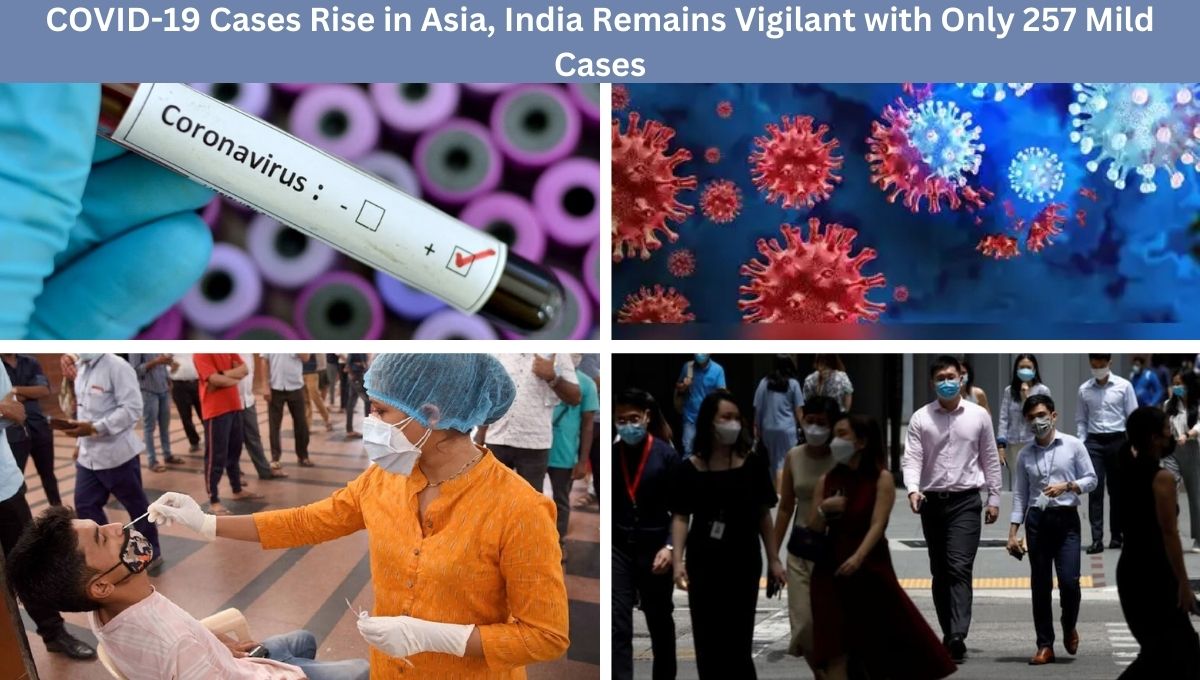
Including Singapore and Hong Kong, COVID-19 Cases Rise in Asia, India Remains Vigilant with Only 257 Mild Cases. As parts of Asia, face a resurgence in COVID-19 cases, India has stepped up vigilance. However, according to the Union Health Ministry, the current COVID-19 situation in India is under control, with only 257 active cases as of May 19, 2025, all classified as mild and not requiring hospitalization.
COVID-19 Cases Rise in Asia, India Remains Vigilant with Only 257 Mild Cases
COVID-19 Surge in Asia Triggers Precautionary Measures in India
The recent uptick in COVID-19 cases in Asia has put health authorities on high alert. Singapore saw its weekly cases rise to over 14,000 in early May, with variants LF.7 and NB.1.8, both descendants of the JN.1 Omicron sublineage, accounting for more than two-thirds of all sequenced cases.
Hong Kong has also reported a “quite high” level of viral activity, according to local health authorities.
In light of these developments, India convened a high-level review meeting including experts from the National Centre for Disease Control (NCDC), Emergency Medical Relief (EMR) division, Disaster Management Cell, Indian Council of Medical Research (ICMR), and top central government hospitals. The meeting was chaired by the Director General of Health Services (DGHS).
India’s Situation: Stable and Mild Cases Only
Despite rising concerns globally, India’s health infrastructure reports only 257 active COVID-19 cases, with the majority found in Kerala (69), Maharashtra (44), and Tamil Nadu (34).
Importantly, almost all cases are mild and do not necessitate hospitalization. Two recent deaths reported in Maharashtra were due to pre-existing illnesses a 59-year-old cancer patient and a 14-year-old with kidney disease though both also tested positive for COVID-19.
An official from the Union Health Ministry emphasized that this number is very low considering India’s vast population.
India continues to monitor the situation under the Integrated Disease Surveillance Programme (IDSP) and ICMR surveillance systems.
No Alarming Variant Behavior Detected Yet
Dr. Raman Gangakhedkar, former ICMR scientist and a leading Indian epidemiologist, reassured the public, stating there is no need for panic unless there is a sharp rise in hospitalizations or mortality.
He explained that the current dominant variants in Asia LF.7 and NB.1.8—are part of the Omicron JN.1 lineage, which shows immune evasion but not increased disease severity.
“These are not new or alarming. We must accept that COVID-19 has become endemic,” Dr. Gangakhedkar said, urging elderly and immunocompromised individuals to continue following basic COVID-appropriate behavior, such as mask-wearing in crowded places and maintaining hand hygiene.
The JN.1 Variant: What You Should Know
First identified in August 2023, the JN.1 variant is a subvariant of Omicron BA.2.86, also known informally as ‘Pirola’. According to Johns Hopkins Medicine, JN.1 has 30 mutations, giving it enhanced immune evasion capabilities.
Preliminary research shows that JN.1 has one additional spike protein mutation, possibly contributing to its greater transmissibility.
Symptoms of the JN.1 variant are similar to previous strains and include:
- Sore throat
- Dry cough
- Fever
- Runny or clogged nose
- Fatigue and exhaustion
- Headache
- Loss of taste or smell
- Diarrhea in some cases
Most mild cases can be managed at home, and serious complications remain rare, especially in vaccinated individuals.
Do We Need a Booster Dose?
The question of COVID-19 booster doses continues to arise with each new surge. However, Dr. Gangakhedkar stated that there is no strong scientific evidence to suggest a need for booster doses at this time, even for the elderly.
India already has an mRNA-based vaccine developed by Gennova Biopharmaceuticals, called GEMCOVAC-19, targeting the Omicron variant. The Health Ministry has indicated that if necessary, vaccine production can be quickly scaled up.
India’s Public Health Infrastructure Under Scrutiny
Amid the uptick in cases, especially in Maharashtra, concerns have been raised about the preparedness of the public health infrastructure.
Reports from Mumbai’s King Edward Memorial Hospital indicate insufficient staffing and resource shortages in primary health centers.
Local volunteers have highlighted that each health worker is covering up to 1,200 homes, often without adequate supplies or seating in health posts.
The Brihanmumbai Municipal Corporation (BMC) has urged residents to stay alert but not panic, stating that hospitals remain well-prepared and that there have been no major outbreaks or clusters.
Experts Warn of Waning Immunity
Health experts have warned that the rise in cases in Asia could be linked to waning antibodies in the population.
Dr. Vikas Maurya of Fortis Shalimar Bagh and Dr. Sandeep Budhiraja of Max Healthcare both suggested that if immunity in India is similarly diminished, a modest spike in cases is possible, though unlikely to cause a severe wave unless accompanied by a more virulent variant.
Dr. Budhiraja noted that it is unusual for respiratory viruses to spike in summer months, suggesting that COVID-19 continues to evolve and exploit weakened immune responses in localized populations.
Government Remains Proactive and Prepared
The Union Health Ministry reiterated its commitment to closely monitor the evolving situation, especially in light of developments in Singapore and Hong Kong.
For now, India has no confirmed spread of the JN.1 variant, but surveillance is ongoing, and authorities are prepared to act swiftly if hospitalization rates increase.
Final Thoughts
While the COVID-19 resurgence in Asia is concerning, India’s current situation remains stable and under control, with no signs of severe disease or hospitalization.
The JN.1 variant is being watched globally, but current evidence suggests it does not pose a major threat in terms of severity.
As COVID-19 transitions into an endemic phase, experts emphasize the importance of maintaining hygiene, staying informed, and not giving in to panic.
Vigilance not fear remains India’s most powerful tool against COVID-19 in 2025.
Also Read: COVID-19 Cases Surge in Hong Kong and Singapore: Health Officials on High Alert
Also Read: Covid-19 cases rising: What’s behind the sudden spike in Asia?