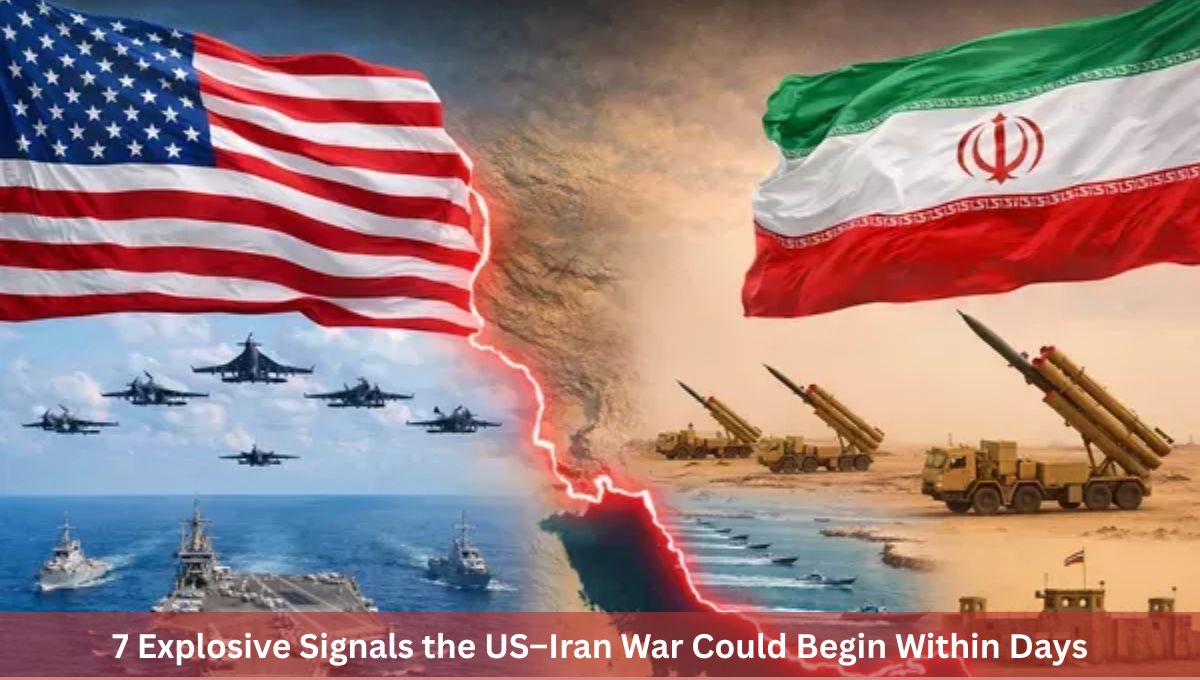
7 Explosive Signals the US–Iran War Could Begin Within Days, last weeks, and reshape the Middle East. The United States and Iran are closer to open war than at any point in years. A massive US military buildup is already in motion.
Thank you for reading this post, don't forget to subscribe!Israeli leaders are openly preparing for conflict. Diplomatic talks in Geneva remain fragile and incomplete. And President Donald Trump, according to multiple sources, is actively weighing whether to authorize military strikes against Iran as early as this weekend. While no final order has been given, the infrastructure of war is now firmly in place.
What happens next could shape global security, energy markets, and the future of the Middle East for years to come.
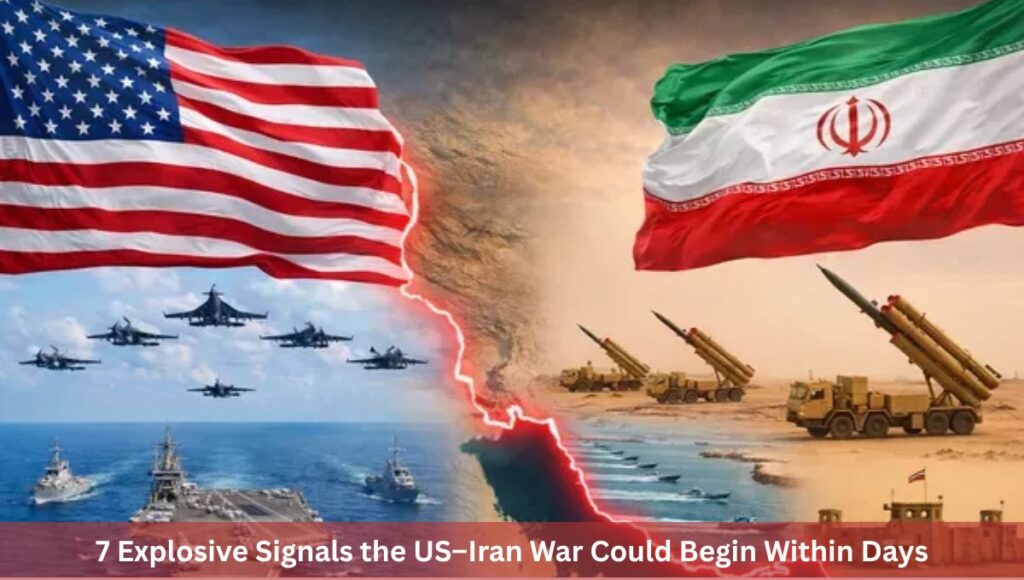
7 Explosive Signals the US–Iran War Could Begin Within Days
1. US Military Ready to Strike Iran at Short Notice
According to US officials cited by multiple American outlets, the White House has been briefed that the US military could execute strikes against Iran within days.
Senior administration officials met in the White House Situation Room to review operational readiness, while Trump has been repeatedly briefed by his national security team.
One official described the president as “spending a lot of time thinking about this,” underscoring the gravity of the decision.
Although Trump has not yet made a final call, the key point is this:
the military no longer needs time — only authorization.
2. A Massive US Military Buildup Is Already Underway
The scale of the American military presence now converging on the Middle East is extraordinary — and historically consistent with preparations for a sustained air campaign.
- 13 US warships currently deployed
- One active aircraft carrier: USS Abraham Lincoln
- The world’s largest aircraft carrier, USS Gerald R. Ford, en route with escort destroyers
- Nuclear submarines and guided-missile destroyers operating quietly under CENTCOM
Having two carrier strike groups in or near the Middle East is rare — and widely viewed by military analysts as a clear deterrent signal, if not a prelude to action.
Airpower Flooding the Region
Open-source flight data confirms the movement of:
- F-22 Raptor stealth fighters
- F-35 Lightning II jets
- F-16 and F-15 strike aircraft
- KC-135 aerial refueling tankers
- E-3 Sentry AWACS surveillance aircraft
- U-2 Dragon Lady reconnaissance platforms
These assets allow the US to conduct deep strikes, air superiority missions, electronic warfare, and missile defense — the essential components of a multi-week campaign.
3. Nuclear Talks Are Progressing — But Not Fast Enough
Even as military forces move into position, diplomacy has not fully collapsed.
Indirect talks between US and Iranian negotiators in Geneva lasted more than three hours. Iran’s lead negotiator described the outcome as agreement on a “set of guiding principles.” American officials, however, stressed that major gaps remain.
The White House has publicly stated that Iran is expected to submit more detailed proposals in the coming weeks — but crucially, officials have not ruled out military action during that window.
Vice President JD Vance acknowledged progress while warning that Iran has yet to accept all US red lines, particularly regarding nuclear weapons capability.
The result: diplomacy exists — but on borrowed time.
4. Israel Is Preparing for War — And Pushing for It
Israeli officials have become increasingly vocal in recent days.
Former Israeli Military Intelligence chief Amos Yadlin warned publicly that Israel may be only days away from conflict, advising Israelis to reconsider travel abroad.
Prime Minister Benjamin Netanyahu has long argued that Iran represents an existential threat to Israel and has pushed Washington toward decisive military action.
Israeli lawmakers have openly discussed civil defense readiness, while security officials describe current conditions as the most dangerous in years.
According to multiple reports, any US strike would likely be coordinated with Israel, potentially making it the largest joint military operation between the two allies in decades.
5. Iran Is Fortifying Nuclear Sites and Signaling Retaliation
Iran is not waiting passively.
Satellite imagery analyzed by international experts shows Iran reinforcing key nuclear facilities with concrete and soil, burying sensitive sites deeper underground in anticipation of airstrikes.
Meanwhile, Iran’s Islamic Revolutionary Guard Corps has:
- Conducted live-fire drills in the Strait of Hormuz
- Temporarily restricted maritime traffic
- Announced joint naval exercises with Russia in the Sea of Oman
Iran’s Supreme Leader Ali Khamenei issued a pointed warning about US warships, hinting at anti-ship capabilities without elaboration.
The message is clear: any attack will be met with retaliation.
6. Timing Windows Are Narrowing Fast
Several calendar factors may influence Trump’s decision — but none appear decisive.
- The Winter Olympics conclude this weekend
- Ramadan has begun, raising sensitivities in Muslim-majority countries
- Trump is set to deliver a major State of the Union address
Despite these considerations, officials emphasize that operational readiness now outweighs symbolism.
The military is positioned. The intelligence picture is fresh. And the political pressure — from Israel, from hawks in Washington, and from stalled negotiations — is intensifying.
7. A US–Iran War Would Not Be Short or Limited
Multiple US and Israeli officials have cautioned against assuming a “quick strike.”
Sources familiar with Pentagon planning say any confrontation would likely be:
- Multi-week in duration
- Focused initially on nuclear, missile, and air-defense targets
- Followed by sustained operations to degrade Iran’s retaliatory capacity
Iran, in turn, could respond by:
- Targeting US bases across the Middle East
- Launching missile or drone strikes against Israel
- Disrupting global energy supplies via the Strait of Hormuz
Roughly 20% of the world’s oil passes through that chokepoint. Even temporary disruption could send shockwaves through global markets.
What Trump Is Weighing Now
President Trump finds himself balancing competing imperatives:
- Preventing Iran from acquiring nuclear weapons
- Avoiding another prolonged Middle East war
- Maintaining US credibility after repeated warnings
- Managing domestic political fallout
Publicly, Trump continues to insist that diplomacy remains his preferred option. Privately, aides say frustration is growing.
As one adviser put it bluntly:
“All options are on the table — and the military option is now real.”
The Bottom Line
The world is approaching a decisive moment.
The US military is ready.
Israel is preparing.
Iran is bracing.
Diplomacy is alive — but fragile.
Whether President Donald Trump chooses war or negotiation in the coming days may determine not only the future of Iran’s nuclear program, but the trajectory of global security in an already volatile era. For now, the final call rests with one man — and the clock is ticking.
Also Read: 9 Explosive Signals Behind the US Carrier Move as Iran Tensions Boil
Also Read: USS Gerald R. Ford will reach Arabian Sea in 4 days; Iran-US war could start by Feb 21: Report
Related Posts:
- 3 Explosive Conditions Iran Sets to End War with US…

- 10 Explosive Warnings as Donald Trump Calls Iran…
- 10 Explosive Signals: Trump Rates Iran War “15/10”…
- 7 Explosive Signs Russia Is Quietly Backing Iran in…
- 10 Powerful Revelations from the Trump–Putin Call on…

- 10 Explosive Signals Trump Says Iran War Could End…