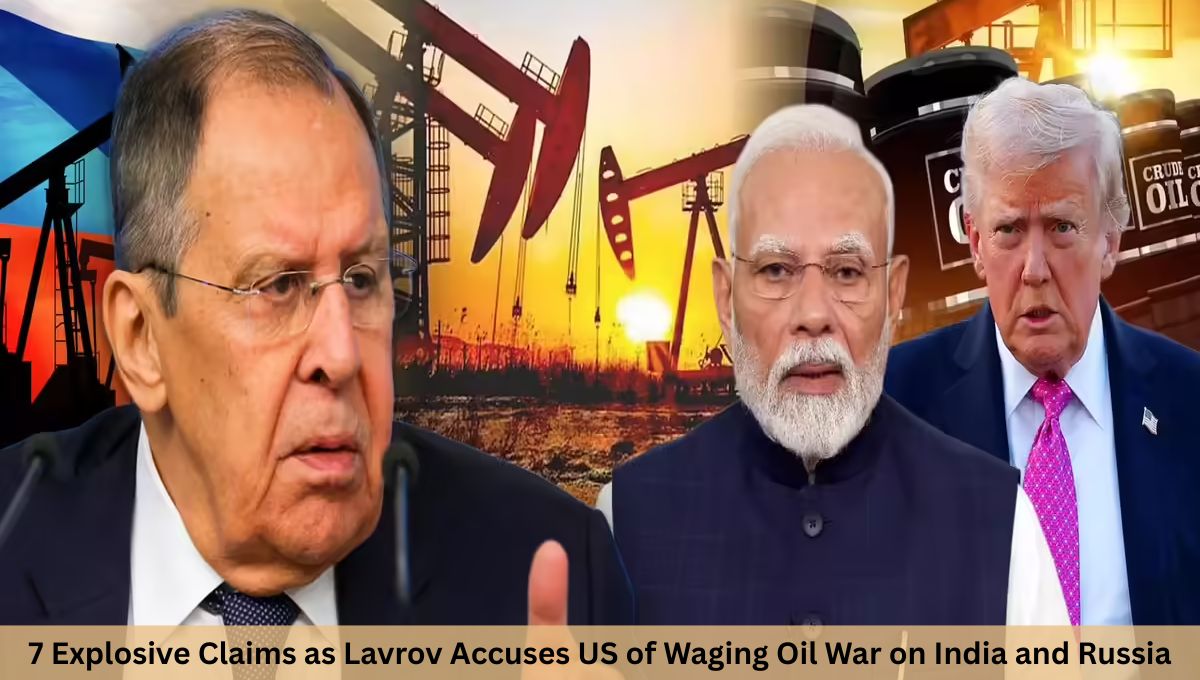
7 Explosive Claims as Lavrov Accuses US of Waging Oil War on India and Russia to pursue global energy dominance.Russian Foreign Minister Sergei Lavrov has launched one of his sharpest critiques yet of the United States, accusing Washington of trying to prevent India and other major economies from purchasing affordable Russian oil.
Speaking in a wide-ranging interview with TV BRICS, Lavrov alleged that the US is using sanctions, tariffs, and even maritime pressure to coerce countries into abandoning Russian energy supplies in favor of costlier American liquefied natural gas (LNG).
Lavrov’s remarks come amid intensifying global debates over energy security, the future of Russia–Ukraine peace negotiations, and the growing role of emerging economies such as India, China, Brazil, and Indonesia in shaping a multipolar world order.
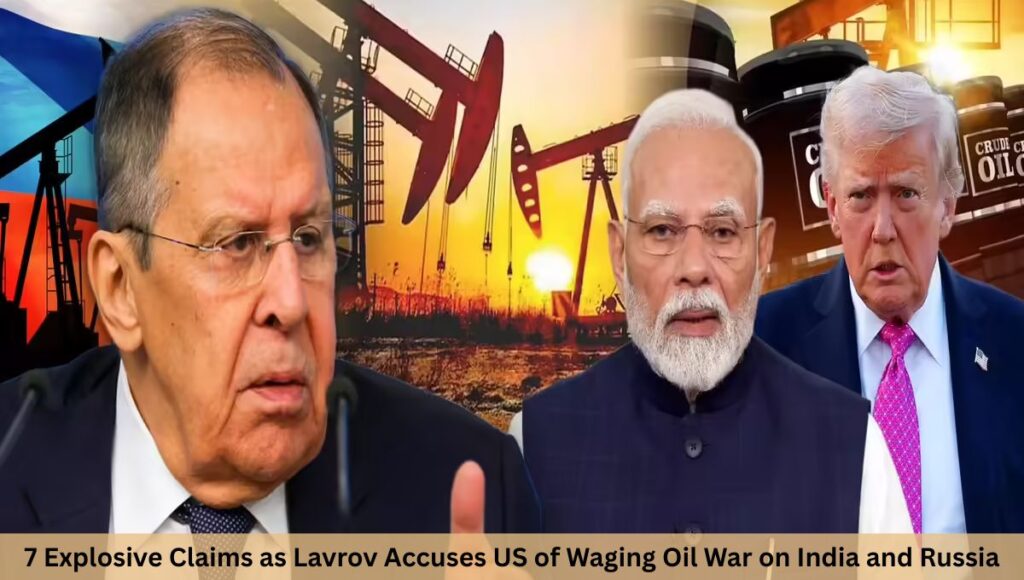
7 Explosive Claims as Lavrov Accuses US of Waging Oil War on India and Russia
‘Trying to Ban India’: Lavrov’s Central Charge
At the heart of Lavrov’s criticism is what he described as a coordinated US effort to block Russian oil exports to key partners.
“New sanctions are being imposed, a war against tankers in the open sea is being waged in violation of the UN Convention on the Law of the Sea,” Lavrov said. “They are trying to ban India and our other partners from buying cheap, affordable Russian energy resources.”
He argued that while Europe has already been effectively barred from purchasing Russian oil and gas, Washington is now extending similar pressure tactics toward Asia, particularly India.
Allegations of a ‘War Against Tankers’
Lavrov accused the United States and its allies of targeting Russia’s so-called shadow fleet of oil tankers, vessels often used to transport crude outside Western insurance and shipping frameworks.
According to the Russian foreign minister, such actions amount to an undeclared maritime conflict that undermines international law and freedom of navigation.
He said tanker seizures and sanctions represent a dangerous escalation that threatens global energy supply chains.
“These actions are incompatible with fair competition and international norms,” Lavrov claimed, framing the measures as part of a broader economic war.
US Push for Global Energy Dominance
Lavrov alleged that Washington has set itself the objective of controlling global energy markets and supply routes.
He accused successive US administrations, including the current Trump administration, of weaponizing the dollar, sanctions, and trade restrictions to maintain economic dominance.
“They are forcing countries to buy US LNG at exorbitant prices,” he said, adding that this strategy prioritizes American commercial interests over global energy stability.
The Russian minister described tariffs, direct prohibitions, and financial restrictions as tools designed to suppress competitors and lock partners into US-centric supply chains.
India’s Strategic Energy Dilemma
India has emerged as one of the largest buyers of discounted Russian crude since the start of the Ukraine war, significantly reshaping global oil flows.
New Delhi has consistently defended its purchases, citing national interest, price stability, and energy security for its population of 1.4 billion.
Foreign Secretary Vikram Misri reiterated this position this week, stating that India’s energy policy is guided by “adequate availability, fair pricing and reliability of supply.”
India has neither confirmed nor denied reports suggesting it may scale back Russian oil imports following recent shifts in US–India trade relations.
US–India Trade Talks and Tariff Rollbacks
Lavrov’s remarks coincide with renewed attention on US–India economic ties.
Recently, US President Donald Trump signed an executive order rolling back an additional 25 percent tariff imposed on Indian goods, reducing overall tariffs to around 18 percent following an interim trade deal.
Some analysts have speculated that energy considerations may have played a role in the negotiations, though Indian officials have firmly denied any linkage between trade concessions and oil import decisions.
Commerce Minister Piyush Goyal has emphasized that decisions on Russian oil purchases are made by Indian companies based on commercial considerations, not political directives.
Russia Claims US Backtracked on Ukraine Peace Proposals
Beyond energy, Lavrov accused Washington of reneging on alleged understandings reached during high-level talks in Anchorage, Alaska, last year.
“They made an offer, we agreed, and the problem should have been resolved. And now they are not ready,” Lavrov said, referring to what he described as a US proposal on resolving the Ukraine conflict.
The White House has not confirmed the existence of any such agreement, and US officials have denied forcing territorial concessions on Ukraine.
Ukraine, Donbas, and the Stalemate
Territorial issues remain the central obstacle in negotiations to end the war in Ukraine.
Russia continues to demand Ukrainian withdrawal from the Donbas region, while Kyiv has ruled out surrendering territory.
The United States has floated alternative ideas, including demilitarized zones and economic reconstruction frameworks, but no breakthrough has been achieved.
Lavrov argued that continued sanctions and energy restrictions contradict Washington’s stated desire to end the war.
BRICS, Multipolarity, and Alternative Systems
Lavrov framed the dispute within a broader geopolitical shift toward multipolarity.
He said BRICS countries are increasingly developing alternative payment systems, trade settlements in national currencies, and new financial mechanisms to reduce dependence on Western institutions.
India’s upcoming BRICS chairmanship in 2026, he noted, aligns with priorities such as energy security, counterterrorism, and technology cooperation.
“These measures are not provocations,” Lavrov said. “They are safeguards against external pressure.”
Shadow Fleets and Sanctions Enforcement
Western governments argue that sanctions on Russian oil are necessary to reduce Moscow’s ability to finance its war effort.
US officials maintain that actions against tanker fleets target sanctions evasion, not lawful trade.
Critics, however, warn that aggressive enforcement risks destabilizing global shipping lanes and increasing volatility in energy markets.
India’s Balancing Act Between Washington and Moscow
India’s position highlights the complexity facing major emerging economies caught between rival power blocs.
While New Delhi has deepened strategic ties with Washington, it has also preserved longstanding energy and defense links with Moscow.
Officials in New Delhi have consistently stressed strategic autonomy, rejecting what they see as binary choices imposed by great power rivalries.
Global Implications of Energy Weaponization
Lavrov’s accusations underscore a wider debate over the weaponization of trade, finance, and energy.
Analysts say the growing use of sanctions could accelerate fragmentation in global markets, pushing countries to seek alternative supply chains and financial systems.
For energy-importing nations, affordability and reliability remain paramount, particularly amid inflationary pressures and economic uncertainty.
What Comes Next
With diplomatic activity intensifying around Ukraine and US–Russia relations, energy is likely to remain a central flashpoint. Decisions by major buyers such as India will have far-reaching consequences for global oil markets and geopolitical alignments.
Lavrov insisted that Russia remains open to cooperation, including with the United States, but warned that “artificial obstacles” created by Washington risk deepening divisions.
As the world navigates an era of heightened geopolitical competition, the intersection of energy security, trade policy, and diplomacy is set to shape global stability for years to come.
Also Read: Lavrov’s USSR Sweatshirt Sparks Controversy at Trump-Putin Alaska Summit