9 Explosive Warnings as Hezbollah Backs Iran Against Trump Threats, raising fears of a wider Middle East conflict. The risk of a broader Middle East conflict has intensified after Hezbollah leader Naim Qassem declared that threats by US President Donald Trump against Iran’s Supreme Leader Ayatollah Ali Khamenei constitute a direct threat to the Lebanese militant group itself.
Speaking at rallies held across Hezbollah strongholds, Qassem warned that any war on Iran would “ignite the region” and vowed to confront what he described as an existential challenge to the so-called Axis of Resistance.
The remarks come amid a growing US military buildup in the Gulf, renewed warnings from Iranian-backed militias in Iraq, and persistent Israeli strikes in Lebanon, raising fears that the region may be edging toward a multi-front confrontation.
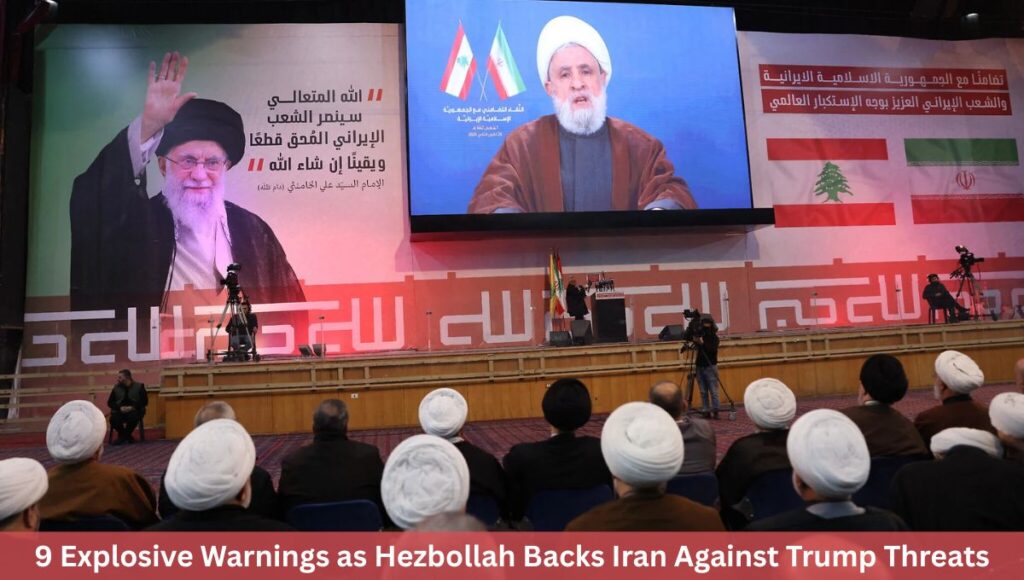
9 Explosive Warnings as Hezbollah Backs Iran Against Trump Threats
“A War on Iran Will Ignite the Region”
Addressing supporters during solidarity rallies held across Lebanon, Qassem framed Trump’s rhetoric as a turning point. He said Hezbollah and Iran were facing an aggression that made no distinction between allies.
“A war on Iran this time will ignite the region,” Qassem warned, adding that Hezbollah would not remain neutral if Tehran were attacked.
While stopping short of announcing immediate military action against Israel, Qassem made clear that Hezbollah reserves the right to respond based on evolving battlefield conditions.
“We will choose at that time how to act based on the conditions of the battle… but we are not neutral,” he said.
Trump’s Threats and the Khamenei Factor
Tensions escalated after Trump publicly suggested that Iran’s leadership could be targeted, marking the first time he appeared to call for the removal of Ayatollah Khamenei.
Last week, the US president announced that a US “armada” was heading toward the Persian Gulf, citing Iran’s violent crackdown on anti-government protesters.
Although Trump initially appeared to step back from direct military intervention, he later insisted that force remained an option and said Washington was watching Iran “very closely.”
“We have a lot of ships going that direction, just in case,” Trump said. “And maybe we won’t have to use it.”
Hezbollah Frames Threat as Religious and Existential
Qassem went beyond geopolitical language, framing the threat to Khamenei in religious terms. He said Khamenei’s supporters view him as the “deputy of the infallible” Imam Mehdi, a messianic figure in Shiite Islam.
“When Trump threatens Imam Khamenei, he threatens tens of millions who follow his leadership,” Qassem said. “It is our duty to confront this threat by any means.”
He added that Hezbollah considers any attempt to assassinate Khamenei as an “assassination of stability in the region and the world.”
Mediators Warn Hezbollah of Possible Strikes
Qassem revealed that intermediaries had delivered a “clear and explicit question” to Hezbollah in recent months:
whether the group would intervene if the United States and Israel went to war with Iran.
According to Qassem, the mediators raised scenarios in which Hezbollah could be targeted either before or during an attack on Iran.
“We are the targets of potential aggression,” he said. “We have full authority to take whatever measures we deem appropriate.”
Despite these warnings, Qassem did not issue a direct pledge to attack Israel, reflecting Hezbollah’s weakened position following months of conflict and a November 2024 ceasefire.
Rallies Across Lebanon Signal Mobilisation
Amid Trump’s threats, Hezbollah called on supporters to gather in its strongholds across Lebanon.
Demonstrators in Beirut’s southern suburbs carried portraits of Khamenei, waved Hezbollah and Iranian flags, and chanted anti-American slogans, including “death to America.”
The rallies were framed as expressions of solidarity with Iran “in the face of American-Zionist sabotage and threats,” according to Hezbollah statements.
Qassem blamed the violence seen during Iranian protests on “infiltrators” planted by enemies of the Islamic Republic.
Iraqi Militia Warns of ‘Total War’
The rhetoric escalated further after Kataib Hezbollah, one of Iraq’s most powerful Iran-backed militias, warned of “total war” if Iran is attacked.
The group’s leader, Abu Hussein al-Hamidawi, issued a statement late Sunday calling on fighters to prepare for conflict and describing Iran as the “fortress and pride” of Muslims.
“War against the Islamic Republic will not be a walk in the park,” he said. “You will taste the bitterest forms of death.”
Unlike previous confrontations, al-Hamidawi suggested that Iran’s regional allies would not remain on the sidelines if conflict erupts again.
Axis of Resistance Signals a Shift
When Israel and the US struck Iran in June last year, the Axis of Resistance—including Hezbollah and Iraqi armed groups—largely refrained from direct intervention. Al-Hamidawi indicated that this restraint may not hold this time.
“The necessity of supporting it from the forces of the axis and assisting it in whatever way they can,” he said, emphasising readiness for escalation.
Kataib Hezbollah remains a major component of Iraq’s Popular Mobilisation Forces (PMF), a powerful umbrella of militias formed in 2014 to counter ISIL. Its statements carry significant weight within Iraq’s security landscape.
US Pressures Iraq to Distance Itself from Iran
As militias escalate their rhetoric, Washington has intensified diplomatic efforts to prevent Iraq from being drawn into a wider conflict.
In a phone call with Iraqi Prime Minister Mohammed Shia al-Sudani, US Secretary of State Marco Rubio urged Baghdad to keep its distance from Iran.
“A government controlled by Iran cannot successfully put Iraq’s own interests first,” Rubio said, according to the US State Department.
The call came amid reports that former prime minister Nouri al-Maliki could return to power more than a decade after leaving office, raising concerns in Washington over Baghdad’s political direction.
Israel-Hezbollah Front Remains Volatile
Despite a ceasefire reached in November 2024, Israel has continued regular strikes on what it describes as Hezbollah targets in southern Lebanon and the Beqaa Valley.
On Monday, Lebanon’s health ministry reported three deaths from Israeli strikes, including one in the southern city of Tyre. Hezbollah’s Al-Manar television said the strike killed Sheikh Ali Noureddine, a religious figure and former presenter at the channel.
Hezbollah described his killing as a “treacherous assassination,” while Israel accused Noureddine of serving as an artillery squad leader for the group.
Lebanese Information Minister Paul Morcos condemned the strike, saying Israeli attacks “do not spare press and media personnel.”
Religious Language Raises Alarm
In a separate statement dated January 25, Kataib Hezbollah’s leader used religious language calling for mobilisation and readiness for what he described as a “holy war” should religious authorities declare jihad.
The statement referenced “martyrdom operations,” language widely associated with suicide attacks, drawing concern from regional analysts monitoring escalation risks.
Such rhetoric underscores fears that ideological mobilisation could translate into coordinated military action across multiple fronts.
Airspace Disruptions and Regional Anxiety
As tensions rise, airlines have begun suspending flights across parts of the Middle East, including routes to Israel, citing security concerns.
Iran has pledged to defend itself against any attack. Foreign Ministry spokesperson Esmaeil Baghaei said Iran’s armed forces would respond firmly to any violation of sovereignty.
“Iran is doing everything it can diplomatically,” Baghaei said, “but will respond firmly.”
A Region on the Brink
With US warships moving into position, militant groups issuing open threats, and diplomatic channels under strain, the Middle East faces one of its most volatile moments in years.
While no side has formally declared war, the language used by Hezbollah, Iraqi militias, and Washington suggests that miscalculation could rapidly spiral into a wider confrontation.
For now, all sides appear to be testing red lines—yet the warnings from Hezbollah and its allies make clear that any direct strike on Iran could trigger consequences far beyond its borders.
Also Read: 9 Explosive Signals Behind the US Carrier Move as Iran Tensions Boil
Also Read: Iran-backed militias in Iraq and Yemen threaten new attacks as U.S. carrier approaches region
Related Posts:
- 11 Explosive Warnings as Trump Vows to ‘Knock the…

- 10 Explosive Warnings as Donald Trump Calls Iran…
- 10 Explosive Signals Trump Says Iran War Could End…
- 12 Explosive Claims as Donald Trump Says Iran War…
- 10 Explosive Signals: Trump Rates Iran War “15/10”…
- 9 Explosive Claims: Trump Says Iran ‘Knocked Out’ as…