

11 Defiant Signals as Venezuela’s Interim Leader Pushes Back on US Pressure after Maduro’s capture. Venezuela’s interim president Delcy Rodríguez has delivered her clearest public rebuke yet of Washington’s influence, declaring she has had “enough” of US orders nearly a month after assuming power following the capture of former president Nicolás Maduro by American forces.
Her comments underscore the fragile balance she is attempting to strike between asserting Venezuelan sovereignty and maintaining US backing that underpins her interim government.
Speaking to oil workers in the eastern city of Puerto La Cruz, Rodríguez said Venezuela’s internal political disputes must be resolved domestically, without foreign dictates.
“Enough already of Washington’s orders over politicians in Venezuela,” Rodríguez said in remarks broadcast by state television. “Let Venezuelan politics resolve our differences and our internal conflicts.”
The statement marked a rare moment of public defiance from a leader whose authority depends in large part on US recognition and support.
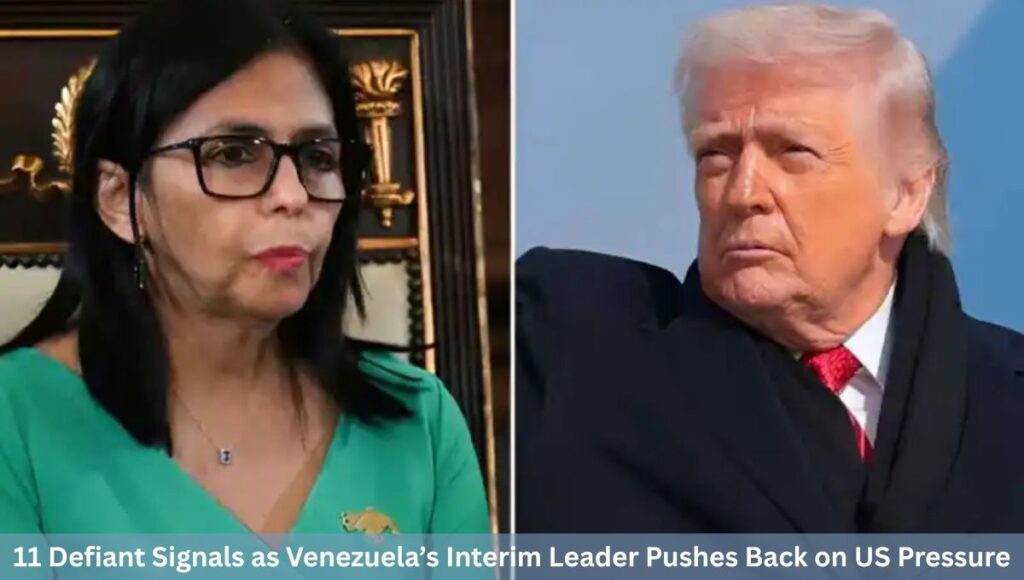
11 Defiant Signals as Venezuela’s Interim Leader Pushes Back on US Pressure
A Tightrope Between Sovereignty and Survival
Since being sworn in as interim president after the US capture of Maduro and his wife Cilia Flores in early January, Rodríguez has walked a political tightrope.
Backed by Washington as a stabilising figure, she has also had to maintain the loyalty of a fractured ruling coalition at home that includes Maduro loyalists, hard-line chavistas, and left-wing factions deeply suspicious of US intentions.
Rodríguez has repeatedly insisted that Venezuela is not governed by foreign powers—even as her government engages in delicate negotiations with the Trump administration over oil, diplomacy, and political reforms.
“The people of Venezuela have a government, and this government obeys the people,” she said. “We do not accept orders from any external power.”
Washington’s Demands After Maduro’s Capture
The Trump administration has applied steady pressure on Caracas since the dramatic US raid that led to Maduro’s arrest and transfer to New York, where he faces federal drug trafficking charges.
According to senior US officials, Washington has laid out a series of conditions for continued support, including:
- Resuming large-scale oil production
- Prioritising US companies in future oil sales
- Cutting ties with China, Iran, Russia, and Cuba
- Releasing political prisoners
- Preparing for elections under US-defined conditions
Rodríguez has publicly resisted the framing of these demands as directives, while quietly taking steps that align with many of Washington’s expectations.
Oil at the Heart of the Power Struggle
Oil remains Venezuela’s most valuable leverage. The country holds the world’s largest reserves of extra-heavy crude—difficult and costly to refine, but ideally suited to US refineries.
Since taking office, Rodríguez has authorised the sale of between 30 million and 50 million barrels of oil to the United States and opened discussions on reforming Venezuela’s Hydrocarbons Law to attract foreign investment.
Executives from companies including Chevron, Repsol, and Shell attended meetings with Rodríguez this week, signalling renewed international interest in Venezuela’s energy sector after years of sanctions and mismanagement.
Public Defiance, Private Cooperation
Rodríguez’s nationalist rhetoric has played well with sceptical chavista supporters, many of whom fear she could become a US proxy.
Social media platforms have been flooded with accusations that she betrayed Maduro or played a role in an internal conspiracy leading to his capture.
At the same time, US officials say cooperation behind the scenes has been constructive. Trump himself has praised Rodríguez, calling her a “terrific person” and saying relations with Venezuela are “very good.”
“I think we’re getting along very well with Venezuela,” Trump said after a recent phone call with Rodríguez.
Trump Plays Down Tensions
Asked about Rodríguez’s comments rejecting US orders, Trump claimed he was unaware of the remarks.
“Well, I don’t know exactly what’s going on there,” he told reporters at the White House. “But I haven’t heard that at all.”
The White House has continued to project confidence in Rodríguez’s leadership, even as US intelligence agencies express doubts about her willingness to fully sever ties with America’s geopolitical rivals.
US Intelligence Raises Red Flags
According to US intelligence reports cited by sources familiar with the assessments, there are growing doubts about whether Rodríguez will comply with Washington’s demand to cut relations with Iran, China, and Russia.
Her swearing-in ceremony was attended by representatives of those countries, and she has yet to announce any expulsions of diplomats or advisers.
CIA Director John Ratcliffe travelled to Caracas on January 15 to discuss Venezuela’s political future, though officials have not disclosed whether the talks altered intelligence assessments.
Abandoning Longtime Allies Comes at a Cost
For Venezuela, breaking ties with traditional partners would carry significant economic and security consequences:
- China has accepted oil as repayment for billions in loans
- Iran has helped repair Venezuela’s aging refineries
- Russia has supplied weapons and military support
- Cuba has provided intelligence and security assistance
Critics of Trump’s Venezuela strategy argue that demanding an abrupt geopolitical realignment risks destabilising an already fragile transition.
Political Prisoners and a Humanitarian Gesture
One area where Rodríguez has aligned closely with US expectations is the release of political prisoners.
Human rights group Foro Penal reported that at least 104 detainees were freed on Sunday alone, bringing the total number of releases since January 8 to at least 266.
Interior Minister Diosdado Cabello claimed the number was higher, saying 808 people had been released since December.
Trump welcomed the releases, calling them a “powerful humanitarian gesture” and suggesting the pace would increase.
Disputes Over Transparency Remain
Despite the releases, activists and opposition figures have criticised the government for failing to publish a full list of freed detainees.
Authorities have denied holding political prisoners, a claim disputed by human rights organisations that estimate more than 1,000 people were jailed for political reasons before the recent releases.
Rodríguez has said Venezuela would welcome a visit from UN High Commissioner for Human Rights Volker Türk to verify the process.
Opposition Watches from the Sidelines
Venezuela’s fractured opposition remains uncertain about its role in the post-Maduro era.
Trump has said he would like opposition leader María Corina Machado “involved” in the country’s leadership.
Machado, who remains popular with many Venezuelans, met Trump at the White House earlier this month and presented him with her Nobel Peace Prize.
US intelligence assessments suggest Machado lacks strong ties to the military and oil sectors, limiting her immediate viability as a governing figure.
She is reportedly viewed by Washington as a longer-term option, possibly in an advisory role.
Allegations of Secret Assurances
Tensions intensified after media reports claimed Rodríguez and her brother, National Assembly President Jorge Rodríguez, privately assured US and Qatari officials they would cooperate with Washington following Maduro’s removal.
The Venezuelan government dismissed the reports as “fake,” posting images of headlines stamped with a red “fake” label without addressing the substance of the claims.
Sources cited in the reports said Rodríguez stopped short of actively assisting the US raid, but signalled she would manage the aftermath.
A Nation Still in Shock
Rodríguez has repeatedly referred to the US military operation on January 3 as unprecedented, saying Venezuela never imagined a South American capital would be attacked by a foreign power.
Following the strikes, Venezuela declared a state of emergency. Trump later confirmed the operation and said Washington would “run” Venezuela during the transition—a remark he later softened.
National Unity as a Survival Strategy
In recent speeches, Rodríguez has emphasised reconciliation and dialogue, urging Venezuelans to put aside political differences in the interest of peace and stability.
“There can be no political or partisan differences when it comes to peace in Venezuela,” she said.
She has appealed for talks with opposition groups, even as her government consolidates control with US backing.
A Fragile Truce with Washington
For now, Washington appears committed to working with Rodríguez, despite lingering doubts. US officials say there is no immediate alternative capable of governing Venezuela without risking chaos.
At the same time, contacts are reportedly being developed with senior military and security officials as contingency plans.
What Comes Next for Venezuela
Rodríguez’s defiant words reflect both domestic pressure and geopolitical reality.
Her interim presidency depends on maintaining a delicate equilibrium:
- Appeasing a nationalist base hostile to US influence
- Delivering reforms demanded by Washington
- Preventing internal fractures within chavismo
- Stabilising an economy battered by years of crisis
Whether she can sustain this balance remains uncertain. What is clear is that Venezuela’s future is being shaped not just in Caracas, but in Washington—and Rodríguez is determined, at least publicly, to remind both audiences where she believes authority ultimately lies.
Also Read: 11 Explosive Claims as Trump Calls Himself Acting President of Venezuela
Also Read: Venezuela frees more than 100 political prisoners as interim president pushes back on US pressure
Related Posts:
- 11 Explosive Revelations From Ted Cruz’s Leaked…
- 7 Explosive Demands Trump Is Making of Venezuela’s…

- 7 Critical Shifts as Trump Rejects Maduro’s Demands…
- Trump Considers Military Strikes on Venezuelan Drug…

- 9 Explosive Signals as Trump Warns Maduro and U.S.…

- 9 Explosive Signals as Trump Targets Cuba’s Oil…
