7 Shocking Strikes That Expose Gaza Ceasefire Fragility and worsening humanitarian crisis.Israeli airstrikes across the Gaza Strip have killed at least 11 Palestinians in a single day, according to medical officials, following what the Israel Defense Forces (IDF) described as a failed rocket launch from Gaza City.
The incidents, unfolding despite an October ceasefire meant to halt large-scale hostilities, have once again underscored the fragility of the truce and the deep mistrust between Israel and Hamas. The strikes hit multiple locations across Gaza — from Khan Younis in the south to Jabalia in the north — including tents sheltering displaced families and a school housing civilians.
While Israel says the attacks were a direct response to militant activity, Palestinian officials and humanitarian groups argue they represent continued violations of the ceasefire and exacerbate an already dire humanitarian situation.
What follows is a detailed account of the latest violence, the competing narratives surrounding the failed rocket launch, the stalled ceasefire process, and the growing humanitarian and diplomatic consequences.
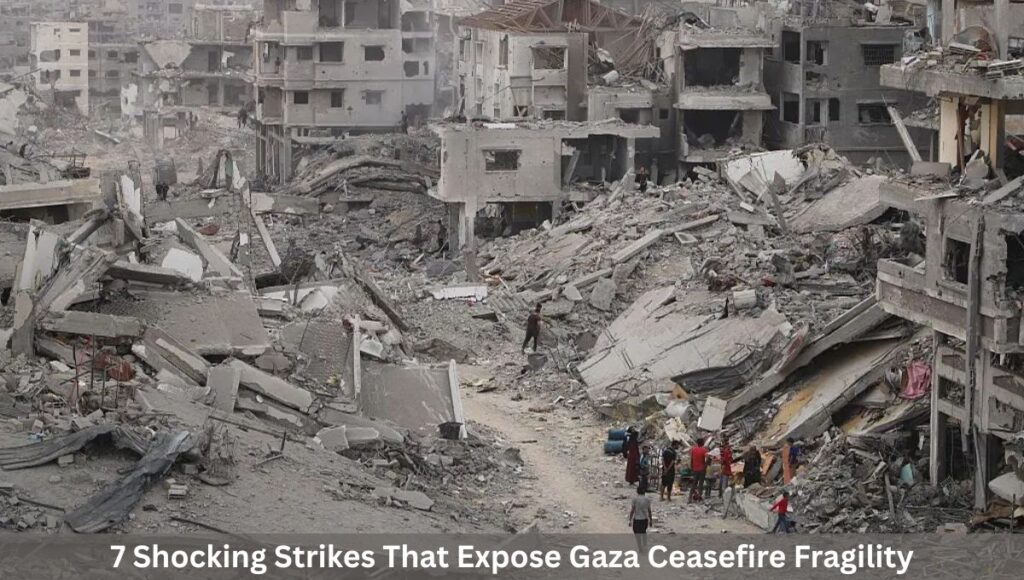
7 Shocking Strikes That Expose Gaza Ceasefire Fragility
Civilians Killed in Khan Younis, Jabalia, Gaza City
Deadly Strikes on Tents and Shelters
According to Gaza-based medical sources, one of the deadliest incidents occurred in western Khan Younis, where an Israeli airstrike hit a tent sheltering displaced people. At least four Palestinians were killed, and three others wounded, including children.
The area is part of al-Mawasi, which had been designated as a relatively safer zone after Israeli troop withdrawals.
Another strike east of Khan Younis killed one person near areas where Israeli forces continue to operate. Later in the day, additional attacks were reported across the Strip.
In northern Gaza, a man was killed when an Israeli strike hit a school in Jabalia that was sheltering displaced families. Elsewhere, a tent near Deir al-Balah in central Gaza was struck, killing another civilian. Four more Palestinians were killed in a separate attack in the Zeitoun neighborhood of Gaza City.
Medical officials said many of the victims were civilians with no immediate connection to militant activity, a claim that Israel disputes.
Israeli Military Response to Failed Rocket Launch
IDF Says Rocket Fell Short Inside Gaza
The Israeli military said the strikes followed the detection of a rocket launched from Gaza City toward Israeli territory. According to the IDF, the projectile failed shortly after launch and fell inside Gaza, landing near a hospital.
“In a rapid closure of the loop, we precisely struck the launch point,” the military said, adding that it had targeted Hamas militants, rocket launch pits, and what it described as “terror infrastructure.”
The IDF accused Hamas of violating the ceasefire and said it views any attempt by militant groups in Gaza to attack Israel “with utmost severity.”
A source within Hamas told Reuters the group was investigating Israel’s claims regarding the rocket launch. No Palestinian faction has formally claimed responsibility for the attempted attack.
Conflicting Casualty Figures and Media Accounts
Different news agencies reported varying casualty figures from Thursday’s violence. Reuters cited at least 11 Palestinians killed, while Al Jazeera reported at least 14 deaths, including five children.
Hamas-run civil defense authorities later said seven people had been killed in separate Israeli attacks.
The discrepancies highlight the difficulty of independently verifying information in Gaza, where access remains severely restricted and infrastructure has been devastated by months of war.
Despite differing numbers, all accounts agree that civilians, including children, were among the dead.
An 11-Year-Old Girl Killed in Jabalia
One of the most harrowing incidents involved the killing of an 11-year-old girl, identified by relatives as Hamsa Housou, in Jabalia.
According to her uncle, Khamis Housou, the family was asleep when Israeli fire struck their building.
“I woke up to screaming,” he told reporters. “I saw Hamsa lying on the floor and blood coming out of her nose and mouth.”
Such personal accounts have fueled anger and despair among Gaza’s population, where nearly all residents have been displaced at least once since the war began.
Ceasefire That Never Moved Beyond Phase One
October Agreement Stalls
The ceasefire agreed in October was designed as a multi-phase process. Under the first phase, major fighting stopped, Israel withdrew from parts of Gaza, and Hamas released Israeli hostages in exchange for Palestinian detainees and convicted prisoners.
However, the agreement has failed to progress beyond this initial stage.
Under later phases — still not finalized — U.S. President Donald Trump’s plan envisages Hamas disarming, Israel withdrawing further, and an internationally backed administration overseeing Gaza’s reconstruction.
None of these steps have been implemented.
Hostage Issue Blocks Further Progress
Israel is awaiting the handover of the final Israeli hostage body due under the first phase of the truce. An Israeli official close to Prime Minister Benjamin Netanyahu has said Israel will not move to the next phase until Hamas returns the remains.
The unresolved hostage issue has also delayed the opening of the Rafah crossing between Gaza and Egypt, another key condition of the U.S.-backed plan. Israel says it will open the crossing only after the remains are returned.
Hamas, for its part, has accused Israel of using the issue as leverage to avoid making further concessions.
Hundreds Killed Since Ceasefire Took Effect
Despite the truce, violence has continued at a lower but persistent level. More than 400 Palestinians and three Israeli soldiers have been reported killed since the ceasefire began, according to multiple sources.
Nearly all of Gaza’s more than two million residents now live in makeshift shelters or damaged buildings, concentrated in a narrow strip of territory from which Israeli troops have partially withdrawn and where Hamas has reasserted control.
Humanitarian agencies warn that even limited military activity has devastating consequences in such densely populated conditions.
Hamas Accuses Israel of Over 1,100 Violations
A Hamas official told Reuters that the group has documented more than 1,100 Israeli violations of the ceasefire since October.
These allegedly include killings, injuries, artillery fire, airstrikes, home demolitions, and detentions.
The official said Hamas has repeatedly urged international mediators to intervene but has seen little tangible progress.
Israel rejects the accusations, saying its actions are defensive and targeted responses to militant threats.
Israel Warns of Renewed War if Hamas Refuses to Disarm
Israel has made clear that it considers Hamas’s disarmament non-negotiable. Israeli officials have warned that military action will resume if Hamas does not give up its weapons peacefully.
Hamas has categorically refused to disarm, arguing that it has the right to resist occupation and that disarmament without a political settlement would leave Gaza defenseless.
This fundamental disagreement remains the biggest obstacle to moving the ceasefire forward.
Humanitarian Crisis Deepens Across Gaza
Aid Restrictions and NGO Bans
As fighting continues, Gaza’s humanitarian situation is deteriorating rapidly. Israel has moved to restrict or ban dozens of international aid organizations from operating in the Strip.
At least 37 NGOs have had their operating licenses revoked under new Israeli regulations requiring detailed disclosure of staff, funding, and operational information. Aid groups say the requirements contravene humanitarian principles and endanger staff.
Doctors Without Borders (MSF), Medecins du Monde Suisse, and the Danish Refugee Council reported that Israeli authorities recently refused entry to their international staff, forcing some organizations to scale back or halt services.
UNRWA Faces Severe Funding Crisis
The United Nations Relief and Works Agency for Palestine Refugees (UNRWA) announced it was laying off hundreds of employees due to a severe funding shortfall.
According to the agency, 571 staff members outside Gaza were informed they were being separated from the agency with immediate effect.
UNRWA said it received only about $570 million in contributions in 2025, far short of the roughly $880 million required to sustain its operations.
Israel has long criticized UNRWA and accused some of its employees of ties to militant groups, allegations the agency disputes.
Winter Storms Worsen Conditions for Displaced Families
Heavy winter rains have flooded tent camps across Gaza, leaving thousands of families exposed to cold, damp conditions. Humanitarian organizations report rising cases of respiratory infections, skin diseases, and wound complications.
Doctors Without Borders warned that babies are suffering from severe cold as Israel continues to block or delay the entry of essential shelter supplies, including tents, tarpaulins, and temporary housing materials.
Despite limited aid deliveries through crossings such as Kerem Shalom and Zikim, agencies say the assistance falls far short of Gaza’s needs.
International Reactions and Diplomatic Moves
Spain Signals Willingness to Send Peacekeepers
Spain announced it is ready to send peacekeeping troops to Gaza “when the opportunity presents itself,” according to Prime Minister Pedro Sanchez.
Spain, which recognized a Palestinian state in 2024, has been one of Europe’s most outspoken critics of Israel’s war in Gaza.
Sanchez said Spain must actively participate in rebuilding hope in Palestine, calling the situation in Gaza “intolerable.”
Israel has opposed certain countries, including Turkey, playing a role on the ground in Gaza.
U.S. Pushes for Phase Two Despite Unresolved Issues
The United States is reportedly seeking to initiate the second phase of the ceasefire, even as key conditions remain unmet. President Donald Trump is expected to announce a “Board of Peace” to supervise governance in Gaza.
Israel has shown some openness to the proposal. President Isaac Herzog and Prime Minister Netanyahu have met with former UN envoy Nikolay Mladenov, who is expected to serve as the board’s representative in Gaza.
However, without agreement on disarmament, hostages, and border crossings, analysts warn the initiative may struggle to gain traction.
A Truce on the Brink
The latest Israeli strikes, the failed rocket launch, and the mounting civilian toll all point to a ceasefire that exists more on paper than in practice.
With Hamas refusing to disarm, Israel unwilling to advance to the next phase without further concessions, and civilians paying the price amid worsening humanitarian conditions, the truce appears increasingly fragile.
Unless sustained diplomatic pressure and concrete confidence-building measures are implemented soon, many fear Gaza could slide back into full-scale war — with devastating consequences for an already exhausted population.
Conclusion: No End in Sight for Gaza’s Suffering
More than a year after the war began, Gaza remains trapped in a cycle of violence, deprivation, and political deadlock.
The events of Thursday serve as a stark reminder that a ceasefire without enforcement, trust, or meaningful progress risks becoming meaningless.
As international actors debate governance frameworks and peacekeeping missions, Gaza’s civilians continue to bury their dead, endure winter storms in tents, and wait for relief that too often fails to arrive.
For now, the promise of peace remains elusive, and the cost of failure is measured in lives lost and futures shattered.
Also Read: 7 Key Takeaways as the UN Approves Trump’s Gaza Peace Plan
Also Read: A Fragile Truce: Israeli Strikes Kill 11 in Gaza After Failed Rocket Launch
Related Posts:
- Israel’s Gaza Takeover Plan: What’s Been Achieved…

- Trump’s 20-Point Gaza Peace Plan Gains Urgent Global…

- 7 Heartbreaking Facts About Venezuela's Earthquake Disaster
- Israel–Hamas Ceasefire Under Strain: 4 More Hostage…

- 5 Key Developments as Israel Confirms Hamas Handed…

- 5 Major Takeaways from the US Supreme Court's…