

9 Explosive Facts Behind Trump’s Greenland Military Threat that calls the Island a U.S. national security priority.
Thank you for reading this post, don't forget to subscribe!US President Donald Trump has reignited one of the most controversial geopolitical debates of the modern era:
the future of Greenland. What once sounded like a provocative real estate idea during Trump’s first term has now escalated into a full-blown international crisis, with the White House openly confirming that military force is among the options being discussed to acquire the vast Arctic Island.
In statements to the BBC, CNN, and Reuters, the Trump administration described Greenland’s acquisition as a “national security priority”, arguing that growing Russian and Chinese activity in the Arctic demands decisive American action. European leaders, however, see the rhetoric as a direct threat to international law, NATO unity, and the principle of territorial sovereignty.
The situation has grown even more tense following the US military operation in Venezuela, where American forces captured President Nicolás Maduro—an event that has made Trump’s warnings about Greenland feel far less hypothetical.
This article examines what Trump wants, why Greenland matters, how Europe is responding, and why the dispute could fundamentally reshape NATO and global security.
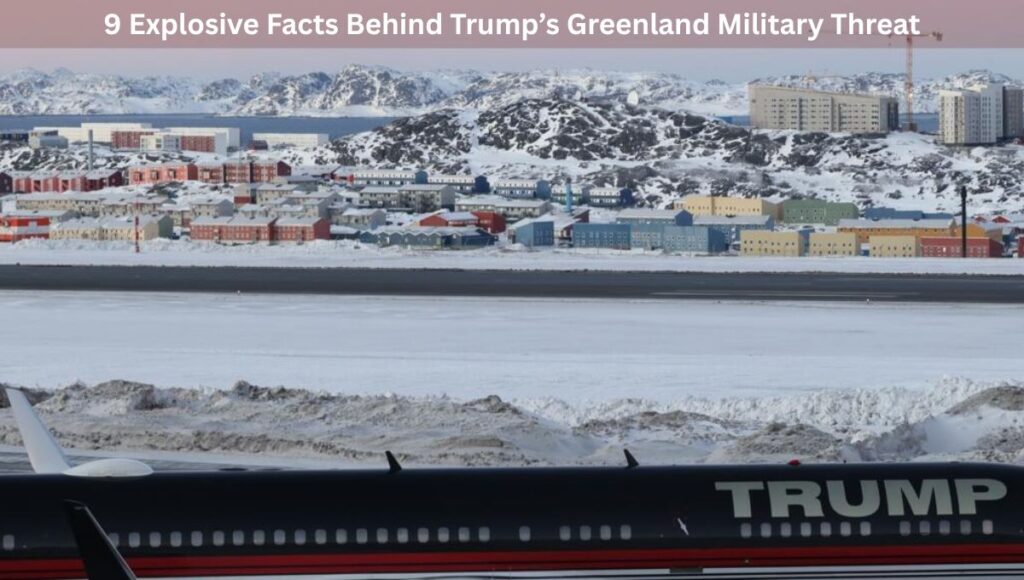
9 Explosive Facts Behind Trump’s Greenland Military Threat
1. The White House Confirms Military Force Is on the Table
The most alarming development came from an official White House statement on January 6, 2026.
“The President and his team are discussing a range of options to pursue this important foreign policy goal, and of course, utilizing the U.S. military is always an option at the Commander-in-Chief’s disposal.”
The administration insists diplomacy remains the preferred path. But by refusing to rule out force, Washington has crossed a line that European leaders say undermines decades of alliance norms.
Trump himself has repeatedly said the US “needs” Greenland for national defense, claiming Denmark lacks the capacity to secure the territory against hostile powers.
2. Why Trump Wants Greenland: National Security Above All
Trump argues Greenland is essential for US national security, not economic exploitation.
Strategic Importance
- Greenland sits between North America and Europe
- It anchors the GIUK gap, a critical naval chokepoint
- It hosts the US Pituffik Space Base, vital for missile defense
- It provides early warning for ballistic missile threats
The White House claims Russia and China have dramatically increased Arctic activity, including naval patrols and commercial investments.
“Our common adversaries have been increasingly active in the Arctic,” the State Department told the BBC.
Trump has even mocked Denmark’s defense posture, saying it had added “one more dog sled” to protect the island—comments that infuriated Copenhagen.
3. Europe Pushes Back: ‘Greenland Belongs to Its People’
Within hours of the White House statement, major European powers issued a rare joint declaration backing Denmark.
Leaders from France, Germany, Italy, Poland, Spain, the UK, and Denmark stated:
“Greenland belongs to its people. It is for Denmark and Greenland, and them only, to decide on matters concerning their relations.”
The statement stressed that Arctic security must be achieved collectively within NATO, not through unilateral action.
Canada and Nordic countries soon echoed the message, reinforcing Greenland’s right to self-determination under international law.
4. Denmark Warns: A US Attack Could End NATO
Danish Prime Minister Mette Frederiksen delivered one of the strongest warnings yet.
“If the United States chooses to attack another NATO country militarily, then everything stops—including NATO.”
Denmark argues that Greenland is already covered by NATO’s Article 5 security guarantee and that the US already enjoys extensive military access under existing agreements.
Frederiksen said Trump’s threats must be taken seriously, adding that Denmark would not accept coercion from a historic ally.
5. Stephen Miller’s Blunt Message: Power Over ‘Niceties’
White House Deputy Chief of Staff Stephen Miller escalated tensions further in a CNN interview.
“We live in a world governed by strength, by force, by power.”
Miller questioned Denmark’s right to control Greenland and stated that it is the “formal position” of the US government that Greenland should be part of the United States.
When pressed on military force, he replied:
“Nobody’s going to fight the United States over the future of Greenland.”
Those remarks stunned European diplomats and sparked outrage across Denmark and Greenland.
6. Options on the Table: Purchase, COFA, or Pressure
According to Reuters, Trump’s advisers are discussing multiple paths to acquire Greenland:
Potential US Options
- Outright purchase from Denmark
- Compact of Free Association (COFA) with Greenland
- Expanded US military presence
- Economic pressure and diplomatic leverage
A COFA arrangement—similar to those with Micronesia or Palau—would stop short of annexation but give Washington extensive control over defense and foreign policy.
However, Greenland’s government has repeatedly said the island is not for sale.
7. Greenlanders React: Fear, Anger, and Resistance
For Greenland’s 57,000 residents—nearly 90% of whom are Inuit—the rhetoric has been deeply unsettling.
Morgan Angaju, a resident of Ilulissat, told the BBC:
“It has been terrifying to listen to the leader of the free world talk about us like we’re something to claim.”
Polls show overwhelming opposition to joining the US, even among those who support eventual independence from Denmark.
Greenland Prime Minister Jens-Frederik Nielsen has called Trump’s language “disrespectful” and urged calm.
“Our status is rooted in international law and territorial integrity,” he said.
8. Congress Pushes Back Against Trump
Opposition is growing inside the United States as well.
Democratic Senator Ruben Gallego has introduced a resolution to block any use of force against Greenland.
“Trump is telling us exactly what he wants to do. We must stop him before he invades another country on a whim.”
Even some Republicans have voiced alarm. Senator Lindsey Graham said Greenland was “a different deal” from Venezuela, while others warned of catastrophic alliance damage.
Senators Jeanne Shaheen and Thom Tillis, co-chairs of the Senate NATO Observer Group, urged respect for Denmark’s sovereignty.
9. Venezuela’s Shadow Looms Large
The Greenland crisis cannot be separated from the recent US military operation in Venezuela, where elite forces captured President Nicolás Maduro.
That operation shattered assumptions about what Trump would or would not do militarily.
Shortly afterward, a social media post by Katie Miller—featuring Greenland colored like the US flag with the word “SOON”—went viral, inflaming fears that Greenland could be next.
Trump himself fueled anxiety by saying a decision on Greenland could come “in about two months.”
Why Greenland Matters More Than Ever
Rare Earth Minerals
Greenland holds vast untapped deposits of:
- Rare earth elements
- Uranium
- Critical minerals for defense and green energy
The US wants to reduce reliance on China, which dominates global rare earth supply chains.
Climate Change and Trade Routes
Melting Arctic ice is opening new shipping lanes, making Greenland even more strategically valuable.
Despite Trump downplaying the mineral angle, US officials have privately emphasized resource security.
What Happens If the US Uses Force?
Experts warn that a US military move against Greenland would trigger unprecedented consequences:
- NATO credibility collapse
- Global shock to international law
- Deep rift between US and Europe
- Strengthened Russian and Chinese narratives
- Long-term damage to US alliances
Senator Chris Murphy summed it up bluntly:
“Article 5 did not anticipate the invading country would be a NATO member.”
Conclusion: A Defining Test for NATO and the Global Order
Donald Trump’s renewed push to acquire Greenland has transformed from rhetorical provocation into a defining geopolitical test.
At stake are:
- NATO’s unity
- The sanctity of borders
- The rights of indigenous peoples
- The balance of power in the Arctic
For now, Greenland remains Danish—and determined to decide its own future. But with the White House openly acknowledging that military force is an option, the world is watching closely.
What happens next could reshape not just the Arctic, but the entire post-World War II international order.
Also Read: 9 Explosive Developments as Trump Taps Greenland Envoy
Also Read: Why Trump wants Greenland — and what makes it so important for national security
Related Posts:
- 5 Major Revelations in the BBC–Trump Panorama…

- 10 Explosive Facts About Donald Trump’s $1 Billion…

- 9 Stark Signals as US Deploys Aircraft to Greenland Base

- 9 Explosive Revelations as Trump Declares His Health…

- 9 Explosive Developments as Trump Taps Greenland Envoy

- 7 Explosive Reasons Denmark Warned Trump to Stop…
