9 Strategic Signals: Kim’s Cruise Missile Test Escalates Nuclear Push ahead of key 2026 party congress. North Korean leader Kim Jong Un has overseen a test launch of long-range strategic cruise missiles and issued one of his strongest statements yet on the future of the country’s nuclear arsenal, calling for the “unlimited and sustained” development of nuclear combat forces.
The test, reported by state media, comes as Pyongyang intensifies military demonstrations ahead of a major ruling party congress scheduled for early 2026.
The latest missile launch, combined with revelations about a nuclear-powered submarine under construction and expanded missile production, underscores North Korea’s determination to entrench itself as a permanent nuclear power despite international pressure and sanctions.
9 Strategic Signals: Kim’s Cruise Missile Test Escalates Nuclear Push
Cruise Missile Test Signals Strategic Intent
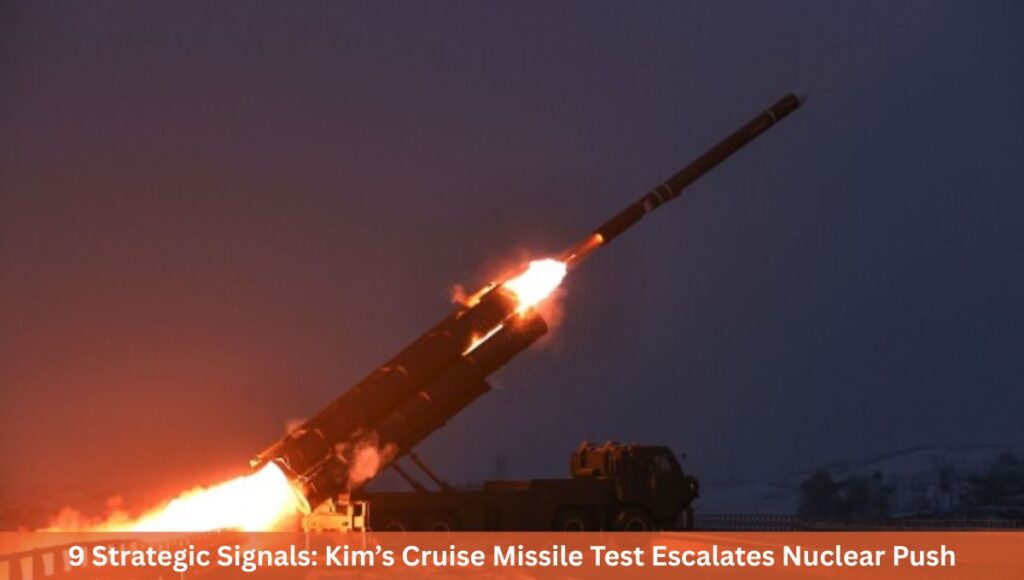
According to the Korean Central News Agency (KCNA), Kim personally observed the test launch of long-range strategic cruise missiles on Sunday.
The missiles reportedly flew along a preset orbit over waters west of the Korean Peninsula before striking their designated targets.
KCNA said Kim expressed “great satisfaction” with the performance of the missiles, describing the test as a necessary measure to ensure the reliability and rapid response capability of North Korea’s nuclear deterrent.
Kim framed the launch as a defensive exercise, stating that regular checks of nuclear deterrent components were a “responsible exercise” in light of what Pyongyang describes as persistent and evolving security threats.
Notably, KCNA did not disclose the exact launch location. However, South Korea’s military later confirmed detecting multiple cruise missile launches from the Sunan area near Pyongyang on Sunday morning.
South Korea Warns of Further Tests
South Korea’s Joint Chiefs of Staff said its military closely monitored the launches and warned that additional missile tests could follow before the end of the year or around New Year’s Day.
A spokesperson for South Korea’s defence ministry described North Korea’s recent activities—including cruise missile launches and submarine construction—as actions that undermine peace and stability on the Korean Peninsula.
Yonhap News Agency, citing military officials, reported that Pyongyang may be preparing for further demonstrations of force, although South Korea declined to speculate publicly on specific timelines.
‘Unlimited’ Nuclear Combat Forces
At the heart of Kim’s message was a clear political directive. KCNA quoted him as reaffirming that North Korea would devote “all efforts” to the unlimited and sustained development of its nuclear combat force.
Such language reflects a long-standing shift in North Korean doctrine. Since the collapse of Kim’s 2019 summit with former U.S. President Donald Trump, Pyongyang has repeatedly declared its nuclear status “irreversible,” rejecting denuclearisation talks unless sweeping sanctions relief is offered.
Analysts say the emphasis on cruise missiles is particularly significant, as these systems are generally harder to detect than ballistic missiles and can potentially carry both conventional and nuclear warheads.
Strategic Timing Ahead of Party Congress
The cruise missile test is part of a broader pattern of heightened activity by Kim as North Korea approaches the Ninth Congress of the ruling Workers’ Party of Korea, expected in early 2026.
The congress will set Pyongyang’s next five-year national development plan, covering economic policy, military strategy, and defence industrial output.
Kim has spent recent weeks attending factory openings, inspecting industrial sites, and highlighting weapons development achievements.
Observers believe these highly publicised events are designed to reinforce Kim’s authority internally while presenting a narrative of resilience and progress despite economic strain and international isolation.
Nuclear-Powered Submarine Revealed
In a separate but closely linked development, KCNA recently released images of Kim inspecting a large nuclear-powered “strategic guided missile submarine” under construction.
It marked the first time North Korean state media had shown more complete visuals of the vessel since March.
The submarine is estimated to displace more than 8,000 tonnes, making it the largest submarine ever built by North Korea.
Its size suggests the presence of a nuclear propulsion system and the capacity to carry “strategic missiles,” potentially including nuclear-capable submarine-launched ballistic missiles (SLBMs).
Naval experts believe the submarine could carry around 10 SLBMs in an unusual sail-mounted configuration, along with multiple torpedo tubes and advanced sonar systems.
If operational, the vessel would significantly enhance North Korea’s second-strike nuclear capability by enabling sea-based deterrence.
Kim’s Warning to South Korea
During the submarine inspection, Kim warned that South Korea’s plans to develop nuclear-powered submarines posed a direct threat to North Korea’s security and “must be countered.”
His comments came after South Korea received approval from the United States to pursue its own nuclear-powered submarine program, a move Pyongyang views as part of a broader regional arms buildup.
Kim was accompanied at the inspection by his daughter, widely seen as a potential successor, further highlighting the political importance of the submarine program.
Expanded Missile and Rocket Production
Beyond cruise missiles and submarines, North Korea has also showcased new multiple rocket launcher systems capable of targeting South Korea.
State media said Kim toured a factory producing these weapons and described them as capable of “annihilating the enemy” through concentrated precision strikes.
North Korean military doctrine has long relied on massed artillery and rocket fire to threaten Seoul and other major South Korean population centres.
Studies have suggested that such systems could inflict tens of thousands of casualties within hours in the event of conflict.
Kim reportedly ordered the expansion and modernisation of missile production facilities, signalling increased output of both conventional and nuclear-capable weapons.
The unveiling of the nuclear-powered submarine comes amid a broader modernisation drive within the Korean People’s Navy (KPN).
In 2025, North Korea inducted two Choe Hyon-class guided missile destroyers, the largest surface combatants in its history, each exceeding 5,000 tonnes and reportedly capable of carrying nuclear weapons.
These ships are also the first in North Korean service to use vertical launch systems. Below the surface, the navy operates a fleet of aging diesel-electric submarines, many dating back to early Cold War Soviet designs.
The new nuclear-powered submarine is intended to offset these limitations and strengthen North Korea’s maritime deterrence.
International Context and Russian Ties
North Korea’s accelerated weapons development has been aided by closer ties with Russia, particularly since Moscow’s invasion of Ukraine.
Pyongyang has reportedly provided thousands of troops and military support to Russia, receiving economic and technical assistance in return.
This partnership has emboldened Kim’s leadership, reducing concerns about diplomatic isolation and strengthening North Korea’s strategic position.
The missile tests also follow a ballistic missile launch conducted last November, shortly after former U.S. President Donald Trump expressed interest in re-engaging with Kim during a regional tour. Pyongyang did not respond to the overture.
A Calculated Show of Force
Experts say the combination of cruise missile testing, submarine construction, and factory inspections reflects a calculated effort to demonstrate readiness across multiple domains.
Hong Min of the Korea Institute for National Unification noted that the cruise missile test likely involved upgraded systems capable of carrying nuclear warheads.
Other analysts suggest North Korea may also be testing weapons with an eye toward potential export.
As the 2026 party congress approaches, Kim Jong Un appears determined to present North Korea as a technologically advanced, militarily resilient state with a credible nuclear deterrent across land, sea, and air.
Outlook for the Korean Peninsula
While North Korea insists its actions are defensive, regional governments view the developments with growing concern.
South Korea and the United States continue to emphasise deterrence and alliance readiness, while calling for restraint.
With additional missile tests likely and diplomatic channels largely dormant, tensions on the Korean Peninsula appear set to remain high into the coming year.
For Kim Jong Un, the message is clear:
nuclear weapons are not a bargaining chip but a permanent pillar of North Korea’s national strategy.
Also Read: Kim Jong Un Vows Rapid Nuclear Expansion Amid US-South Korea Military Drills
Also Read: ‘Annihilate the enemy’: Kim Jong Un hails new rocket system as North Korea steps up weapons push