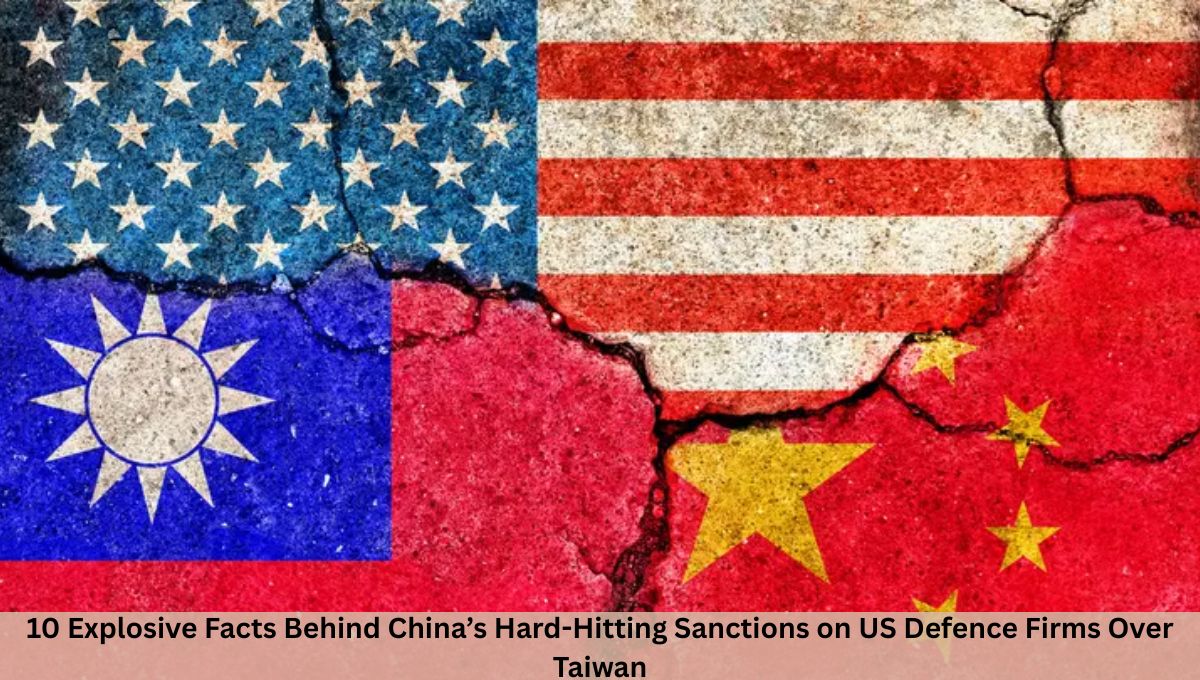
10 Explosive Facts Behind China’s Hard-Hitting Sanctions on US Defence Firms Over Taiwan arms sale. China has sharply escalated tensions with the United States by imposing sanctions on a large group of American defence companies and senior executives over Washington’s latest arms sales to Taiwan.
Thank you for reading this post, don't forget to subscribe!The move, announced by China’s Ministry of Foreign Affairs, targets 20 US defence-related firms and 10 individuals, freezing their assets in China and banning business dealings with Chinese entities. The sanctions come in direct response to the Trump administration’s approval of a record $11.1 billion weapons package for Taiwan, one of the largest such deals in US–Taiwan relations.
Beijing says the arms sales violate the one-China principle, interfere in China’s internal affairs, and undermine its sovereignty and territorial integrity. While the sanctions are widely seen as largely symbolic, they carry strong political and strategic messaging, both internationally and domestically.
Below is a comprehensive breakdown of what happened, who has been sanctioned, why China acted, and whether these measures will have any real-world impact.
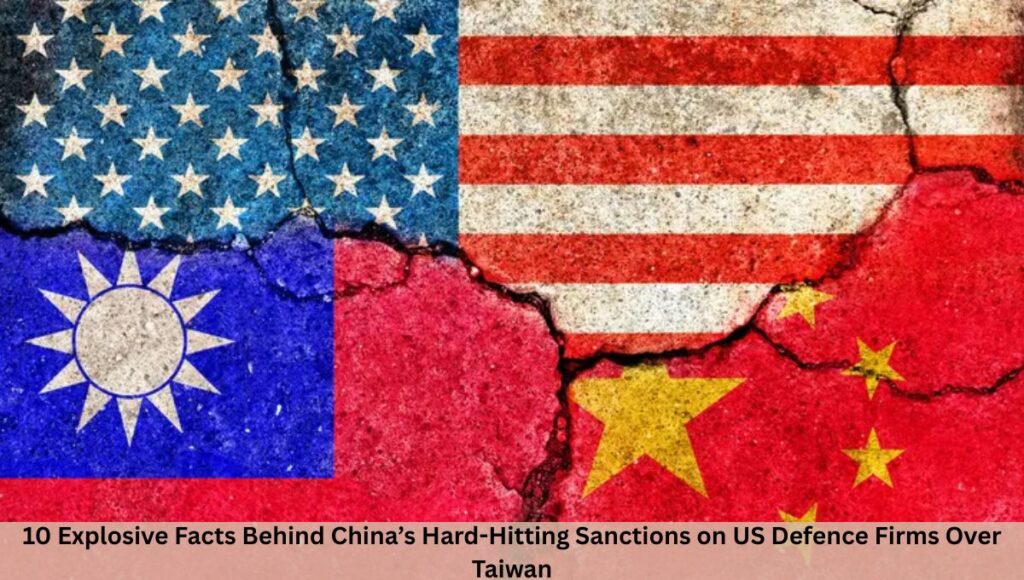
10 Explosive Facts Behind China’s Hard-Hitting Sanctions on US Defence Firms Over Taiwan
What Did China Announce?
On Friday, China’s foreign ministry announced that it would impose countermeasures under the Anti-Foreign Sanctions Law against US defence companies and executives involved in supplying weapons to Taiwan in recent years.
A spokesperson for the ministry warned that:
“Anyone who attempts to cross the line and make provocations on the Taiwan question will be met with China’s firm response. Any company or individual who engages in arms sales to Taiwan will pay the price for the wrongdoing.”
The measures took effect immediately and include:
- Freezing all movable and immovable assets of the sanctioned companies located in China
- Barring Chinese organisations and individuals from engaging in transactions, cooperation, or other dealings with them
- Restricting the China-based assets and activities of sanctioned executives
- Banning sanctioned individuals from entering mainland China, Hong Kong, and Macau
Beijing described the Taiwan issue as the “core of China’s core interests” and the first red line in China–US relations.
Why Has China Sanctioned US Companies?
Trigger: Record US Arms Sale to Taiwan
The sanctions follow Washington’s approval of a massive arms sale package for Taiwan, announced in mid-December by the Trump administration.
According to the US State Department and Taiwanese authorities, the proposed package includes eight separate arms deals valued at approximately $11.1 billion, making it one of the largest US weapons sales to Taiwan to date.
What’s in the Arms Package?
The proposed sales reportedly include:
- 82 HIMARS (High Mobility Artillery Rocket Systems)
- 420 ATACMS (Army Tactical Missile Systems)
- M109A7 self-propelled howitzers
- Javelin and TOW 2B anti-tank missiles
- Anti-armor and loitering munition drones
- Surveillance and combat UAVs
- Spare parts and logistical support
Many of these systems are similar to those supplied to Ukraine in its conflict with Russia, raising alarm in Beijing about Taiwan’s growing strike and deterrence capabilities.
Taiwan has allocated part of the purchase under a NT$1.25 trillion (US$39.85 billion) special defence budget, which is still pending legislative approval.
China’s Core Objection: The One-China Principle
Beijing argues that US arms sales to Taiwan:
- Violate the one-China principle
- Breach the three China–US Joint Communiqués
- Interfere in China’s internal affairs
- Encourage “Taiwan independence” forces
- Undermine peace and stability in the Taiwan Strait
China considers Taiwan a part of its sovereign territory and has not ruled out the use of force to achieve reunification. Taiwan, however, rejects Beijing’s claim and maintains its own democratic government, military, and foreign relations.
Which US Companies Have Been Sanctioned?
China has sanctioned 20 US defence-related companies allegedly involved in arms supplies to Taiwan. The list includes major defence contractors as well as specialised technology and drone firms.
Sanctioned Companies
- Northrop Grumman Systems Corporation
- L3Harris Maritime Services
- Boeing (St. Louis division)
- Gibbs & Cox
- Advanced Acoustic Concepts
- VSE Corporation
- Sierra Technical Services
- Red Cat Holdings
- Teal Drones
- ReconCraft
- High Point Aerotechnologies
- Epirus
- Dedrone Holdings
- Area-I
- Blue Force Technologies
- Dive Technologies
- Vantor
- Intelligent Epitaxy Technology
- Rhombus Power
- Lazarus Enterprises
Under the sanctions, all assets belonging to these companies within China will be frozen, and Chinese firms are prohibited from engaging with them in any capacity.
Which Individuals Were Targeted?
China also sanctioned 10 senior executives, accusing them of direct involvement in arms sales to Taiwan.
Sanctioned Executives
- Palmer Luckey, founder of Anduril Industries
- John Cantillon, Vice President, L3Harris Technologies
- Michael J. Carnovale, CEO, Advanced Acoustic Concepts
- John A. Cuomo, CEO, VSE Corporation
- Mitch McDonald, President, Teal Drones
- Anshuman Roy, Founder and CEO, Rhombus Power
- Dan Smoot, CEO, Vantor
- Aaditya Devarakonda, CEO, Dedrone Holdings
- Ann Wood, President, High Point Aerotechnologies
- Jay Hoflich, Co-founder and CEO, ReconCraft
Their China-based assets have been restricted, and they are barred from entering China.
How Has the US Responded?
The US State Department strongly objected to China’s move, stating that:
- US policy toward Taiwan has remained consistent across multiple administrations
- Arms sales contribute to peace and stability in the Taiwan Strait
- Beijing’s sanctions represent economic and diplomatic coercion
Washington reiterated that it is legally bound under US law to provide Taiwan with the means to defend itself.
Are the Sanctions Effective or Symbolic?
Limited Economic Impact
Experts widely agree that the sanctions are largely symbolic:
- US defence firms already have minimal or no defence-related business in China
- Strict US export controls prohibit military technology transfers to China
- Many sanctioned companies have negligible assets in China
As a result, the sanctions are unlikely to disrupt revenue, operations, or supply chains.
Why China Still Uses Sanctions
Despite limited economic impact, the sanctions serve several strategic purposes:
- Political signaling to Washington
- Deterrence messaging to other countries considering arms sales to Taiwan
- Domestic messaging to Chinese audiences
- Psychological pressure on Taiwan
China has imposed similar sanctions multiple times since 2023, including against Lockheed Martin and Raytheon, without changing US policy.
A Pattern of Repeated Sanctions
This is not the first time China has sanctioned US defence firms over Taiwan:
- 2023: Sanctions on Lockheed Martin and Raytheon
- 2024: Multiple rounds targeting drone manufacturers and executives
- 2025: Expanded lists under export controls and the Unreliable Entities List
The recurrence underscores that the measures are meant more as strategic warnings than economic weapons.
What This Means for Taiwan
Taiwan’s Ministry of National Defence welcomed the US arms deal, stating it helps:
- Strengthen self-defence capabilities
- Build credible deterrence against potential aggression
- Maintain regional stability
Taipei has grown increasingly concerned about China’s military drills and pressure campaigns around the island.
Rising Military Stakes in the Taiwan Strait
A recent Pentagon report warned that China aims to develop the capability to reunify Taiwan by force by 2027, stating that the People’s Liberation Army continues to refine military options for a decisive victory.
The growing scale and sophistication of US arms sales to Taiwan could complicate Beijing’s military planning, which partly explains the sharp diplomatic response.
Global Implications
The sanctions highlight:
- Deepening China–US strategic rivalry
- Rising militarisation of the Indo-Pacific
- Increased risk of miscalculation in the Taiwan Strait
- The growing role of arms sales in geopolitical signaling
While the sanctions may not halt US weapons transfers, they add another layer of tension to an already fragile relationship between the world’s two largest powers.
What Happens Next?
Despite Beijing’s warnings, there is strong bipartisan support in the US Congress for arming Taiwan. If approved, the latest package would surpass previous arms deals and further solidify US–Taiwan defence ties.
China, meanwhile, has made it clear that it will continue to respond with “resolute measures”—diplomatic, economic, or otherwise—to defend what it considers its core national interests.
Conclusion
China’s sanctions on US defence firms over Taiwan arms sales are unlikely to change Washington’s policy or significantly harm the targeted companies.
However, they send a powerful message about Beijing’s red lines, its resolve over Taiwan, and the escalating geopolitical contest shaping the future of the Indo-Pacific.
As arms sales grow larger and rhetoric sharper, the Taiwan Strait remains one of the most dangerous flashpoints in global politics—where symbolism, deterrence, and power projection increasingly collide.
Also read: 7 Dangerous Signals: Japan–China Fighter Jet Standoff Escalates
Also Read: China sanctions US defence firms over Taiwan arms sale. All about the move