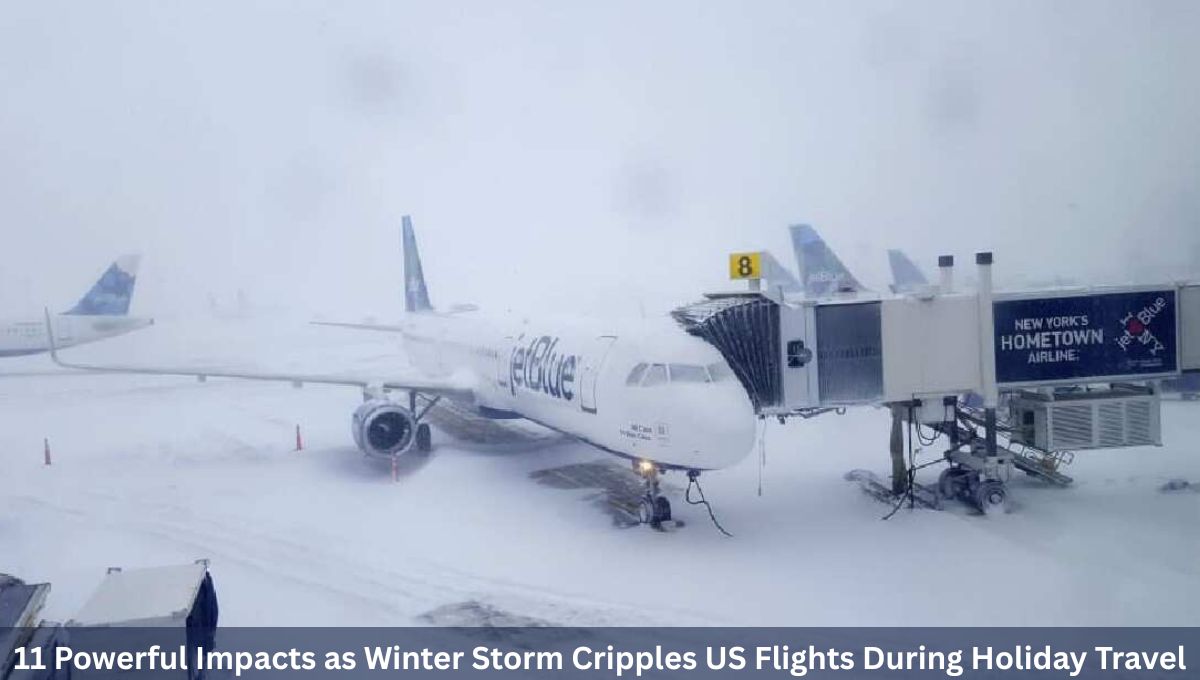
11 Powerful Impacts as Winter Storm Cripples US Flights During Holiday Travel nationwide. Severe winter weather sweeping across large parts of the United States has paralysed peak holiday travel, grounding thousands of flights, delaying tens of thousands more, and forcing states to issue emergency warnings as heavy snow, ice, and flooding spread from the Great Lakes to the Northeast and the West Coast.
The storm, identified by forecasters as Winter Storm Devin, has arrived at one of the busiest travel periods of the year, leaving millions of travellers scrambling to adjust plans as airports, highways, and rail systems struggle to cope with rapidly deteriorating conditions.
11 Powerful Impacts as Winter Storm Cripples US Flights During Holiday Travel
Thousands of Flights Cancelled and Delayed Nationwide
According to FlightAware, the world’s largest flight-tracking platform, the scale of disruption grew steadily throughout Friday and into Saturday.
Latest Flight Disruption Figures
- 1,600–2,000+ flights cancelled nationwide
- 7,400 to more than 26,000 flights delayed
- Nearly half of all cancellations concentrated around New York City airports
As of Friday night, FlightAware showed 1,600 cancellations and 7,400 delays, while later updates pushed those numbers beyond 1,800 cancellations and 22,000 delays, reflecting the storm’s rapid intensification.
New York Airports Bear the Brunt
The most severe disruptions were concentrated at New York City’s three major airports:
- John F. Kennedy International Airport (JFK)
- LaGuardia Airport (LGA)
- Newark Liberty International Airport (EWR)
Together, these airports accounted for more than 800 cancelled flights within a 24-hour period, placing them at the top of FlightAware’s “Misery Map,” which tracks nationwide aviation disruption.
Other heavily impacted airports included Boston Logan, Chicago O’Hare, Detroit Metropolitan, Philadelphia International, and Toronto Pearson in neighbouring Canada.
Airlines Forced to Ground Hundreds of Flights
Major US carriers cancelled hundreds of flights as crews, aircraft, and runways were affected by snow, ice, and poor visibility.
Airline Cancellation Breakdown
- JetBlue Airways: 225–350 flights cancelled
- Delta Air Lines: 212–241 flights cancelled
- Republic Airways: 157–180 flights cancelled
- Southwest Airlines: 151 flights cancelled
- American Airlines: ~100–146 flights cancelled
- United Airlines: ~97–100 flights cancelled
JetBlue confirmed it had cancelled approximately 350 flights across Friday and Saturday, primarily in the Northeast where it has a significant operational footprint.
Airports Urge Travellers to Check Flight Status
Airports across the Northeast and Midwest issued repeated warnings on social media platform X, urging travellers to check flight statuses before heading to terminals.
Many passengers reported arriving at airports only to find flights cancelled at the last minute, while others faced hours-long delays due to aircraft de-icing and runway clearing operations.
Winter Storm Warnings Cover Tens of Millions
The National Weather Service (NWS) issued winter storm warnings and advisories stretching across vast portions of the country.
People Affected
- 40+ million Americans under winter storm warnings or advisories
- 30+ million facing flood or storm alerts, particularly in California
The warnings extended from the upper Great Lakes through the Mid-Atlantic and into southern New England, with hazardous travel expected through Saturday morning.
Heavy Snow Forecast for Northeast and Midwest
Forecasters warned that some of the heaviest snowfall in years was expected in major population centres.
Expected Snowfall Totals
- New York City: 9–10 inches (23–25 cm)
- Southern Connecticut: Up to 9 inches
- Hudson Valley & Catskills: Up to 12 inches
- Parts of New England: 4–9 inches
- Upper Midwest: Snow and ice mix
The heaviest snowfall was forecast between 6:00 p.m. and midnight, creating near-whiteout conditions at times.
Second Major Snowfall of the Season for New York
This storm marks New York City’s second significant snowfall of the season, following a storm on December 14 that blanketed the city with several inches of snow.
Meteorologists said this could be the heaviest snowfall in nearly four years, intensifying concerns about road safety, public transport reliability, and power supply stability.
State and City Leaders Issue Travel Warnings
Governor Kathy Hochul
New York Governor Kathy Hochul urged residents to avoid unnecessary travel.
“If you must travel, plan ahead, take it slow, and leave plenty of time to get to where you need to go safely,” she said.
Similar warnings were issued by the governors of New Jersey and Connecticut, who advised residents to stay off roads unless absolutely necessary.
Mayor Eric Adams Activates Emergency Plans
New York City Mayor Eric Adams activated the city’s Winter Weather Emergency Plan, deploying sanitation crews, snowploughs, and salt spreaders across all five boroughs.
He urged commuters who drove to work on Friday to leave early or use public transport, warning that road conditions would worsen rapidly as temperatures fell overnight.
Snowploughs and Road Crews Deployed
City officials confirmed that snowploughs would begin clearing streets once two inches of snow had accumulated, with hundreds of vehicles staged and ready.
Drivers were warned to expect slippery roads, reduced visibility, and icy patches, particularly as temperatures drop further into the weekend.
Hazardous Conditions for Drivers
The National Weather Service warned motorists to carry emergency supply kits, including blankets, food, water, and flashlights.
Commercial vehicle restrictions were imposed on several interstate highways in Pennsylvania and New Jersey, reflecting the heightened risk of jack-knifing and pile-ups.
Flooding and Mudslides Batter California
While the Northeast grappled with snow, California faced a different weather threat.
An atmospheric river dumped intense rainfall across parts of the state, triggering:
- Flash flooding
- Mudslides
- Road closures
- Airport shutdowns
Santa Barbara Airport Closure
Santa Barbara Airport, northwest of Los Angeles, was forced to close temporarily due to flooding. After overnight cleanup operations, the airport reopened Friday morning.
Firefighters rescued more than 100 people from floodwaters in Los Angeles County, including 21 motorists airlifted by helicopter.
Storms Stretch Coast to Coast
The National Weather Service said winter storm warnings and advisories now span:
- California
- Nevada
- Idaho
- Wyoming
- Colorado
- Midwest states
- Northeast corridor
In Mono County, California, higher elevations were forecast to receive 1–3 feet of snow, compounding existing hazards on mountain highways.
Pile-Ups Reported on Sierra Nevada Highways
California Highway Patrol reported multiple vehicle pile-ups on Interstate 80 near Donner Summit, where snow and ice caused traffic to halt for hours.
Despite chain controls and advance warnings, dozens of motorists were stranded as emergency crews worked through the night to clear the scene.
Holiday Travel Meets La Niña Volatility
Meteorologists linked the erratic weather patterns to the return of La Niña, a climate phenomenon associated with volatile winter conditions in North America.
Experts warned that further swings between heavy snow, freezing rain, and Arctic cold are likely in the coming weeks.
Record Holiday Travel Numbers Intensify Impact
The storm coincided with one of the busiest travel periods of the year.
According to figures cited by Reuters:
- 109 million Americans expected to drive long distances between December 20 and January 1
- Around 8 million projected to fly during the holiday window
The convergence of record travel volumes and extreme weather amplified delays and cancellations nationwide.
Power Grids Holding — For Now
Despite soaring electricity demand for heating, power grids have not yet shown signs of significant stress.
However, colder temperatures pushed US natural gas prices higher, with futures rising more than 3%, reflecting increased demand.
What Travellers Can Expect Next
Forecasters warned that lingering icy conditions could extend travel disruptions well into the weekend and early next week.
A potentially stronger cold front is expected to sweep through the Northeast, including the Washington, DC region, bringing blustery conditions and renewed snow threats.
Parts of western Pennsylvania remain under ice storm warnings, raising concerns about power outages and road closures.
Airlines Offer Flexibility Amid Disruptions
Several airlines issued travel alerts and fee waivers, allowing passengers to rebook without penalties.
JetBlue said it was “working to assist affected customers with rescheduling,” while Delta, United, and American issued similar advisories.
Authorities Urge Caution as Storm Continues
Across the country, officials repeated a consistent message: slow down, plan ahead, and avoid unnecessary travel.
“Road conditions will be treacherous for those travelling back from the holiday,” the National Weather Service warned.
Conclusion: A Holiday Season Frozen by Weather
As Winter Storm Devin tightens its grip, the United States is facing one of the most disruptive holiday travel periods in years.
With thousands of flights cancelled, highways clogged, and emergency warnings in effect from coast to coast, the storm has underscored the vulnerability of modern travel networks to extreme weather.
For millions of Americans trying to return home after Christmas, patience, flexibility, and caution have become essential — as winter shows no sign of loosening its hold just yet.
Also Read: Arizona Haboob Dust Storm Grounds 62 Flights, Cuts Power to Thousands in Phoenix
Also Read: Bomb cyclone to bring blizzard conditions, icy travel, strong winds to Great Lakes, Northeast