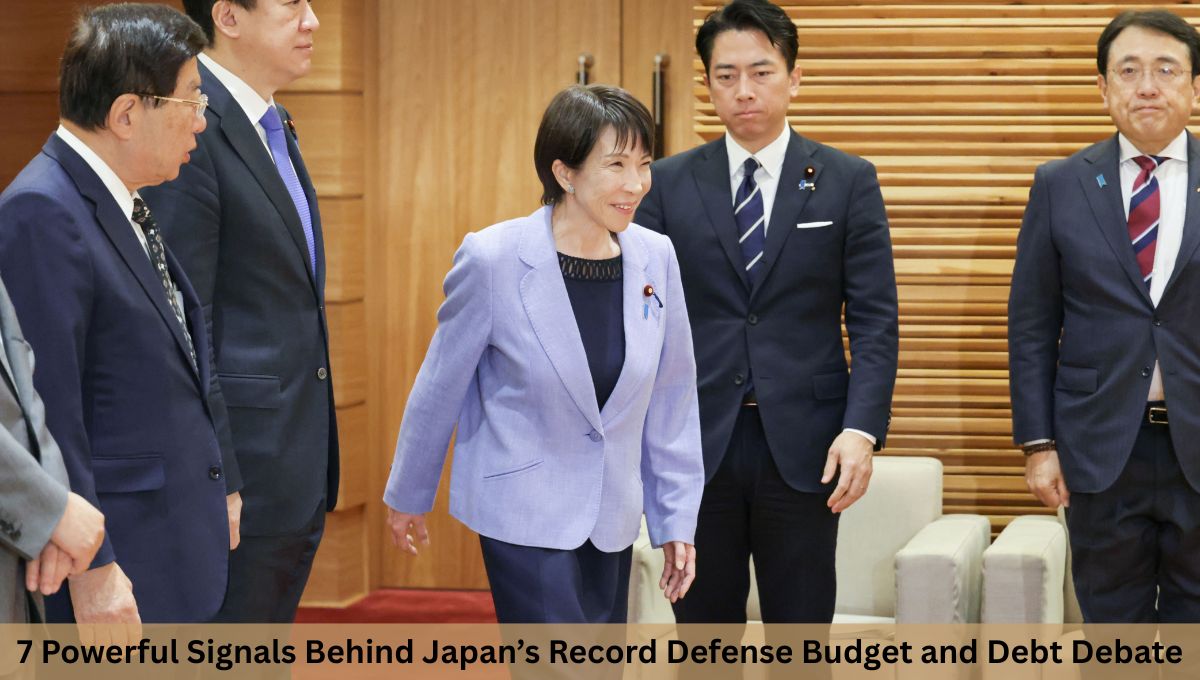
7 Powerful Signals Behind Japan’s Record Defense Budget and Debt Debate amid rising China tensions. Japan has approved its largest-ever national budget, marking a decisive shift in the country’s security posture while intensifying concerns over fiscal sustainability and public debt.
The ¥122.3 trillion ($785 billion) budget for fiscal year 2026 includes a record-breaking defence allocation exceeding ¥9 trillion, underscoring Tokyo’s determination to strengthen its military capabilities as regional tensions with China escalate.
The move reflects a historic transformation in Japan’s post-war defence policy, driven by concerns over China’s growing military reach, threats around Taiwan, and the need to modernise a force facing demographic and technological challenges.
At the same time, the scale of the spending has unsettled financial markets, forcing Prime Minister Sanae Takaichi to reassure investors that fiscal discipline will not be abandoned.
7 Powerful Signals Behind Japan’s Record Defense Budget and Debt Debate
Record Defence Spending Signals Strategic Shift
The defence budget approved by Japan’s Cabinet represents the fourth year of a five-year programme designed to double military spending to 2% of gross domestic product, a level long urged by the United States and NATO allies.
Fourth Year of Historic Military Buildup
The draft defence budget for fiscal 2026 is up 9.4% from the previous year, placing Japan on track to reach its 2% of GDP target two years ahead of schedule, by March.
If completed as planned, Japan’s annual defence spending will approach ¥10 trillion, making it the world’s third-largest military spender, after the United States and China.
Defence officials have described Japan’s security environment as the “most severe and complex since the end of the war,” a characterisation that underpins the urgency of the spending surge.
China Identified as Japan’s Biggest Strategic Challenge
Japan’s latest security posture is shaped overwhelmingly by concerns over China’s expanding military footprint in the Pacific.
Taiwan Flashpoint Raises Alarm in Tokyo
Prime Minister Sanae Takaichi heightened regional tensions in November when she stated that Japan’s military could become involved if China were to take action against Taiwan, the self-governing island claimed by Beijing.
Those remarks came amid increasingly frequent Chinese naval and air operations near Japan’s southwestern islands, a region that Tokyo now views as a potential frontline in any future conflict.
Carrier Drills and Radar Lock Incidents
Tensions escalated further this month after Chinese aircraft carrier drills near southwestern Japan prompted formal protests from Tokyo.
Japanese officials said Chinese aircraft had locked radar onto Japanese planes, an act widely regarded as a possible precursor to missile targeting.
In response, Japan’s Defence Ministry will establish a new office dedicated to analysing China’s Pacific operations, focusing on equipment, strategy, and operational patterns.
Missiles and Drones Central to New Defence Strategy
A significant portion of the defence budget is dedicated to transforming Japan’s military into a force capable of striking adversaries from long range—an explicit departure from decades of strictly defensive doctrine.
¥970 Billion for Standoff Missile Capability
More than ¥970 billion has been allocated to strengthen Japan’s “standoff” strike capacity. This includes the purchase of upgraded Type-12 surface-to-ship missiles, which will have a range of approximately 1,000 kilometres.
The first batch of these domestically developed missiles will be deployed in Kumamoto Prefecture by March—a year earlier than originally planned—highlighting the urgency of Japan’s missile build-up in the southwest.
Unmanned Weapons to Offset Demographic Decline
Japan’s rapidly ageing population and shrinking workforce have created acute staffing challenges for the Self-Defense Forces. As a result, unmanned systems have become a cornerstone of the country’s future military planning.
SHIELD Coastal Defence System
The budget includes ¥100 billion for the deployment of unmanned air, sea-surface, and underwater drones under a coastal defence programme known as SHIELD, scheduled for completion by March 2028.
The drones are designed to:
- Monitor maritime approaches
- Detect hostile landings
- Strengthen surveillance in remote island chains
To accelerate deployment, Japan plans to initially rely on imports, with potential suppliers including Turkey and Israel, before transitioning to domestic production.
Breaking With Post-War Military Restraints
Japan’s growing emphasis on offensive capability represents one of the most significant departures from its post-World War II security doctrine.
Shift From Purely Defensive Posture
For decades, Japan limited the use of force strictly to self-defence.
However, the security strategy adopted in 2022 explicitly calls for:
- Counterstrike capabilities
- Pre-emptive response options
- Deeper integration with US military planning
China is named directly in official documents as Japan’s foremost strategic challenge, reflecting a sharp change in tone from earlier defence white papers.
Joint Development of Fighters, Frigates, and AI Drones
Japan is also reshaping its defence industry, seeking to move beyond domestic production by partnering with allied nations and promoting arms exports.
Next-Generation Fighter Jet Programme
More than ¥160 billion has been earmarked for joint development of a next-generation fighter jet with Britain and Italy, with deployment planned for 2035.
The project also includes research into AI-operated drones designed to fly alongside the jet, reflecting a growing emphasis on manned-unmanned teaming.
Australia Chooses Japanese Frigates
In a major boost to Japan’s defence industry, Australia selected Mitsubishi Heavy Industries to upgrade its Mogami-class frigates, replacing its ageing ANZAC-class fleet.
Japan’s budget includes nearly ¥10 billion to support defence manufacturing capacity and promote overseas arms sales, following the easing of export restrictions in recent years.
Record National Budget Raises Debt Concerns
While defence spending has drawn headlines, it is only part of a much larger fiscal picture.
¥122.3 Trillion Overall Budget
The total budget for fiscal 2026 will reach ¥122.3 trillion, surpassing the previous record of ¥115 trillion. It comes on top of a ¥21.3 trillion stimulus package approved earlier to offset rising living costs.
Japan already carries the highest debt-to-GDP ratio among major economies, projected to exceed 230% in 2025, raising alarms among investors.
Bond Markets React With Unease
Financial markets have responded cautiously to Japan’s fiscal expansion.
Yields Rise, Yen Weakens
Super-long government bond yields have recently touched record highs amid fears of increased issuance to fund spending. Although yields eased after reports that issuance may be reduced next year, concerns remain.
The yen has also come under pressure, prompting warnings from the finance minister about potential market intervention.
Takaichi Promises Fiscal Discipline
Facing growing market anxiety, Prime Minister Takaichi has repeatedly emphasised that her government will not rely excessively on debt.
Lower Debt Dependence Ratio
Under the draft budget:
- New bond issuance will be capped at ¥29.6 trillion
- Debt reliance will fall to 24.2%, the lowest level since 1998
Takaichi described the plan as balancing economic growth with fiscal sustainability.
“It does not mean expanding expenditures indiscriminately based solely on scale,” she told business leaders.
Funding the Defence Push
To finance rising military costs, the government plans:
- Higher corporate taxes
- Increased tobacco taxes
- A phased income tax hike beginning in 2027
However, economists warn that sustaining defence spending beyond the 2% target could prove politically and economically challenging.
Meeting Targets, Facing Uncertainty
If approved by parliament by March, Japan will meet its defence spending commitments on schedule. What remains unclear is how far the country is willing—or able—to go beyond that benchmark.
With China’s military activity expanding, demographic pressures mounting, and financial markets watching closely, Japan’s record defence budget marks not an endpoint, but the beginning of a more complex and uncertain strategic era.
Also Read: Sanae Takaichi Becomes Japan’s First Female Prime Minister 2025
Also Read: Japan’s Cabinet OKs record defense budget that aims to deter China