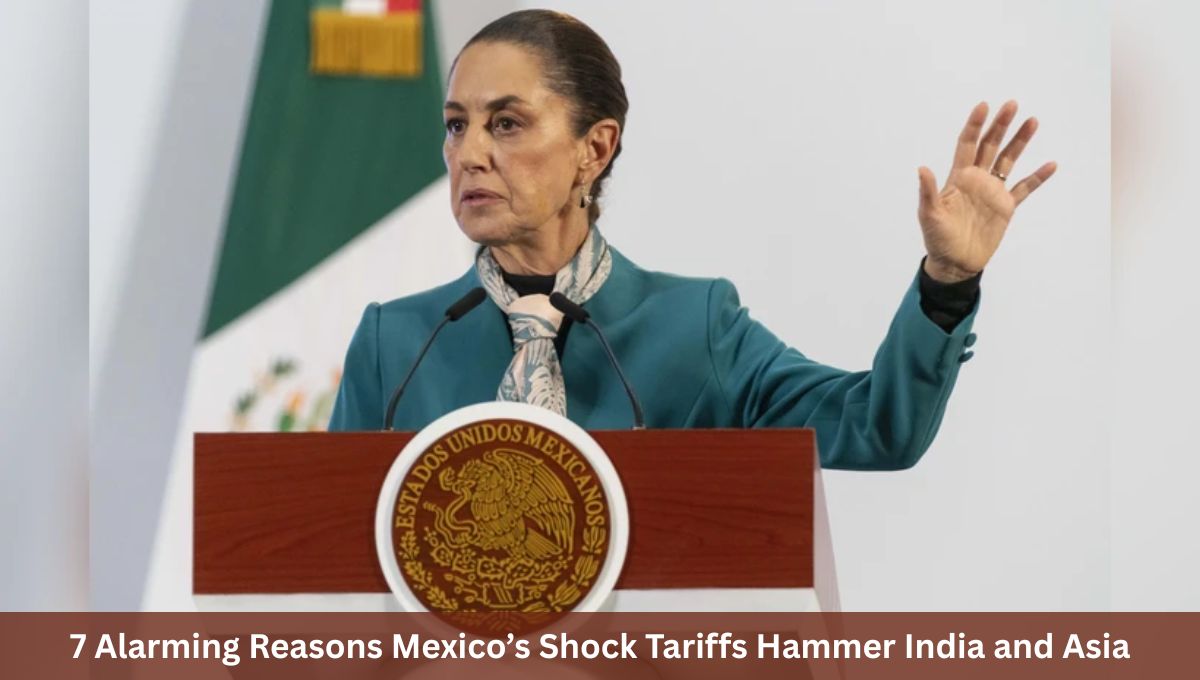
7 Alarming Reasons Mexico’s Shock Tariffs Hammer India and Asia, signalling a major strategic shift and escalating global trade tensions. Mexico has ignited a new flashpoint in the escalating global trade war by approving tariffs of up to 50% on more than 1,400 products imported from India, China, South Korea, Thailand and other Asian nations.
Thank you for reading this post, don't forget to subscribe!The move represents one of the most dramatic shifts in Mexico’s economic policy in decades and places India squarely among the countries most affected. The tariff package—backed strongly by Mexico’s Senate and lower house—will begin rolling out in January 2026 and continue expanding through the year.
It affects a sweeping range of goods including automobiles, auto parts, textiles, clothing, plastics, metals, footwear, machinery, electronics, and industrial components.
While the Mexican government publicly frames the decision as necessary to “strengthen domestic production,” analysts across India, China and the US argue that the timing, structure and scale of the move align almost perfectly with US President Donald Trump’s aggressive protectionist agenda.
With Washington preparing for a critical review of the US–Mexico–Canada Agreement (USMCA) in 2026, Mexico appears to be signalling that it is willing to tighten its trade regime to avoid harsher penalties from the United States—its largest and most vital trade partner.
For India, the impact could be significant. Bilateral trade surged to an all-time high of $11.7 billion in 2024, and Indian exporters have spent more than a decade deepening their footprint in Mexico, which serves as a strategic gateway into the North American supply chain.
But with the new Mexican tariffs, that advantage is now under threat.
7 Alarming Reasons Mexico’s Shock Tariffs Hammer India and Asia
Why Mexico Imposed the 50% Tariffs
Mexico’s tariff decision is a blend of domestic economic strategy, geopolitical pressure, and diplomatic calculations. Several key factors converged to produce this unprecedented policy shift.
1. Pressure from the United States and Trump’s Trade Agenda
Trump has repeatedly accused Mexico of serving as a backdoor for Chinese, Indian and other Asian goods into the American market. Over recent months, he has:
- threatened 50% tariffs on Mexican steel and aluminium
- warned of an additional 25% levy linked to fentanyl trafficking
- accused Mexico of violating a 1944 water treaty
- attacked the Sheinbaum administration for “failing to control imports”
Facing these escalating threats, Mexico’s government appears keen to demonstrate that it can clamp down on Chinese and Asian imports before USMCA is reopened for review.
2. Domestic Industry Protection
Mexico’s manufacturing sector—especially steel, aluminium, plastics, auto components and textiles—has complained about:
- rising imports from China
- cheaper competition from India and Korea
- pressure on local factories and jobs
Local auto associations strongly backed the new tariffs, warning that Chinese automakers have already captured 20% of the Mexican automobile market, up from almost nothing six years ago.
3. Fiscal Needs
Mexico’s finance ministry expects the tariff package to generate:
- 52 billion pesos (USD 2.8 billion) in new revenue
- 3.76 billion USD equivalent according to alternative estimates
With Mexico seeking to narrow its fiscal deficit, the tariffs provide a politically convenient revenue stream.
How the Tariffs Work
Mexico’s new tariff system applies to all countries without a free-trade agreement (FTA) with Mexico. India is in this category.
Key Features
- Tariffs range from 5% to 50%, depending on product category.
- Over 1,400 tariff lines are affected.
- Most products fall under the 35% bracket, but high-priority sectors like automobiles and industrial steel components will face up to 50%.
- The Economy Ministry now has expanded powers to revise tariffs at will, without congressional approval.
This flexibility suggests Mexico is preparing for rapid adjustments before next year’s USMCA review—potentially including new tariff waves.
Why Analysts Say Mexico’s Move Is Meant to Please Trump
Although Mexico’s government has officially denied acting under US pressure, multiple economic analysts, trade groups and foreign governments have pointed to unmistakable patterns:
- The tariff structure mirrors Trump’s own tariff proposals.
- The timing coincides with high-stakes US–Mexico negotiations.
- The move primarily targets countries that Washington has labelled “high-risk exporters,” especially China.
- The maximum 50% tariff applies to Chinese automobiles—precisely the category Trump has repeatedly warned about.
Even Mexican senators acknowledged that the move is partly intended to “reduce political tension” with the United States.
Reuters, Bloomberg and several Latin American economists describe it bluntly:
Mexico is sending a clear signal that it is aligned with Washington’s protectionist stance.
Impact on India: A Significant New Trade Barrier
India–Mexico Trade Snapshot
- Total bilateral trade (2024): USD 11.7 billion
- India’s exports to Mexico: USD 8.9 billion
- India’s imports from Mexico: USD 2.8 billion
- India’s current surplus: approx. USD 6.1 billion
India is Mexico’s ninth-largest export market, and Mexican companies rely heavily on Indian machinery, pharmaceuticals and engineering goods. But the new tariffs could erode India’s competitive position in one of Latin America’s most important markets.
Which Indian Sectors Will Be Hit Hardest?
1. Automotive Exports
India is a major exporter of:
- motor cars
- auto parts
- commercial vehicles
- passenger cars
These items fall squarely within the 35–50% tariff bracket. This is likely to reduce India’s share in Mexico’s fast-expanding auto supply chain.
2. Textiles and Apparel
India’s textile and apparel exports—already competing with low-cost Chinese products—will face significantly higher duties, raising landed costs for Mexican manufacturers.
3. Machinery and Industrial Components
Indian engineering goods, machinery and industrial inputs will be priced far higher once tariffs hit, pressuring:
- appliance manufacturers
- electronics assemblers
- automotive sub-suppliers
4. Chemicals and Pharmaceuticals
These sectors may remain somewhat insulated if Mexico grants selective exemptions, but the broad wording of the law suggests that India will still face cost increases.
The Strategic Importance of Mexico for Indian Companies
Indian businesses have long used Mexico as:
- a manufacturing and assembly base
- a gateway into the North American market
- a logistics hub connected to the US and Canada
- a partner in automotive and engineering value chains
With Mexico shifting toward protectionism, Indian firms may need to reassess:
- supply-chain routing
- local manufacturing viability
- export competitiveness
- alternative Latin American markets
Companies that export through Mexico into the US under USMCA rules may encounter more scrutiny from American regulators.
China Reacts Strongly — And Why India Should Take Note
China is by far the biggest target of Mexico’s new tariffs. Beijing responded sharply:
- calling the tariffs “erroneous unilateral protectionism”
- warning Mexico of “serious damage to bilateral interests”
- launching an investigation into Mexico’s trade actions
China’s heavy presence in Mexico—especially in automotive manufacturing—means the tariffs disrupt deep supply chains.
India, too, must now anticipate:
- slower trade growth in Mexico
- higher barriers to autos and machinery
- tougher competition from domestic Mexican firms
- increased pressure from US-led supply chain rules
Why This Marks a Historic Shift in Mexico’s Trade Philosophy
For more than three decades, Mexico maintained one of the world’s most open trade regimes, signing:
- over 50 free-trade agreements
- major supply chain integration deals
- deep partnerships with US and Canadian manufacturers
The new tariff regime represents a break with Mexico’s free-trade legacy.
Reasons for the shift include:
- US political pressure
- concerns over Chinese dominance
- need to protect local industries
- fiscal pressures
- strategic positioning ahead of the USMCA review
The sweeping new powers granted to Mexico’s Economy Ministry indicate that this is not a temporary move—it could redefine Mexico’s trade relations for years.
How This Fits Into the Broader Global Trade War
Mexico’s tariffs are part of a larger global pattern:
- The US has imposed 50%–100% tariffs on China and India under Trump.
- Canada has adopted targeted duties on Chinese imports.
- The EU is weighing new tariffs on Chinese EVs and steel.
- China is retaliating with its own trade barriers.
Mexico’s sudden shift is one more indication that the era of hyper-globalization is ending, replaced by regional protectionism and politically motivated tariff regimes.
What Happens Next for India?
The final tariff list is still being finalized, but early indicators show that:
- most Indian exports in machinery, automotive, textiles and plastics will be affected
- supply chains involving Mexico will become costlier
- exporters may need to explore Brazil, Colombia or Chile as alternative hubs
- Indian companies operating in North America may face new compliance requirements
India’s Commerce Ministry has not yet issued a formal statement, but trade officials are tracking the situation closely.
Conclusion: A New Front in the Global Trade War — and a New Challenge for India
Mexico’s decision to impose up to 50% tariffs on imports from India, China and other Asian countries marks a major geopolitical and economic turning point.
It reflects:
- a deepening global protectionist environment
- Mexico’s attempt to align with the United States under pressure
- rising fears of Chinese industrial dominance
- shifting supply chain calculations across North America
For India, the stakes are high. The new tariff regime threatens to disrupt a growing trade relationship, challenge exporters across multiple sectors, and reshape Indo-Mexican economic engagement at a critical moment in the global trade war.
As tariffs take effect in 2026, India must reassess strategy, strengthen regional alliances and adapt to a world where trade walls are rising faster than ever.
Also Read: 9 Explosive Reasons Trump Hit Mexico With a 5% Tariff Over Water
Also Read: Why is Mexico raising tariffs on Indian goods? How big will the impact be?
Related Posts:
- 5 Major Takeaways from the US Supreme Court's…

- In 8 Moves, EU Targets China-Linked Refineries and…

- 7 Heartbreaking Facts About Venezuela's Earthquake Disaster

- 7 Powerful Facts About Ayatollah Ali Khamenei’s…

- 7 Powerful Measures: Trump Sanctions Russian Oil…

- 11 Explosive Revelations From Ted Cruz’s Leaked…