7 Alarming Signals in the China–Japan Clash Over PM Takaichi’s Taiwan Remarks, sparking a major diplomatic crisis. China and Japan are locked in one of their most volatile diplomatic clashes in recent years, triggered by a single parliamentary statement from Japanese Prime Minister Sanae Takaichi.
The fallout has rapidly expanded—from official protests and ambassador summons to a Chinese travel warning, military threats, and inflamed public sentiment on both sides. The confrontation centers around Taiwan and the question that has haunted Asia-Pacific security for decades:
Could a conflict over Taiwan pull Japan and China into a direct military confrontation?
Below is a comprehensive breakdown of the escalating crisis, how it unfolded, and why the stakes are higher than ever.
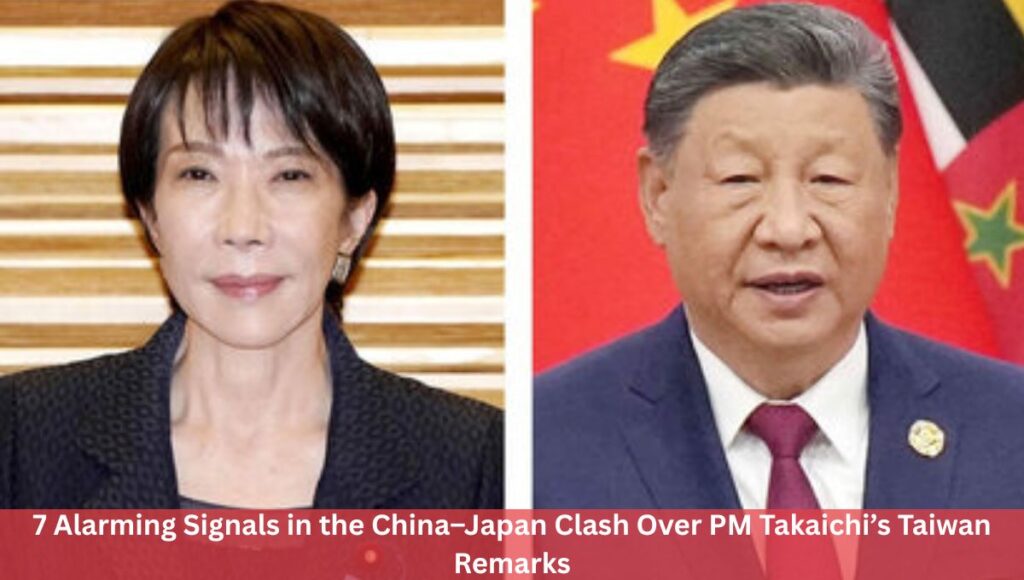
7 Alarming Signals in the China–Japan Clash Over PM Takaichi’s Taiwan Remarks
China Issues Travel Warning as Diplomatic Clash Erupts
China’s Foreign Ministry published a stark advisory urging Chinese citizens to avoid traveling to Japan, claiming that recent comments from Prime Minister Sanae Takaichi about Taiwan have created “additional risks to the safety and security of Chinese citizens in Japan.”
This travel warning is the most concrete retaliatory step Beijing has taken so far. While largely symbolic, it demonstrates China’s willingness to use its economic influence—and its millions of outbound tourists—as leverage in geopolitical disputes.
According to official statistics cited by NHK, 7.5 million Chinese tourists visited Japan between January and September this year, making China the country’s largest inbound tourism source. Any sharp decline could have immediate economic repercussions for Japan’s retail and hospitality sectors.
What Triggered the Crisis? Takaichi’s Taiwan Statement Explained
The diplomatic explosion stems from a seemingly routine question in Japan’s parliament. When asked which Chinese actions against Taiwan could trigger Japan’s right to collective self-defense under the 2015 security laws, Takaichi gave an unusually direct and explicit answer.
She stated that:
- A Chinese attack on Taiwan
- Any military operation around the island
- Deployment of Chinese battleships
…could constitute “a situation threatening Japan’s survival.”
This wording is crucial. Under Japanese law, such a scenario may allow Japan’s Self-Defense Forces (SDF) to join military operations alongside allies—most notably the United States.
For Beijing, which views Taiwan as a core national interest and non-negotiable “red line”, Takaichi’s statement was interpreted as Japan openly preparing to intervene in the Taiwan Strait.
China’s Fury: “Dirty Neck Must Be Cut Off”
Beijing’s anger escalated dramatically after Xue Jian, China’s Consul General in Osaka, reshared an article about Takaichi’s remarks with a chilling message:
“The dirty neck that sticks itself in must be cut off.”
The post was deleted shortly after, but the damage was done. The language immediately sparked outrage in Japan and ignited fierce online commentary in China, where nationalist sentiment has surged in recent years.
Chinese state media amplified the criticism, with some commentators attacking Takaichi personally. Hu Xijin, a prominent Chinese journalist, labeled Takaichi an “evil witch” who had ignited new waves of hostility between Chinese and Japanese citizens.
Diplomatic Firestorm: Ambassadors Summoned in Both Directions
Japan Summons China’s Ambassador
Tokyo called in China’s Ambassador Wu Jianghao to lodge a complaint over the “highly inappropriate” remarks made by Consul General Xue.
Japanese Foreign Minister Toshimitsu Motegi denounced the comments and urged Beijing to take “appropriate measures” to prevent deterioration of relations.
China Summons Japan’s Ambassador
Beijing responded by summoning Japanese Ambassador Kenji Kanasugi—marking the first formal summons in over two years.
Chinese Vice Foreign Minister Sun Weidong condemned Takaichi’s remarks as:
- “Erroneous”
- “Provocative”
- “Extremely serious in nature and impact”
He accused Japan of violating the One-China Principle and expressed anger that Tokyo refused to retract the statement.
Sun warned that Japan must “bear all consequences” if it continues on what Beijing called the wrong path.
China’s Military Threat: “Japan Will Suffer a Crushing Defeat”
China’s reaction escalated even further as its Ministry of Defense issued an explicit military warning, declaring that:
If Japan dares to intervene in the Taiwan question, it will suffer a crushing defeat.
A commentary in the People’s Liberation Army Daily similarly stated that any Japanese military response in the Taiwan Strait would be met with a “head-on blow.”
This aggressive rhetoric came as Taiwan reported heightened Chinese military activity:
- 21 Chinese aircraft detected
- 18 crossing the Taiwan Strait median line
- Multiple naval vessels operating near Taiwan
The heightened military presence adds serious weight to the diplomatic crisis, raising fears of miscalculation.
Tokyo Maintains Its Position Despite Pressure
Despite mounting threats, Tokyo has refused to retract Takaichi’s comments. Japanese officials insist the prime minister’s statement was:
- Hypothetical
- Fitting within discussions of “existential crisis situations”
- Consistent with Japan’s right to collective self-defense
Chief Cabinet Secretary Minoru Kihara emphasized that “peace and stability in the Taiwan Strait” are vital for both Japan and the wider international community.
Takaichi herself later clarified that she would refrain from making such hypothetical remarks in parliament again—but she did not retract the original statement.
Why Takaichi’s Words Hit a Nerve in Beijing
To understand why the China–Japan tensions escalated so rapidly, it’s important to consider three key factors:
1. Taiwan Is China’s Core National Interest
Beijing views Taiwan as its territory and has repeatedly said it will pursue reunification—by force if necessary. Any suggestion of foreign military involvement triggers immediate backlash.
2. Japan’s Security Laws Are Evolving
Japan’s 2015 security legislation allows collective self-defense, a major shift from its postwar pacifism. Beijing fears Japan is edging closer to a more assertive military posture.
3. China Distrusts US–Japan Alliance Strengthening
Takaichi is a strong supporter of closer defense ties with Washington. Beijing sees this as an attempt by Japan and the US to contain China’s regional ambitions.
Rising Anti-Japanese Sentiment in China Intensifies the Crisis
China’s reaction to Takaichi’s statement did not occur in a vacuum. Public sentiment toward Japan has grown increasingly nationalistic, fueled by:
- State media narratives
- Historic grievances over Japan’s wartime actions
- Japan’s growing alignment with Taiwan and the US
The Consul General’s inflammatory post poured gasoline on an already volatile public atmosphere. Beijing’s travel advisory indirectly reflects these domestic pressures.
How the Crisis Threatens Asia-Pacific Stability
The China–Japan relationship has always been delicate, but this clash strikes at the heart of three strategic fault lines:
The Taiwan Question
Any escalation could drag major powers—including the US—into conflict.
Military Posturing
With Chinese jets crossing the median line and Japanese defense build-up underway, military miscalculations are possible.
Economic Fallout
The travel warning could affect tourism, trade, and diplomatic ties, which both nations have tried to stabilize in recent years.
The Meeting That Failed to Prevent Crisis
Ironically, the clash erupted less than two weeks after Takaichi and Chinese President Xi Jinping held their first-ever meeting on the sidelines of an international summit.
Both leaders had agreed to pursue “constructive, stable ties.”
The speed with which relations collapsed underscores how fragile the China–Japan relationship remains—and how central Taiwan is to regional tensions.
Will This Crisis Push China and Japan Closer to Conflict?
Several factors will determine whether the situation escalates or stabilizes:
Japan’s Strategic Ambiguity
Historically, Japanese leaders avoid directly linking Taiwan to military action. Takaichi’s shift toward more explicit language marks a turning point.
China’s Increasing Aggression
Beijing’s warnings—military and diplomatic—reflect growing confidence and willingness to use coercive tools.
US Influence
Washington maintains strategic ambiguity on Taiwan, but its alliance with Japan means it cannot remain uninvolved in a major crisis.
Domestic Politics
Takaichi’s assertiveness appeals to conservative voters; Chinese leaders also rely on nationalism to maintain support.
With both sides unwilling to back down, diplomatic tensions may continue rising before any meaningful de-escalation occurs.
Conclusion: A Dangerous New Chapter in China–Japan Relations
The current crisis marks one of the most serious confrontations between China and Japan in years. What started as a parliamentary exchange has spiraled into:
- Reciprocal ambassador summons
- Travel warnings
- Public threats
- Military intimidation
- Intensified nationalist sentiment
With Taiwan at the center of the dispute, the crisis taps into deep historical, political, and strategic tensions. For now, both governments insist they want stability. But their actions—and escalating rhetoric—suggest that the risk of miscalculation is growing, and the Asia-Pacific region may be heading into an increasingly turbulent period.
Also Read: Sanae Takaichi Becomes Japan’s First Female Prime Minister 2025
Also Read: Explained: How Japan PM Takaichi’s Taiwan remarks triggered a diplomatic storm with China
Related Posts:
- 5 Major Takeaways from the US Supreme Court's…

- In 8 Moves, EU Targets China-Linked Refineries and…

- 7 Powerful Facts About Ayatollah Ali Khamenei’s…

- 12 Explosive Shifts as Japan’s Iron Lady Takaichi…

- 7 Alarming Signs China–Japan Tensions Are Spiraling…
- 7 Heartbreaking Facts About Venezuela's Earthquake Disaster