7 Alarming Facts About the New US Bill Targeting the H-1B Visa Programme — A move that could end citizenship pathways and force millions to return home. The H-1B visa—long considered the bridge that allowed highly skilled foreign workers, especially Indians, to access world-class jobs in the United States—is facing an unprecedented threat.
Over the last few days, the American political landscape has erupted with back-to-back hardline proposals targeting the H-1B programme and broader immigration policies. At the centre of the storm is Republican Congresswoman Marjorie Taylor Greene, whose newly announced bill seeks nothing less than the complete elimination of the H-1B visa.
Her proposal, combined with an even more sweeping immigration freeze bill promised by Texas Congressman Chip Roy, has sparked intense debate across the US and abroad—especially in India, home to more than 70% of H-1B recipients.
This article breaks down the new bill, Trump’s surprising defence of the H-1B visa, the political backlash, and what it all means for Indian professionals, US companies, and the future of skilled immigration.
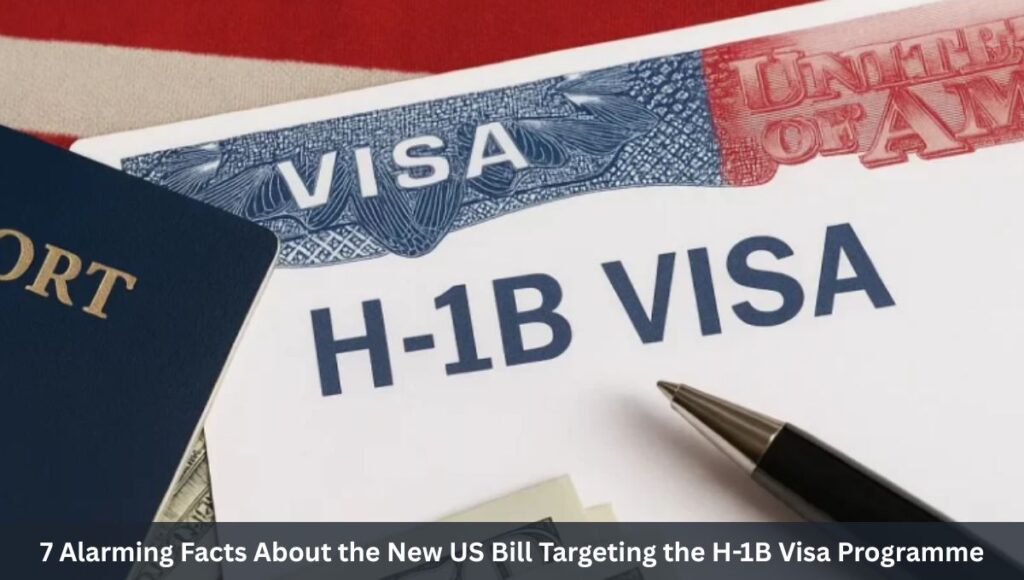
7 Alarming Facts About the New US Bill Targeting the H-1B Visa Programme
What the New H-1B Elimination Bill Proposes
In a video posted on X, Marjorie Taylor Greene announced her intention to introduce legislation that would terminate the H-1B visa programme entirely, including its long-standing pathway to US citizenship.
Complete Abolition of the H-1B Programme
Greene claims the visa category has been “riddled with fraud and abuse” and has displaced American workers for decades. Her proposal calls for:
- Total shutdown of all H-1B visas across sectors
- Mandatory return of all visa holders once their current status expires
- Removal of the path to permanent residency (Green Card)
- Eventual elimination of any exceptions, including for medical professionals
She stated emphatically:
“My bill eliminates the corrupt H-1B programme and puts Americans first.”
The Only Exemption—And Its Expiry
Greene’s bill contains one temporary exemption:
- 10,000 visas per year for doctors and nurses providing essential medical care.
However, even this exemption is not permanent. She proposes:
- A 10-year phase-out, after which no medical worker on an H-1B would be allowed.
Her justification: the US must build its own medical workforce pipeline instead of relying on foreign doctors.
Ending the Path to Citizenship
A central feature of the bill aims to stop employers from sponsoring H-1B workers for Green Cards. Once their visa expires, workers would have to return to their home countries.
Greene argues that the original intent of the H-1B was temporary, and it should not be a route to long-term residency.
Why Greene Wants the H-1B Programme Ended
According to Greene, American industries—especially Big Tech—have been using H-1B workers to replace American workers and suppress wages.
She accused companies such as:
- Big Tech & AI giants
- Hospitals
- Engineering firms
- Manufacturing companies
Her claim:
“Americans are the most talented people in the world. We must invest in them, not bring in foreigners to replace them.”
She also cited residency placement statistics:
- 9,000 US medical graduates did not secure residencies last year
- Over 5,000 foreign-born doctors did
She called the situation “entirely unfair” and “America last”.
Trump’s Stunning Reversal on H-1B Visas
Greene’s bill comes just days after a remarkable shift in tone from President Donald Trump, who unexpectedly defended the H-1B programme during a Fox News interview.
Trump Says US Lacks Certain Talent
When Fox host Laura Ingraham pressed him, Trump replied:
“You don’t have certain talents. You can’t take people off an unemployment line and put them in a factory making missiles.”
This was a stunning statement because:
- Trump has historically been critical of the H-1B programme
- His administration has cracked down heavily on visa rules
- Many conservative commentators oppose H-1B visas
- Yet Trump now admits the US lacks sufficient domestic talent in key sectors like tech and defence
His defence of the visa programme created immediate backlash among conservative influencers, including:
- Benny Johnson
- Steve Bannon
- Fox host Will Cain
Cain later criticised the programme, arguing that 80% of H-1B roles are “entry level” and should be filled by young American workers.
Chip Roy’s Hardline Proposal: A Freeze on All Immigration
If Greene’s bill wasn’t dramatic enough, Texas Congressman Chip Roy went even further.
On The Benny Show, Roy announced he will introduce a bill to impose:
A COMPLETE FREEZE on ALL immigration into the United States
The Conditions for Ending the Freeze
Roy said immigration would remain frozen until the US:
- Reforms chain migration
- Ends the H-1B visa
- Eliminates birthright citizenship
- Implements ideological vetting
- Screens immigrants for adherence to Sharia law
- Strengthens national security protocols
His rhetoric was stark:
“We’re dealing with a massive Islamism problem… communities with no desire to assimilate.”
This language signals a sharp rightward shift in immigration debates, especially with the 2026 election environment intensifying.
The Trump Administration’s Recent H-1B Moves
Before Trump’s surprising defence of the programme, his administration took a major step that sent shockwaves through the global tech community.
The $100,000 H-1B Visa Fee
In September 2025, Trump issued a proclamation:
- Every new H-1B petition must include a $100,000 payment
- This applies to petitions filed after September 21, 2025
- Existing visa holders are not affected
The US State Department later clarified that:
- The fee applies only to new applications
- It includes those entering the 2026 lottery
This dramatic increase from the old fee of $1,500 immediately sparked:
- Panic among applicants
- Confusion in corporate HR departments
- Backlash from India
The White House later walked back parts of the policy due to the chaos.
Why the H-1B Visa Matters So Much for Indians
No country stands to lose more from these proposals than India, which dominates the H-1B programme.
Indians Make Up 70% of All H-1B Workers
According to USCIS data for 2024:
- Indians: 283,397 H-1B approvals
- China: ~46,000 (11–16%)
Together, India and China account for 84% of all H-1B visas.
The H-1B programme is especially crucial for:
- Software engineers
- AI researchers
- Data scientists
- Cloud specialists
- Doctors
- University researchers
- Start-up founders
Tech giants relying heavily on the programme include:
- Amazon
- Meta
- Microsoft
- Apple
Notably, both Satya Nadella and Sundar Pichai were originally H-1B workers before rising to the top of Microsoft and Google.
How Greene’s Bill Would Impact Indian Professionals
If Greene’s bill passes, the consequences for Indian workers would be severe.
No New H-1B Visas for IT Workers
The largest category of Indian migrants—software developers and tech experts—would be completely cut off.
Existing Workers Must Leave at Visa Expiry
With the path to Green Card removed, even current H-1B workers would be forced to return home.
Fewer Opportunities for Indian Doctors
Although 10,000 visas per year would remain temporarily, this exemption will vanish in a decade.
Indian Medical Students in the US Affected
Residency programmes receiving Medicare funds would be banned from admitting non-citizens.
Brain Drain Reversal
Many Indian families who spent years in the Green Card backlog would face deportation risks.
Why US Companies Are Nervous About This Proposal
Major US corporations depend on skilled immigration to fill gaps in:
- Artificial intelligence
- Cybersecurity
- Semiconductor engineering
- Healthcare
- Biotechnology
- Cloud infrastructure
A sudden end to the H-1B programme could:
- Slow innovation
- Push companies to outsource more jobs abroad
- Increase labour shortages
- Make American firms less competitive
- Raise project costs and timelines
Leading tech executives have historically argued that the US needs foreign workers to remain globally competitive.
Conservatives Divided Over H-1B
Interestingly, the Republican Party itself is split:
Pro-H-1B Conservatives
- Donald Trump (recent remarks)
- Corporate Republicans
- Tech-focused lawmakers
- Silicon Valley conservatives
They argue:
- US does not have enough domestic talent
- AI and defence require global expertise
- Skilled immigrants boost innovation
Anti-H-1B Conservatives
- Marjorie Taylor Greene
- Chip Roy
- Will Cain
- Steve Bannon
- Benny Johnson
- Palmer Luckey
They claim:
- The H-1B programme is abused
- Companies hire cheaper workers
- Americans lose jobs and wages
- Immigration must be cut drastically
This division signals internal conflict in the GOP heading into 2026.
Global Repercussions of Ending the H-1B Programme
If the US eliminates H-1B visas, the worldwide impact would be massive:
Effects on India
- Sharp decline in skilled migration
- Major hit to IT and tech collaboration
- Talent returning home could boost Indian start-ups
- Families stuck in the Green Card backlog impacted
Effects on US Companies
- Higher costs
- Loss of specialized talent
- Outsourcing shifts to India and Southeast Asia
- Slower innovation cycles
Effects on Global Tech Competition
The US may lose its edge in:
- AI
- Cybersecurity
- Robotics
- Defence technology
competitors like China could gain.
Is the US Really Looking to Scrap the H-1B Visa Entirely?
The situation is fluid.
What we know:
- Greene will introduce a bill to abolish H-1B visas
- Chip Roy will introduce a bill to freeze all immigration
- Trump defended the H-1B programme, surprising even his supporters
- Conservatives are divided
- US tech companies are alarmed
- Indian workers are anxious
Will the bill pass?
Not necessarily.
It would face:
- Strong corporate resistance
- Opposition from Democrats
- Pushback from moderate Republicans
- Legal challenges
But the fact that such a bill is being seriously discussed signals a major shift in US immigration politics.
Conclusion: A Turning Point for the Future of Skilled Immigration
The battle over the H-1B visa programme has become a defining issue in the wider debate about America’s identity, economy, and global competitiveness. Marjorie Taylor Greene’s proposal to end the H-1B programme outright is one of the most aggressive immigration measures introduced in decades.
Chip Roy’s call for a total immigration freeze goes even further. Yet Trump’s defence of the programme adds complexity—and highlights the deep divide within conservative politics. For India, the stakes are enormous. With over 70% of H-1B visas going to Indian nationals, any drastic change would reshape the lives of hundreds of thousands of workers, families, students, and future applicants.
For now, the world is watching closely as the US confronts questions that will shape the future of global talent, innovation, and migration.
Also Read: 7 Bold Policy Shifts: Trump’s Stunning Change of Heart on H-1B, Tariffs, and Foreign Students
Also Read: Trump’s support for H-1B reignites debate over skilled-worker visas