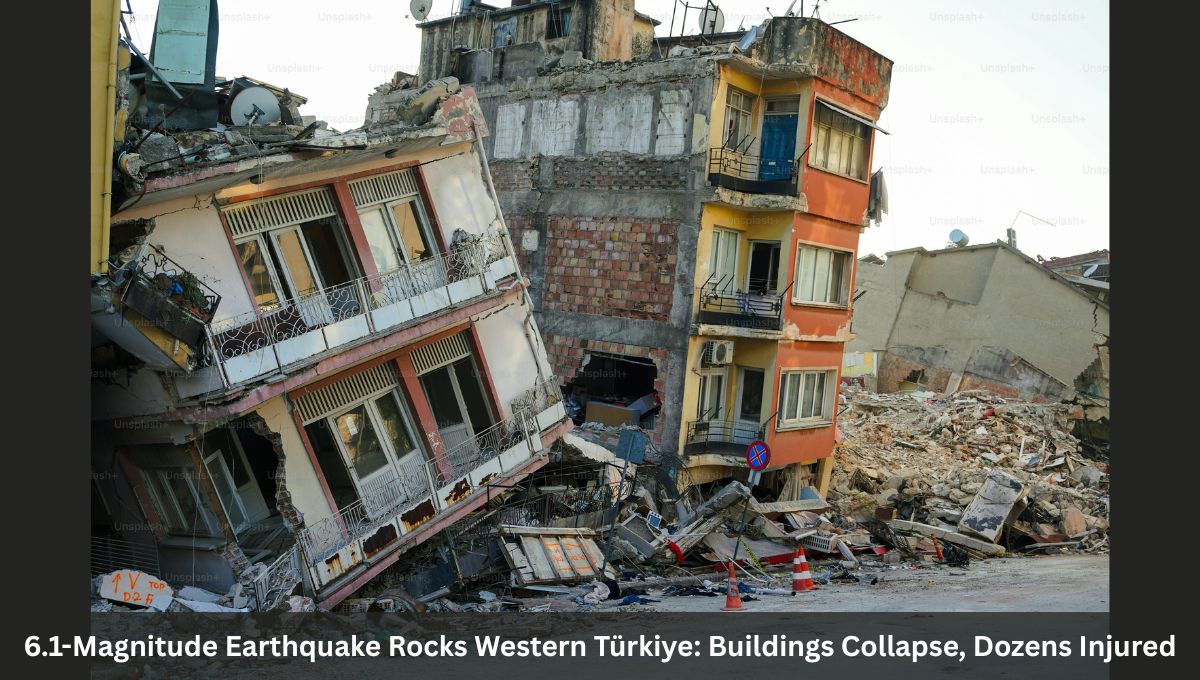
6.1-Magnitude Earthquake Rocks Western Türkiye: Buildings Collapse, Dozens Injured, no fatalities reported. A powerful 6.1-magnitude earthquake struck western Türkiye late Monday night, shaking cities across the Marmara region and leading to the collapse of several previously damaged buildings. At least 22 people were injured, most of them in panic-related incidents, authorities said.
Key Highlights
- The 6.1-magnitude earthquake struck Sindirgi in Balikesir province at 10:48 p.m. local time.
- Three vacant buildings and a two-story shop collapsed; no deaths have been reported.
- Tremors were felt in Istanbul, Izmir, Bursa, Manisa, and Kocaeli.
- 22 people were injured, mostly from falls or panic.
- Experts said the quake’s energy release was comparable to an atomic bomb.
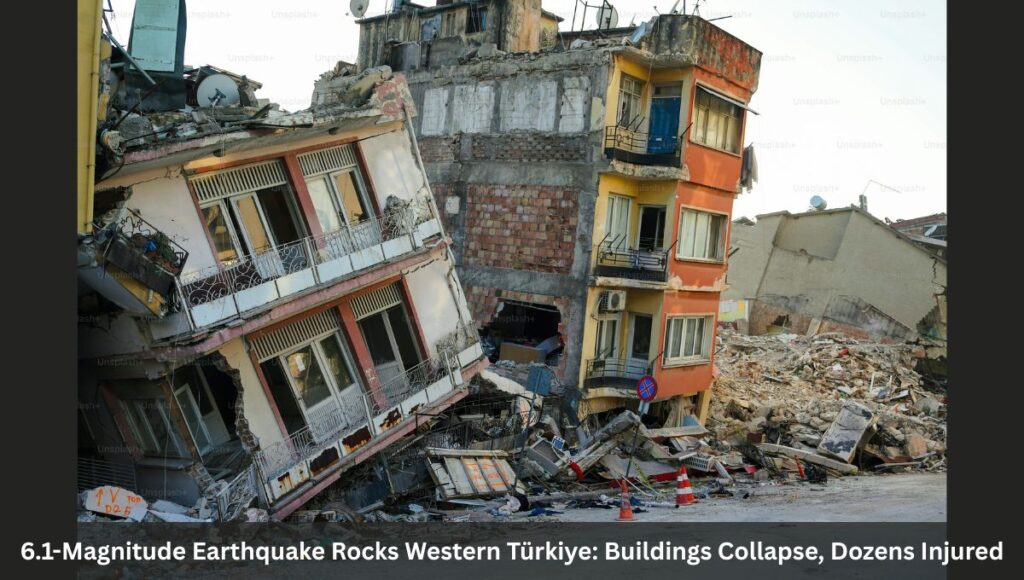
6.1-Magnitude Earthquake Rocks Western Türkiye: Buildings Collapse, Dozens Injured
Epicenter and Scale of the Quake
The Disaster and Emergency Management Authority (AFAD) confirmed that the earthquake’s epicenter was located near the Sindirgi district in Balikesir province, western Türkiye. The tremor occurred at 10:48 p.m. local time (1948 GMT) at a depth of approximately 6 kilometers (3.7 miles).
The quake was strong enough to rattle buildings in Istanbul, nearly 200 kilometers away, and was felt across nearby provinces including Bursa, Manisa, Izmir, Canakkale, and Kocaeli. Dozens of aftershocks, some exceeding magnitude 4, were recorded overnight.
AFAD reported that emergency teams were dispatched immediately to the region to assess structural damage and ensure the safety of residents.
Buildings Collapse but No Fatalities Reported
Interior Minister Ali Yerlikaya confirmed that at least three unoccupied buildings and a two-story shop collapsed in Sindirgi. The affected structures had been previously condemned following a 6.2-magnitude earthquake in August that had already weakened much of the local infrastructure.
“So far, we have not identified any loss of life, but we are continuing our assessment,”
— said Sindirgi district administrator Dogukan Koyuncu, speaking to state-run Anadolu Agency.
Balikesir Governor Ismail Ustaoglu said that 22 people were injured, mainly due to falls, panic attacks, or jumping from buildings. Most of the injuries were minor, and hospitals in Sindirgi and Balikesir were treating patients for trauma-related symptoms.
Residents Spend the Night Outdoors
Following the quake, many residents refused to return home, fearing aftershocks. Local broadcaster Haberturk reported that several families spent the night in open spaces, parks, or their vehicles.
As rain began to fall, authorities opened mosques, schools, and sports halls to provide temporary shelter for those unwilling to sleep indoors.
Governor Ustaoglu said that public buildings will undergo structural inspections, and schools in Balikesir would remain closed on Tuesday for safety evaluations. Pregnant and disabled public employees were also granted temporary leave.
Government and Emergency Response
The Information and Communication Technologies Authority (BTK) reported a temporary spike in mobile traffic immediately after the earthquake but confirmed there were no lasting disruptions to communications networks.
Search and rescue teams from AFAD, along with local police, gendarmerie, and health officials, were deployed overnight to assess rural areas and respond to emergency calls. Authorities also urged citizens to avoid damaged buildings until safety inspections were complete.
By early Tuesday morning, AFAD had set up crisis coordination centers in Balikesir, Izmir, and Bursa, to monitor ongoing seismic activity and manage relief efforts.
Expert Opinions: ‘Energy Equivalent to an Atomic Bomb’
Prominent Turkish geologist Professor Okan Tuysuz said the earthquake released energy comparable to the Nagasaki atomic bomb, underscoring its potential impact had it struck a densely populated area.
“The Sindirgi region has experienced over 12,000 tremors since August 10, and seismic activity is likely to continue,”
— Professor Tuysuz told local media.
He advised residents to stay away from structurally compromised buildings, warning that the risk of aftershocks remains high in the coming days.
Professor Naci Gorur, a member of the Turkish Science Academy, added that the quake was part of ongoing fault activity in the Gordes–Demirci–Selendi–Usak graben system and would not trigger the Marmara fault, which poses the greatest risk to Istanbul.
Another expert, Professor Sener Usumezsoy, stated that the earthquake’s epicenter was in mountainous terrain near Sindirgi, reducing its destructive potential. He emphasized that while the frequency of western Anatolian earthquakes has increased, the distribution of seismic energy across multiple events “is relatively favorable.”
Recurring Seismic Activity in Sindirgi and Western Türkiye
The Sindirgi district has been repeatedly shaken by moderate to strong quakes in recent months. In August 2025, a 6.2-magnitude earthquake struck the same region, killing one person and injuring 29 others. That quake also caused extensive property damage, leaving several buildings structurally unsafe.
Since then, western Türkiye’s Balikesir province has registered thousands of smaller tremors, leading experts to classify it as one of the country’s most active seismic zones this year.
AFAD has recorded an increase in microseismic activity across western Anatolia, particularly along the Gordes–Demirci–Selendi–Usak fault line, suggesting a redistribution of tectonic stress in the region.
Historical Context: Türkiye’s Earthquake Vulnerability
Türkiye lies along several major fault lines, including the North Anatolian Fault (NAF), one of the most seismically active in the world. The country frequently experiences moderate to strong earthquakes, particularly in the Marmara and Aegean regions.
In February 2023, a 7.8-magnitude earthquake devastated 11 southern and southeastern provinces, killing more than 53,000 people and destroying or severely damaging hundreds of thousands of buildings. The disaster also affected northern Syria, where 6,000 additional deaths were reported.
That catastrophe remains Türkiye’s deadliest earthquake in modern history, prompting nationwide building code reforms and stricter construction inspections.
Authorities Urge Preparedness and Caution
In the aftermath of Monday’s quake, Türkiye’s Interior Ministry and AFAD urged residents to follow official safety guidelines, including:
- Avoid entering damaged or cracked buildings until cleared by authorities.
- Keep emergency kits and flashlights ready for potential aftershocks.
- Stay informed through official AFAD updates and emergency broadcasts.
The Balikesir Governor’s Office said damage assessment teams would continue inspections across affected districts throughout the week. Local authorities also assured residents that relief supplies, medical teams, and shelter options were available.
Communication Restored, Inspections Underway
By Tuesday morning, AFAD reported that communication and transportation infrastructure had been fully restored in Balikesir province. No power outages were reported, though minor road damage was detected in rural areas.
Municipal engineers have begun comprehensive building inspections in Sindirgi and surrounding villages, prioritizing hospitals, schools, and government buildings.
Authorities have also dispatched psychological support teams to assist residents coping with post-quake anxiety — a measure introduced following the trauma of the 2023 earthquakes.
Outlook: Continued Aftershocks Expected
Experts from the Kandilli Observatory and Earthquake Research Institute warned that aftershocks could continue for several weeks, some strong enough to cause additional structural weakening.
Residents were advised to remain alert but avoid panic, as ongoing AFAD monitoring systems continue to track fault movement in the western Anatolia seismic belt.
As Türkiye marks another reminder of its geological volatility, officials reiterated the importance of earthquake preparedness, building safety, and public awareness.
Conclusion
While no fatalities have been reported from Monday’s 6.1-magnitude earthquake in western Türkiye, the incident highlights the country’s persistent seismic risks and the ongoing need for infrastructure resilience.
With aftershocks continuing and residents still reluctant to return home, authorities are maintaining emergency shelters and conducting detailed inspections to ensure safety in the days ahead. Officials and experts alike emphasize that while the energy released was immense, the relatively low casualty count is a reminder that preparedness and quick response can significantly reduce disaster impacts in a quake-prone nation like Türkiye.
Also Read: Philippines Earthquake Kills 69: Miss Asia-Pacific Contestants Flee Stage
Also Read: Is it safe to travel to Turkey right now? Latest advice after 5.8 magnitude earthquake
Related Posts:
- 6.1 Magnitude Earthquake Strikes Turkey’s Balikesir…

- 7 Heartbreaking Facts About Venezuela's Earthquake Disaster

- 6.3-Magnitude Earthquake Devastates Northern Afghanistan

- 5 Major Takeaways from the US Supreme Court's…

- 7 Dead in Explosive Iran Protests as Economic Anger…

- Another Earthquake Strikes Afghanistan After 1,400…