

Yemen War 2025: Israeli Strike Kills Houthi Military Chief in ‘Major Blow’ amid fragile Gaza ceasefire. Yemen’s Houthi movement said on Thursday that its Chief of Staff, Major General Muhammad Abd al-Karim al-Ghamari, has been killed “while fulfilling his duties,” in what Israel later claimed as a targeted airstrike on the Yemeni capital, Sanaa. The announcement marks one of the most significant losses for the Iran-backed Houthi movement in years, as Israel intensifies its regional operations amid a U.S.-brokered ceasefire with Hamas in Gaza.
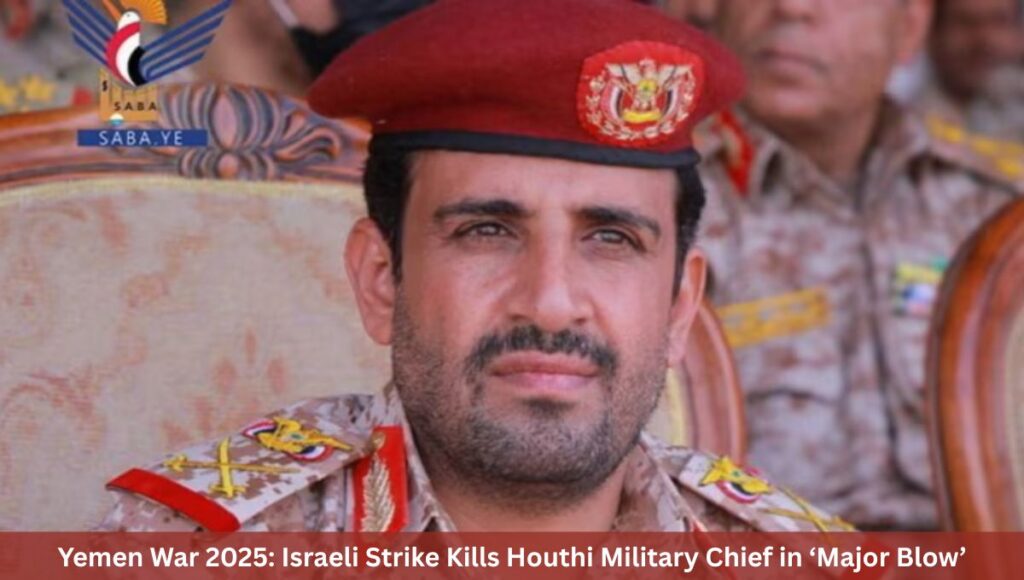
Yemen War 2025: Israeli Strike Kills Houthi Military Chief in ‘Major Blow’
Israel Confirms Responsibility
Within hours of the Houthi statement, Israeli Defence Minister Israel Katz said al-Ghamari had been targeted in an Israeli strike, calling the operation part of Israel’s ongoing campaign to “remove significant threats” posed by the Houthis.
“We will reach all those who sought to harm us,” Prime Minister Benjamin Netanyahu said in a statement. “Another chief of staff in the line of terror commanders who aimed to destroy Israel has been eliminated.”
According to Katz, al-Ghamari died from injuries sustained in an Israeli airstrike in late August that had also killed the Houthi prime minister and several cabinet ministers.
The Israel Defense Forces (IDF) confirmed the operation, stating that it had targeted senior Houthi figures “responsible for coordinating attacks on Israel and Red Sea shipping.”
“We have worked hard against the Houthis to remove significant threats,” Katz said. “We will continue to do so against any threat in the future as well.”
Also Read: Houthi Prime Minister Ahmed al-Rahawi Killed in Israeli Airstrikes on Yemen’s Capital Sanaa
Houthi Confirmation and Reaction
In a statement published through the group’s military media wing, the Houthis said al-Ghamari was killed “in the honourable battle against the Israeli enemy,” alongside his 13-year-old son, Hussein, and several companions.
The group did not specify the date or location of his death but described him as a “martyr” who died in the line of jihadist duty.
“The rounds of conflict with the enemy have not ended, and the Zionist enemy will receive its deterrent punishment for the crimes it has committed,” the Houthi statement read.
The group praised al-Ghamari’s role in Yemen’s armed resistance and vowed that “others in leadership and the military will continue his path.”
Houthi Leader Pledges Retaliation
In a televised address, the Houthis’ supreme leader, Abdel-Malik al-Houthi, hailed al-Ghamari as one of Yemen’s “most steadfast commanders,” describing his death as a “sacrifice for the cause of resistance.”
“We have offered our leaders as sacrifices to God,” he said. “The Yemeni armed forces will not stand down. The enemy will face a deterrent punishment.”
Abdel-Malik al-Houthi accused Israel of “repeated brutal attacks” on Yemen and vowed retaliation if “aggression continues.” He also warned that Yemen’s forces remained ready to resume attacks against Israeli and Western targets should Israel violate the ongoing Gaza ceasefire.
A Blow to Houthi Command
Major General Muhammad al-Ghamari had been a central figure in the Houthi military command since 2016, when the group’s Supreme Political Council appointed him as Chief of Staff. He was later promoted to commander-in-chief in 2021, replacing Abdul Khaleq al-Houthi, the brother of the group’s leader.
Al-Ghamari had been sanctioned by both the United Nations and the U.S. Department of the Treasury, accused of threatening Yemen’s stability and obstructing the country’s peace process.
The U.S. Treasury cited him under Executive Order 13611, which targets individuals “undermining Yemen’s political transition and national security.”
A 2017 UN Security Council report described him as a “key strategist” behind Houthi offensives and missile operations, linking him to campaigns that targeted both Saudi Arabia and international maritime routes.
Long Campaign of Israeli Strikes in Yemen
Israel has launched several rounds of airstrikes against Houthi-controlled Yemen since the Gaza war erupted in October 2023, targeting drone and missile launch sites as well as key command facilities.
The latest series of attacks, conducted in late August and September, targeted what Israel described as “Houthi leadership compounds” in Sanaa, killing senior officials, including Yemen’s Houthi-run prime minister.
The Israeli military said these operations were aimed at preventing drone and missile attacks on Israeli territory and Red Sea shipping lanes.
Houthis, for their part, claimed that they had conducted 758 military operations during the Gaza war, deploying over 1,800 drones and missiles. Most of their missiles aimed at Israel have been intercepted by Israeli or U.S. defense systems.
Houthis’ Regional Role and Iran’s Support
The Houthis, officially known as Ansar Allah, have been one of the key members of Iran’s “Axis of Resistance”, alongside Hezbollah in Lebanon and Iraqi militias.
They have controlled much of northwestern Yemen, including the capital Sanaa, since ousting the internationally recognised government in 2014. Their rise triggered a devastating civil war and a Saudi-led military intervention.
Since 2023, the Houthis have emerged as a regional actor by extending their attacks beyond Yemen’s borders — particularly into the Red Sea and Gulf of Aden — in what they call “solidarity operations” with the Palestinians in Gaza.
Their actions have drawn repeated airstrikes from the United States and the United Kingdom, who accuse the group of endangering global shipping routes.
Impact on Fragile Gaza Ceasefire
Al-Ghamari’s death comes six days into a fragile ceasefire between Israel and Hamas, mediated by the United States, Qatar, and Egypt.
The truce temporarily halted Israel’s two-year war in Gaza, which, according to local health authorities, has killed nearly 68,000 Palestinians and displaced millions.
Rights groups and a United Nations Commission of Inquiry have accused Israel of committing acts amounting to genocide, allegations that Israel strongly denies.
While the ceasefire has quieted fronts in Gaza and Lebanon, Israel’s strike on Yemen underscores the volatile regional dimensions of the conflict, which still involve multiple actors across the Middle East.
A senior Israeli security official, speaking on condition of anonymity, told reporters that the “Houthi threat remains active”, and the latest operation was “a necessary pre-emptive measure.”
U.S. and U.K. Responses
The United States and United Kingdom have not commented directly on al-Ghamari’s killing but have repeatedly expressed concern over Houthi attacks in the Red Sea, which they say endanger global commerce.
In recent months, U.S. and British forces have conducted joint strikes on Houthi sites in Yemen, targeting missile depots, radar installations, and drone launch pads.
Washington maintains that the strikes are defensive, aimed at protecting commercial vessels and ensuring freedom of navigation through the Bab el-Mandeb Strait, one of the world’s busiest maritime chokepoints.
Houthi Military Campaign and Civilian Toll
The Houthis claim their military and naval operations are a “victory for resistance”, crediting leaders like al-Ghamari for what they describe as Yemen’s “steadfastness against aggression.”
Their statement accused Israel and the U.S.-led coalition of launching “brutal attacks” against Yemeni civilians, destroying residential neighbourhoods, infrastructure, and economic facilities.
“Our people have faced these crimes with patience, strength, and resilience,” the statement said.
Humanitarian agencies have warned that Yemen, already devastated by years of conflict and famine, is now facing new humanitarian pressures as the regional conflict widens.
The United Nations says more than 21 million Yemenis — roughly two-thirds of the population — require humanitarian assistance.
Reactions from Israel and Allies
Israeli Prime Minister Benjamin Netanyahu praised the strike as a “decisive achievement” and reaffirmed Israel’s intent to pursue militant leaders across the region.
“The determined hand of Israel will reach all those who aim to destroy us,” he said in a televised address.
Katz, echoing similar remarks, described al-Ghamari’s death as “a continuation of Israel’s campaign to dismantle the Axis of Evil.”
“Ghamari has now joined his thwarted comrades of the Axis of Evil in the depths of hell,” Katz wrote on social media platform X.
He added that Israel’s Intelligence Directorate had played a key role in tracking Houthi commanders and that “further operations” were planned against remaining leadership targets.
Tense Regional Outlook
Analysts say the killing could further destabilise Yemen’s already fragile situation, especially as the Houthis seek to project defiance against both Israel and Western powers.
Regional observers note that while al-Ghamari’s death is a setback for the Houthis, it is unlikely to curb their ideological and military momentum.
“The Houthis thrive on martyrdom narratives,” said a Middle East security expert based in Amman. “The loss of a commander like al-Ghamari may even fuel more attacks rather than suppress them.”
As the Gaza ceasefire continues, attention is now turning to whether the Houthis will maintain their pause in Red Sea operations — or escalate in retaliation for the strike on Sanaa.
Conclusion
The killing of Major General Muhammad al-Ghamari represents both a symbolic and strategic moment in the ongoing regional struggle surrounding the Gaza war.
For Israel, it marks a high-profile success in countering threats from Yemen. For the Houthis, it deepens their sense of defiance and martyrdom. With tensions still simmering across the Middle East, and fragile truces in both Gaza and Lebanon, analysts warn that the conflict’s regional spillover remains far from over.
Also Read: Israeli strike on Yemen’s Houthis reportedly kills eight
Related Posts:
- Houthi Prime Minister Ahmed al-Rahawi Killed in…

- Hezbollah Commander Ali Abd al-Qader Ismail Killed…

- 11 Defining Moments: Hamas Confirms Death of Abu Obeida

- 10 Explosive Strikes: Israel Bombs Tehran Oil Depots…

- 3 Explosive Conditions Iran Sets to End War with US…

- 5 Key Developments as Israel Confirms Hamas Handed…
