
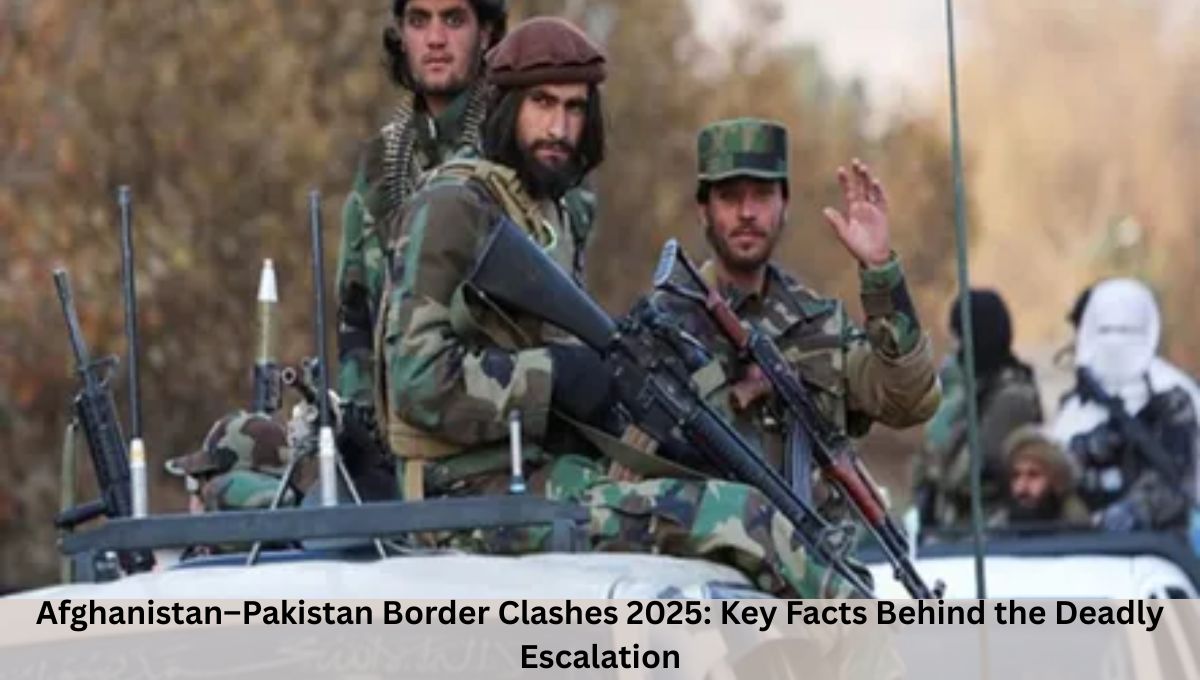
Afghanistan–Pakistan Border Clashes 2025: Key Facts Behind the Deadly Escalation of Cross-Border Violence Since 2021. In one of the most violent flare-ups between Afghanistan and Pakistan in recent years, the Taliban government in Kabul has claimed responsibility for a series of retaliatory attacks along the border that allegedly killed 58 Pakistani soldiers.
Islamabad, in turn, denounced the strikes as “unprovoked” and vowed to respond “with a stone for every brick.” The fierce exchanges have triggered a diplomatic scramble across the region, with Saudi Arabia, Iran, and Qatar calling for restraint, while analysts warn the conflict could destabilize an already volatile frontier.
Afghanistan–Pakistan Border Clashes 2025: Key Facts Behind the Deadly Escalation
1. The Retaliation Claim: Taliban Confirms Deadly Border Assaults
The Taliban administration confirmed that its forces carried out coordinated assaults against Pakistani troops in multiple mountainous regions along the border.
According to Zabihullah Mujahid, the Taliban’s chief spokesman, the operations were “retaliatory” in nature, conducted after Pakistan allegedly violated Afghan airspace and bombed a market in the Paktika province on Thursday.
Mujahid said that 58 Pakistani soldiers were killed and about 30 others wounded, while nine Taliban fighters lost their lives and up to 18 were injured.
“These were defensive operations in response to aggression. Afghanistan will never allow its sovereignty to be violated,” Mujahid told reporters in Kabul.
He claimed Taliban fighters captured 25 Pakistani army posts along the border, including in Kunar and Helmand provinces, destroying military equipment and seizing weapons.
Pakistan has not officially confirmed the casualties, though officials acknowledged intense fighting in Bajaur, Kurram, Dir, Chitral, and Angoor Adda districts.
2. Pakistan’s Response: ‘Unprovoked and Hostile’
Pakistan’s Interior Minister Mohsin Naqvi strongly condemned the Afghan attacks, labeling them “unprovoked acts of aggression.” “The firing by Afghan forces on civilian populations is a blatant violation of international law,” Naqvi said in a televised statement, warning Kabul of a “befitting reply like India.”
His remarks referred to Pakistan’s earlier standoff with India this year, which had brought the two nuclear-armed neighbors to the brink of confrontation. Naqvi added that Pakistan’s forces were exercising restraint but “would respond with full force if provoked again.”
A Pakistani military spokesman said troops had taken necessary defensive measures “to safeguard Pakistani lives and property,” while Prime Minister Shehbaz Sharif called the attacks “provocations” that would not go unanswered.
3. Eyewitness Accounts: Cross-Border Fire and Heavy Weaponry
According to security and police officials stationed near the Kurram district, intense gunfire began around 22:00 local time (17:00 GMT) on Saturday. Witnesses reported the use of artillery, rockets, and heavy machine guns, lighting up the night sky across multiple border points.
Pakistani officials said Afghan forces opened fire in several northwestern districts — Chitral, Bajaur, Mohmand, Khyber, and Kurram — prompting retaliatory shelling from Pakistani positions. Footage shared by Pakistani security sources showed tracer rounds and artillery fire directed toward Afghan positions.
A police officer near Zero Point, Kurram, told the BBC that “heavy weapons fire began suddenly from the Afghan side” and that several border villages came under fire. Unconfirmed reports also suggested that the Taliban had captured three Pakistani military outposts, though Islamabad has not verified these claims.
4. Background to the Escalation
The border violence followed what Afghan officials said was a Pakistani airstrike in Kabul earlier this week.
A Pakistani security source told Reuters that the strike targeted the leader of Tehreek-i-Taliban Pakistan (TTP), who was allegedly traveling in a vehicle in the Afghan capital. It remains unclear if the militant survived.
In retaliation, Afghanistan’s Ministry of Defense announced “successful operations” against Pakistani military positions along the border, accusing Islamabad of violating Afghan sovereignty.
“If the opposing side again violates Afghanistan’s territorial integrity, our armed forces are fully prepared to defend the nation’s borders,” said ministry spokesperson Enayatullah Khowarazmi.
Also Read: Afghanistan-Pakistan border clashes: What we know so far
5. The TTP Factor and Pakistan’s Accusations
For years, Islamabad has accused the Afghan Taliban government of harboring militants from the Tehreek-i-Taliban Pakistan (TTP), a banned extremist organization responsible for numerous deadly attacks inside Pakistan.
The United Nations earlier reported that the TTP “receives substantial logistical and operational support from the de facto authorities” in Kabul — a charge the Taliban denies.
Pakistan’s Defence Minister Khawaja Muhammad Asif told parliament last week that efforts to convince the Taliban to restrain the TTP had failed. “We will not tolerate this any longer,” he said. “United, we must respond to those facilitating them, whether the hideouts are on our soil or Afghan soil.”
6. Kabul Denies Harboring Terrorists
The Afghan Taliban continues to reject Islamabad’s allegations, insisting that Afghan territory is not used against other nations.
“We have no problem with the people of Pakistan or its leadership,” said Afghanistan’s Foreign Minister Amir Khan Muttaqi, currently visiting New Delhi. “But there are groups in Pakistan that are trying to spoil the situation. Afghanistan has a right to keep its borders safe and to respond to violations,” he added.
The Afghan side maintains that Pakistan’s airstrikes inside Afghanistan were illegal and targeted civilian areas. Locals in Paktika province confirmed to Afghan media that a market was bombed, destroying several shops and injuring residents.
7. Regional and International Reactions
Saudi Arabia Calls for Self-Restraint
In a statement issued Sunday, Saudi Arabia’s Ministry of Foreign Affairs expressed “deep concern” over the border violence and called on both sides to “exercise self-restraint and embrace dialogue.”
“The Kingdom reaffirms its support for all efforts aimed at promoting peace and stability,” the statement said, underscoring Riyadh’s growing security partnership with Pakistan under a recently signed mutual defense pact.
Qatar and Iran Join Calls for Calm
Qatar’s Foreign Ministry also urged “dialogue, diplomacy, and restraint,” warning that further escalation could endanger regional stability. Meanwhile, Iranian Foreign Minister Abbas Araghchi called for “mutual restraint,” adding that stability between Afghanistan and Pakistan was “critical for the wider region.”
8. Rising Hostilities and Border Closure
The Torkham border crossing, one of the busiest trade and transit points between the two countries, remained closed on Sunday morning amid the clashes. Officials said that the usual 8 a.m. opening time had been delayed indefinitely as military operations continued on both sides.
The Durand Line, a 2,611-kilometer (1,622-mile) border drawn during British colonial rule, remains a longstanding source of friction between the two nations. Afghanistan has never formally recognized the boundary, which cuts through ethnic Pashtun territories spanning both countries.
9. Diplomatic Fallout: Kabul’s Ties with India Raise Tensions
The escalation coincided with Afghan Foreign Minister Amir Khan Muttaqi’s week-long visit to India, marking the first such high-level Taliban trip since 2021. During the visit, India and Afghanistan announced plans to reopen the Indian Embassy in Kabul and strengthen bilateral ties — a move that angered Islamabad.
Pakistan’s Foreign Office summoned the Afghan ambassador to express “strong reservations” about references to Jammu and Kashmir in the India–Afghanistan joint statement issued in New Delhi.
“It was conveyed that the reference to Jammu and Kashmir as part of India violates UN Security Council resolutions,” the statement read. The diplomatic rift deepened as Islamabad accused Kabul of aligning too closely with New Delhi, a country Pakistan considers its chief rival in South Asia.
10. Escalation Across Provinces
The Afghan Defense Ministry reported that clashes spread across Paktia, Paktika, Khost, Kunar, Helmand, and Nangarhar provinces. In Bahramcha district’s Shakij, Bibi Jani, and Salehan areas, Taliban forces claimed to have seized Pakistani positions, while Pakistan responded with heavy fire across the Durand Line.
Afghan state-run media RTA said the “revenge operation” captured several Pakistani outposts and inflicted heavy casualties. Local Afghan outlets, including TOLOnews, reported that Pakistan suffered significant losses, though these claims remain unverified by independent observers.
11. Mounting Security Concerns
Security experts warn that the Taliban’s show of force marks a new phase in Afghanistan–Pakistan relations. “This is the most severe border escalation since the Taliban returned to power,” said a South Asia analyst based in Islamabad. “Both sides are testing each other’s limits, but the risk of miscalculation is dangerously high.”
Cross-border militancy has intensified since 2021, with Pakistan recording a surge in TTP-led attacks targeting police and military personnel in Khyber Pakhtunkhwa and Balochistan provinces. Pakistani officials claim that TTP fighters operate freely from Afghan soil — a charge Kabul denies.
12. Voices from the Ground
Residents in border areas described a night of fear and confusion. “Explosions shook our houses, and gunfire lasted for hours,” said a villager from Kurram district. Afghan traders reported that several crossings were sealed, disrupting movement of goods and people.
“I was taking fruit to Pakistan when they closed the gate. Now the trucks are stuck,” said a driver near the Torkham crossing. Local humanitarian workers also expressed concern over potential civilian displacement if the fighting continues.
13. Regional Implications
The conflict poses new challenges for regional diplomacy, especially as India’s engagement with the Taliban grows. Analysts note that Pakistan views Kabul’s overtures to New Delhi as a strategic threat, complicating security cooperation.
Meanwhile, countries like Qatar and Saudi Arabia—which maintain channels with both sides—are attempting quiet mediation. A senior Gulf diplomat told Al Jazeera that “the risk is not just limited to the border—it could ripple into a larger proxy conflict if restraint is not observed.”
14. The Path Ahead
Both governments appear unwilling to back down. Pakistan insists on its right to target militants it says operate from Afghan territory, while Kabul maintains its right to defend sovereignty.
With border skirmishes expanding and diplomatic tensions deepening, regional players are now urging a return to dialogue before the situation spirals further.
For ordinary citizens living along the Durand Line, however, the violence is a grim reminder of how fragile peace remains between two uneasy neighbors bound by geography, history, and mutual suspicion.
Conclusion
The Afghanistan–Pakistan border crisis of 2025 underscores the deep mistrust and unresolved grievances that have plagued relations for decades.
With both nations exchanging fire and trading accusations, the risk of a prolonged standoff looms large. While external actors like Saudi Arabia, Iran, and Qatar are calling for restraint, real de-escalation will depend on whether Islamabad and Kabul can separate counterterrorism objectives from nationalist fervor.
For now, as gunfire echoes across the Durand Line, the shadow of instability once again hovers over South Asia.
Also Read: US Thanks Pakistan for Counterterrorism Cooperation Amid Tensions Over Pahalgam Attack
Related Posts:
- Pakistan’s Bold Airstrikes in Kabul: Af-Pak Crisis…

- Pakistan–Afghanistan Border Conflict 2025: Ceasefire…

- Afghanistan–Pakistan War 2025: Inside the 48-Hour Ceasefire

- 8 Shocking Developments in the Pakistan–Afghanistan…
- 5 Key Takeaways as Pakistan–Afghanistan Peace Talks…

- 7 Shocking Details: 13-Year-Old Executes Man Before…
