In a somewhat contradictory move, US Thanks Pakistan for Counterterrorism Cooperation Amid Tensions Over Pahalgam Attack. In the wake of the April 22 terrorist attack in Pahalgam, which claimed 26 civilian lives, the United States has extended appreciation to Pakistan for its cooperation in countering terrorism. This acknowledgment came during high-level talks between US Secretary of State Marco Rubio and Pakistan’s Deputy Prime Minister and Foreign Minister Ishaq Dar in Washington on Friday.
While India blames Pakistan-based groups for the attack, the US is walking a diplomatic tightrope, balancing security concerns with strategic partnership interests. The visit also saw discussions around expanding trade, critical mineral cooperation, and regional stability, particularly between India and Pakistan.
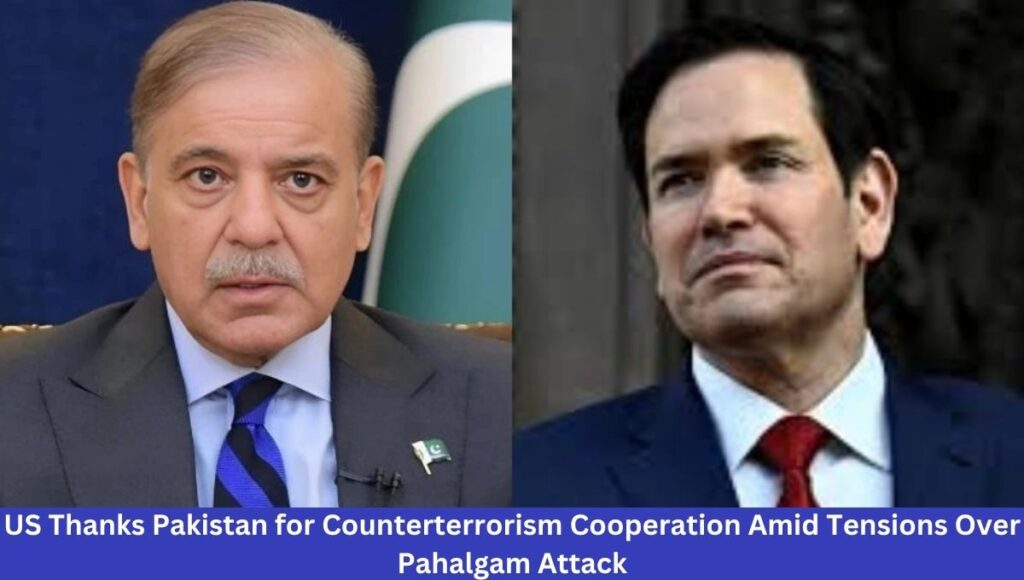
US Thanks Pakistan for Counterterrorism Cooperation Amid Tensions Over Pahalgam Attack
The Pahalgam Attack and Operation Sindoor: A Trigger for Regional Tensions
On April 22, 2025, the peaceful town of Pahalgam in Jammu and Kashmir was rocked by a horrific terror attack.
Twenty-six civilians lost their lives, and Indian intelligence later attributed the attack to The Resistance Front (TRF), a known front of Lashkar-e-Taiba (LeT) a Pakistan-based terror group.
India responded with a swift military counter-offensive under Operation Sindoor, launched on May 7, targeting terrorist infrastructure in Pakistan and Pakistan-occupied Kashmir (PoK).
The operation triggered three days of intense cross-border hostilities, resulting in several casualties and damage on both sides.
Ceasefire Brokered But By Whom?
The violence ended with a ceasefire declaration on May 10, which sparked a diplomatic spat over who played a role in brokering peace.
While Islamabad credited the United States, particularly President Donald Trump and Secretary Rubio, New Delhi outright rejected any foreign involvement, asserting that India-Pakistan issues are bilateral and must be resolved without third-party mediation.
“We remain grateful for the role played by the US in de-escalation of tensions leading to ceasefire,” said Pakistan Foreign Office Spokesperson Shafqat Ali Khan, speaking on the scope of Ishaq Dar’s visit to Washington.
India, however, has strongly denied any foreign mediation, maintaining its policy of no external intervention in India-Pakistan disputes.
TRF Designated as a Terrorist Group by the US
Just days before the Rubio-Dar meeting, the United States officially designated The Resistance Front (TRF) as a Foreign Terrorist Organization (FTO) and Specially Designated Global Terrorist (SDGT).
The move signals a tougher stance by Washington on Pakistan-linked terror networks.
This designation reflects increasing concern within the US over groups operating from Pakistani territory, despite official statements of cooperation.
Though the designation aligns with India’s long-standing accusations, Washington stopped short of blaming Islamabad directly for the Pahalgam massacre.
US Thanks Pakistan Despite Alleged Links to Terror
Secretary Marco Rubio publicly thanked Pakistan for its “partnership in countering terrorism and preserving regional stability.”
The statement, issued on social media and later echoed by State Department Spokesperson Tammy Bruce, was made after Rubio’s bilateral meeting with Ishaq Dar.
The leaders discussed several matters:
- Counterterrorism cooperation
- Regional tensions, especially with Iran and India
- Economic ties, particularly in critical minerals
- Plans for the upcoming US-Pakistan Counterterrorism Dialogue to be held in Islamabad in August
“Pakistan has played a constructive role in mediating regional conversations and supporting peace initiatives,” said Bruce.
This nuanced praise raised eyebrows in New Delhi, given India’s repeated assertion that Pakistan’s military and government directly support and harbor terrorist groups.
India’s Strong Reaction: “Pakistan Promotes Terrorism as Tourism”
Following the Pahalgam attack and Operation Sindoor, Prime Minister Narendra Modi delivered a powerful rebuke.
“While India believes in tourism, Pakistan considers terrorism as tourism, which is very dangerous for the world,” Modi declared in a televised address.
He added that terrorism is used as a tool for monetary gain by the Pakistani army and government, and he urged Pakistan’s civilian population to push back against state-sponsored extremism.
“Those who promoted terrorism ruined your future. Look at India we are now the fourth largest economy. Where does Pakistan stand?”
Modi’s statement was part of India’s broader campaign to internationalize the threat posed by Pakistan-sponsored terrorism, especially as tensions in Kashmir continue to simmer.
Close to a US-Pakistan Trade Deal?
During his Washington visit, Foreign Minister Ishaq Dar claimed that a trade deal between Pakistan and the United States is “just days away.”
Speaking at the Atlantic Council, Dar said negotiations were in the final stages.
“It’s not going to be months, not even weeks I would say days,” said Dar.
However, US officials were more cautious, with both Marco Rubio and the State Department stopping short of confirming any imminent agreement.
While discussions focused heavily on critical minerals, trade expansion, and economic cooperation, no timeline was offered for finalizing the deal.
Pakistan Eyes Critical Minerals Boom
Pakistan sees its untapped critical mineral resources as a key area for investment and strategic partnership.
At the Atlantic Council event, Ishaq Dar claimed that Pakistan’s mineral reserves are worth $6 to $8 trillion.
He invited American companies to explore mining opportunities, saying Pakistan offers favorable conditions and policy support for international investment.
“We are ready for a long-term strategic partnership, not a transactional one,” Dar emphasized.
With global demand for rare earth elements and critical minerals increasing, Pakistan’s pitch aligns with US efforts to diversify mineral sources beyond China, making the Pakistan-US minerals collaboration geopolitically significant.
US-Pakistan Counterterrorism Dialogue Set for August
One concrete outcome of Dar’s visit was confirmation of the US-Pakistan Counterterrorism Dialogue to be held in Islamabad in August 2025.
Both nations agreed to expand cooperation in countering regional threats, including ISIS-K, and addressing cross-border terrorism.
The dialogue is expected to focus on:
- Intelligence sharing
- Financial tracking of terror networks
- Capacity building in law enforcement
- Joint operations against transnational threats
This comes at a time when Pakistan is under pressure to demonstrate real action against groups like LeT and Jaish-e-Mohammed, which India and global watchdogs believe continue to operate with impunity.
Trump’s Role in the Ceasefire Dispute
Former President Donald Trump, who remains influential in foreign policy circles, has repeatedly claimed credit for the May 10 ceasefire between India and Pakistan.
Trump suggested that Washington’s pressure tactics and behind-the-scenes diplomacy helped de-escalate tensions.
While Islamabad supports this narrative, India has categorically denied that Trump played any role.
“India and Pakistan must resolve problems directly,” said an Indian government spokesperson, rejecting external mediation.
The differing accounts highlight the geopolitical complexity and mistrust that continues to plague India-Pakistan relations, even as global powers try to mediate.
Pakistan’s Balancing Act Between US and China
In Washington, Dar also addressed Pakistan’s ties with China, describing them as “strategic,” but not a hindrance to US relations.
“It’s not about choosing sides. We’ll go with whoever gives us the better deal,” said Dar. “We have great strategic relations with China, but we’ve also had a long-standing friendship with the US.”
Dar proposed that Pakistan could act as a bridge between China and the United States, helping navigate tensions between the world’s two largest economies.
Conclusion: A Diplomatic Tightrope for the US
The US is trying to walk a delicate diplomatic path. On the one hand, it’s sanctioning Pakistan-linked terror groups like TRF and expressing solidarity with India. On the other, it’s praising Pakistan’s counterterrorism cooperation and exploring multi-billion-dollar trade and mineral agreements.
With India and Pakistan at loggerheads, and terror attacks like Pahalgam still fresh in global memory, Washington’s moves will be watched closely by both regional powers.
Whether the US-Pakistan partnership evolves into a genuine strategic alliance or remains a transactional relationship will depend on Islamabad’s ability to act decisively against terror and New Delhi’s willingness to engage in constructive dialogue.
Also Read: Pakistan Brings Kashmir and Water Dispute to the Forefront at UN
Also Read: Days after listing TRF as terror outfit, US praises Pakistan’s role in ‘counter terrorism’
Related Posts:
- Pakistan Foreign Minister Ishaq Dar’s Historic Visit…
- Pakistan’s Ishaq Dar in Dhaka: Bangladesh Visit…
- 5 Key Shifts in Bangladesh–Pakistan Relations as…

- Afghanistan–Pakistan War 2025: Inside the 48-Hour Ceasefire

- Pakistan–Afghanistan Ceasefire 2025: Breakthrough…

- 5 Major Takeaways from the US Supreme Court's…