
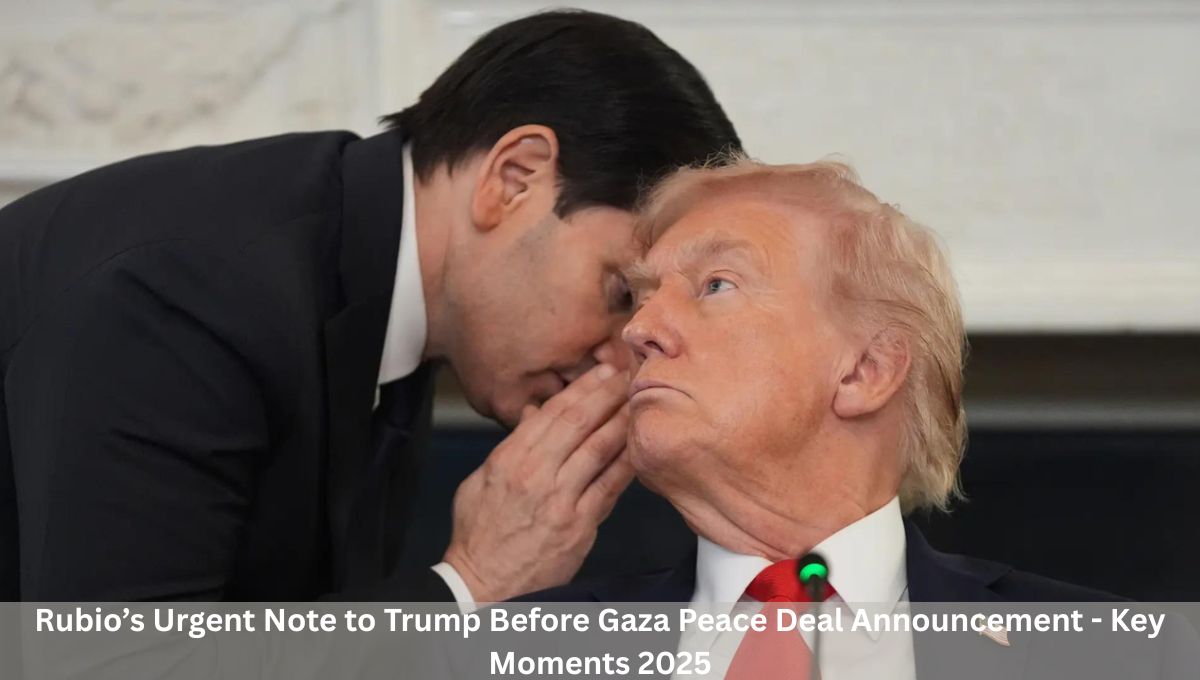
Secretary of State Rubio’s Urgent Note to Trump Before Gaza Peace Deal Announcement – Key Moments 2025. A White House event took an unexpected turn on Wednesday when U.S. Secretary of State Marco Rubio passed a handwritten note to President Donald Trump, signaling a breakthrough in Middle East peace negotiations. Within hours, Trump announced that Israel and Hamas had agreed to the first phase of a U.S.-led Gaza ceasefire plan, ending weeks of high-stakes diplomacy.
The scene unfolded during a roundtable discussion on antifa with conservative influencers in the White House’s Blue Room. The meeting, which had been underway for nearly two hours, was suddenly interrupted when Rubio caught Trump’s attention from a back corner of the room.
Rubio’s Urgent Note to Trump Before Gaza Peace Deal Announcement – Key Moments 2025
A Handwritten Note That Changed the Tone of the Event
According to multiple eyewitnesses and photographs published by the Associated Press, Rubio discreetly approached the president, whispered briefly, and handed him a folded piece of White House stationery.
The note, clearly captured by a photographer’s lens, read:
“You need to approve a Truth Social post soon so you can announce the deal first.”
Rubio’s message hinted at a major diplomatic development — a deal nearing completion in the Gaza peace talks that had been taking place in Sharm el-Sheikh, Egypt, between representatives of Israel, Hamas, and U.S. mediators.
Trump read the note carefully but continued addressing the attendees for several minutes before acknowledging the situation publicly.
“We’re very close to a deal in the Middle East,” he told the room. “They’re going to need me pretty quickly.”
The remark immediately sparked curiosity among attendees and reporters, as the president hinted at a historic breakthrough without giving away details.
The Gaza Talks: Context and Progress
The U.S.-led negotiations in Sharm el-Sheikh marked the third consecutive day of intense discussions involving Qatari Prime Minister Sheikh Mohammed bin Abdulrahman Al Thani, Egyptian envoys, and Trump’s senior Middle East adviser Steve Witkoff.
The talks aimed to finalize the first phase of Trump’s 20-point Gaza Peace Plan, focusing on a ceasefire, hostage release, and phased Israeli troop withdrawal from the Gaza Strip.
Sources close to the negotiations said both sides had exchanged lists of hostages and prisoners to be released under the initial agreement.
A senior Hamas official confirmed that progress had been made toward securing a “mutual and verifiable exchange,” adding that the final text of the deal was being reviewed by mediators from Qatar, Egypt, and Turkey.
Also Read: Trump’s 20-Point Gaza Peace Plan Gains Momentum: Talks Race Toward Breakthrough
Tense Moments in the Blue Room
Inside the White House, however, the atmosphere was markedly different.
As Rubio stood by, visibly anxious, Trump continued answering questions from conservative influencers about domestic policy, antifa, and national security. He even invited Attorney General Pam Bondi and Homeland Security Secretary Kristi Noem to take questions in his stead.
Ten minutes later, Trump paused and smiled. “I have to go now to try and solve some problems in the Middle East,” he said, adding: “Our Secretary of State is very capable — he could probably do an even better job than me, but who knows?”
Despite the lighthearted tone, those in the room sensed the gravity of the situation.
The Truth Social Post That Announced Peace
At 6:51 p.m., nearly two hours after receiving Rubio’s note, Donald Trump took to Truth Social to make the official announcement:
“I am very proud to announce that Israel and Hamas have both signed off on the first Phase of our Peace Plan,” Trump wrote.
He said the agreement would see hostages released “very soon” and Israeli troops withdrawing “to an agreed-upon line.”
Calling it a “GREAT Day for the Arab and Muslim World, Israel, all surrounding Nations, and the United States of America,” Trump thanked the mediators from Qatar, Egypt, and Turkey for helping secure the deal.
He concluded with a biblical flourish:
“BLESSED ARE THE PEACEMAKERS!”
Netanyahu Welcomes Deal, Calls It a ‘Great Day for Israel’
Shortly after Trump’s post, Israeli Prime Minister Benjamin Netanyahu welcomed the development on X (formerly Twitter), calling it a “great day for Israel.”
Netanyahu said he would convene the Israeli government to approve the agreement and ensure the safe return of all hostages.
Israeli Foreign Minister Gideon Sa’ar added that officials were “working with the Prime Minister to return all of our hostages, the living and the dead, to their homes and families — and to provide dignified burials for those we have lost.”
“With God’s help, may we have a holiday of peace and good news,” Sa’ar said.
Also Read: What we know about the Gaza ceasefire deal
A Race to Announce the Deal First
The urgency in Rubio’s note reflected a diplomatic race for credit — and optics. With multiple mediators involved, including Qatar and Egypt, the Trump administration was eager to ensure that the U.S. was first to announce the deal.
According to sources familiar with the process, the Qatari delegation had been preparing its own statement when Rubio intervened at the White House event. Trump’s Truth Social post effectively preempted any simultaneous announcements from other parties.
The decision underscored the political stakes surrounding the Gaza negotiations, as Trump seeks to position the U.S. — and his administration — as the primary architect of peace in the region.
Global Reactions: Cautious Optimism and Skepticism
The announcement drew a wave of cautious optimism from global leaders and organizations.
The United Nations welcomed the ceasefire framework, emphasizing that “the release of hostages and humanitarian access must remain top priorities.”
European Union officials said the deal marked a “critical step toward regional stability,” but urged both sides to adhere to the terms “in good faith.”
In Cairo and Doha, negotiators were seen celebrating the breakthrough after weeks of marathon talks.
However, analysts warned that implementation would be the real test, as both Israel and Hamas have differing interpretations of “withdrawal zones” and “security guarantees.”
A Diplomatic Turning Point for Trump and Rubio
The incident also highlighted the close coordination between Trump and Secretary of State Marco Rubio, who has taken a central role in Middle East diplomacy since his appointment earlier this year.
Rubio, a long-time foreign policy hawk, has worked to bridge communication between the U.S. administration and regional partners, including Qatar and Egypt.
Observers say Rubio’s visible urgency during the White House event reflected not only the time-sensitive nature of the talks, but also a desire to ensure Trump’s leadership remained front and center in the peace process.
“This was about timing, symbolism, and control of the narrative,” said a Washington-based diplomatic analyst. “In international politics, who announces first can shape how history remembers it.”
Behind the Scenes: A Week of Intensive Negotiations
The Gaza talks were part of a broader 20-point plan designed by U.S. diplomats to bring about a sustainable truce and rebuild trust between Israel and Hamas.
Key provisions of the plan include:
- Immediate cessation of hostilities across Gaza.
- Release of all hostages and detainees in coordinated phases.
- Gradual Israeli troop withdrawal from populated areas.
- Deployment of international observers to monitor compliance.
- Launch of reconstruction projects in cooperation with Egypt, Qatar, and Turkey.
Negotiations began three weeks ago, with multiple delegations shuttling between Cairo and Sharm el-Sheikh. Trump’s senior envoy, Steve Witkoff, played a key role in finalizing the terms.
Regional and Humanitarian Context
The breakthrough comes amid dire humanitarian conditions in Gaza.
According to the United Nations, more than 67,000 Palestinians have been killed and 169,000 injured since the conflict escalated in October 2023. Thousands more remain trapped or missing beneath rubble.
“Nearly one in four of the injured are children,” said UN spokesperson Stéphane Dujarric, “and more than 5,000 amputations have been recorded.”
Meanwhile, in Spain, lawmakers voted to impose an arms embargo on Israel, citing humanitarian concerns and urging an immediate ceasefire — a move that drew praise from human rights groups but criticism from Israeli officials.
The Gaza war has also strained relations across the Middle East, with several countries, including Jordan and Turkey, recalling ambassadors and suspending defense cooperation with Israel earlier this year.
Trump Signals Possible Visit to Egypt
During the White House event, Trump also hinted that he might travel to Egypt “toward the end of the week” to oversee the next phase of peace efforts.
“I was just dealing with people from the Middle East on the potential peace deal,” Trump told attendees. “Peace for the Middle East — that’s a beautiful phrase.”
He added that the negotiations were “going along very well” and that he might leave for Egypt “on Sunday, maybe Saturday evening,” depending on developments.
If confirmed, the visit would mark Trump’s first trip to the region since the renewed Gaza conflict began, signaling a more hands-on diplomatic approach as the ceasefire takes effect.
The Broader Impact: Diplomacy, Optics, and Legacy
The dramatic sequence — from Rubio’s note to Trump’s Truth Social post — has already become one of the defining images of the Trump administration’s diplomatic strategy.
Analysts say it reflects the blend of real-time communication and symbolic showmanship that has characterized Trump’s approach to foreign policy.
For Rubio, the moment reinforces his emerging image as a key diplomatic operator, entrusted with some of the administration’s most sensitive negotiations.
“Rubio’s intervention showed discipline, urgency, and strategic awareness,” said one State Department official. “It wasn’t just about a note — it was about ensuring the United States controlled the message and the momentum.”
Conclusion: A Note That Became History
What began as a small exchange of paper during a domestic policy discussion may well go down as a turning point in U.S.-brokered diplomacy.
Within hours of that brief moment in the White House Blue Room, a deal was sealed to halt one of the most devastating conflicts of recent years, bringing new hope for peace in Gaza.
As Trump’s post declared — and Rubio’s note had urged — timing was everything. The world learned of the agreement from the president himself, in his own words: “BLESSED ARE THE PEACEMAKERS.”
Related Posts:
- Trump Designates Antifa as Terrorist Organisation…

- Dramatic Moments Behind Trump’s Gaza Peace Push and…

- Trump’s 2025 Gaza Peace Plan Signing and Historic…

- Trump’s 2025 Nobel Peace Prize Snub: Politics Over…

- 5 Powerful Highlights as Trump Lands Second Nobel…

- Trump’s Breakthrough Gaza Ceasefire Deal 2025: Key Insights
