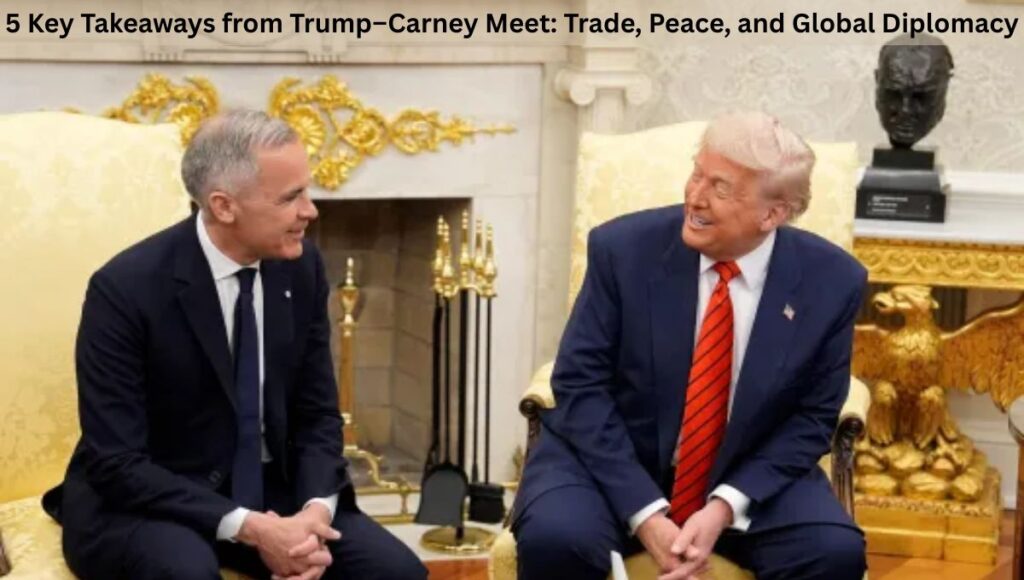
5 Key Takeaways from Trump–Carney Meet: Trade, Peace, and Global Diplomacy amid strained U.S.–Canada relations. Canadian Prime Minister Mark Carney on Tuesday lauded U.S. President Donald Trump as a “transformative president” during bilateral talks at the White House, crediting him with fostering peace between India and Pakistan and reshaping global diplomacy.
“You are a transformative president — the transformation in the economy, unprecedented commitments of NATO partners to defence spending, peace from India, Pakistan through to Azerbaijan, Armenia, disabling Iran as the force of terror,” Carney said in the Oval Office, as Trump nodded in response.
Carney’s remarks marked a striking shift in tone after months of strained relations between Ottawa and Washington, driven by U.S. tariffs and Trump’s controversial comments earlier this year suggesting Canada “should be annexed” into the United States.
5 Key Takeaways from Trump–Carney Meet: Trade, Peace, and Global Diplomacy
Trump’s Claim of Mediating India–Pakistan Peace
Trump, speaking separately on Monday, took fresh credit for using tariffs and trade leverage to avert global conflicts, including one between India and Pakistan.
“If I didn’t have the power of tariffs, you would have at least four of the seven wars raging,” Trump said. “If you look at India and Pakistan, they were ready to go at it. Seven planes were shot down… I don’t want to say exactly what I said, but what I said was very effective.”
Since May 10, when Trump announced that India and Pakistan had agreed to a “full and immediate” ceasefire after a “long night” of discussions reportedly mediated by Washington, he has repeated the claim almost 50 times, asserting that his diplomacy “helped settle” tensions between the two nuclear-armed neighbours.
India’s Ministry of External Affairs (MEA) has, however, consistently denied any third-party role, stating that the ceasefire understanding was reached directly through military communication channels between the Directors General of Military Operations (DGMOs) of both countries.
India launched Operation Sindoor on 7 May, targeting terrorist infrastructure in Pakistan and Pakistan-occupied Kashmir following the 22 April Pahalgam attack, which killed 26 civilians. The cross-border escalation led to four days of intense drone and missile strikes before both sides agreed to a cessation of hostilities on 10 May.
Despite India’s denials, Trump has continued to present himself as the mediator who “prevented a major war” in South Asia.
Also Read: Canadian PM Carney credits Trump for bringing peace between India, Pakistan
Carney’s Praise Seen as Diplomatic Recalibration
Carney, who took office in March, has walked a careful line in managing relations with Washington amid ongoing trade tensions. Tuesday’s meeting was his second with Trump, following his May visit to the White House.
Observers say his praise of Trump as a “transformative president” reflects an effort to reset Canada’s approach to the United States following the acrimonious tenure of former Prime Minister Justin Trudeau, who had clashed with Trump over tariffs and defence spending.
Carney appeared eager to project goodwill during the meeting. “I wore red for you,” he told Trump, pointing to his tie coloured in the Republican hue, to which Trump — dressed in blue — smiled.
After months of tangling over trade, Carney entered the meeting with low expectations of securing relief from steep tariffs on Canadian exports including steel, aluminium, automobiles and lumber.
He left with an ambiguous assurance from Trump that Canada would “walk away happy,” though Trump declined to elaborate, saying only: “You’ll find out.”
Trump’s Trade Approach and Canada’s Economic Strain
Carney’s visit came at a critical time for Canada’s economy, which is showing signs of strain under Trump’s escalating tariff measures.
With unemployment at 7.1%, the highest in nine years, and tariffs impacting key sectors, Carney faces pressure to secure exemptions or sector-specific relief. Trump’s Section 232 tariffs have hit steel and aluminium hardest, with duties reaching up to 50%.
At Tuesday’s meeting, Trump said the United States would “treat Canada fairly” in any new trade deal, adding that future agreements should be “comprehensive” and include sectors such as dairy.
“We have natural conflict,” Trump said. “We also have mutual love.”
Carney responded that while competition existed, “there are more areas where we are stronger together, and that’s what we’re focused on.”
Canada remains the only G7 member without a trade deal to shield it from new U.S. tariffs. Economists warn that the uncertainty is taking a toll on Canada’s export-driven economy.
“There is a necessity for the government to shift away from so much focus on Trump and really think about what they can do to improve the lives of Canadians day-to-day,” said Inu Manak, senior fellow for international trade at the Council on Foreign Relations.
The 51st State Remark Rekindles Controversy
Trump once again referred to Canada as the “51st U.S. state”, reviving a line that has previously angered Canadians and fuelled public resentment.
As Carney was commending Trump for his “transformative” leadership, Trump interrupted with a quip: “The merger of Canada and the United States?”
Carney laughed, replying, “No! That wasn’t where I was going.”
The exchange drew laughter from the room, but underscored the uneasy undercurrent in bilateral ties.
Trump’s repeated remarks about a U.S.–Canada “merger” have alienated Canadian travellers. Government data shows a 23% drop in Canadian visits to the United States in the first seven months of 2025 compared to the same period in 2024.
“The people of Canada, they will love us again,” Trump said. “Most of them still do. If you say only 25%. I assume a lot of them. I think they love us.”
Carney replied with a wry smile: “It’s not bad. They’ll come back.”
USMCA and the Future of North American Trade
Carney’s trip also came ahead of next year’s review of the United States–Mexico–Canada Agreement (USMCA), amid fears that Trump may seek to dismantle or renegotiate it.
Trump indicated he was open to “different deals” with each partner nation. “We could renegotiate it, and that would be good, or we can just do different deals,” he said. “We might make deals that are better for individual countries.”
Canadian officials, including Dominic LeBlanc, Minister in charge of U.S.–Canada trade, described the talks as “positive” and “productive,” while noting that discussions on steel and aluminium tariffs would continue.
Trade experts caution that Trump’s ambivalence could unsettle markets. “What is at risk is the continuation of that deal or the slow unravelling of it,” said Jeffrey Schott of the Peterson Institute for International Economics.
Trump’s Global Peace Narrative Expands
Throughout their meeting, Trump linked his tariff policies to broader global stability. “If I didn’t use tariffs, you’d have four or five wars now,” he said.
Carney supported this framing, citing peace in regions from South Asia to the Caucasus. “Peace from India, Pakistan through to Azerbaijan, Armenia,” he said, crediting Trump’s “transformative leadership.”
While critics view such remarks as exaggerations, analysts suggest Carney’s tone aimed to keep diplomatic doors open amid Canada’s economic vulnerabilities.
“He knows flattery works with Trump,” said one former Canadian diplomat. “But it’s also a way to protect Canada’s interests without direct confrontation.”
Carney Balances Diplomacy and Domestic Pressure
At home, Carney faces rising political pressure over tariffs, inflation, and stagnant wage growth. His government is under scrutiny for appearing too conciliatory toward Washington.
Polls show that a majority of Canadians believe Trump’s tariff policies are harming their economy, while 61% disapprove of closer political alignment with the United States.
Carney, a former central banker known for his composure, has tried to reset the relationship without inflaming nationalist sentiment. During his first Oval Office visit in May, when Trump jokingly suggested that “Canada is for sale,” Carney replied firmly: “Not for sale, ever.”
Trump retorted, “Never say never,” drawing laughter but also unease across Canada.
Economic Fallout and the Road Ahead
Canada’s reliance on the United States — which buys over 75% of its exports — means the tariff conflict carries real risks. Higher border duties have disrupted manufacturing supply chains and raised costs for consumers, even for goods that are technically USMCA-compliant.
Carney’s challenge, analysts say, is to safeguard economic stability while maintaining a workable relationship with Washington. “He’s playing a long game,” said Manak. “It’s about showing cooperation while waiting for a shift in U.S. policy.”
For Trump, the meeting reinforced his self-styled image as a dealmaker and peacemaker. “We are competing for the same business,” he said. “But we also have mutual love.”
As reporters were ushered out of the Oval Office, Trump described Carney as “a nice man, but he can be very nasty.”
Asked why, if Carney was such a “great man,” they had not yet reached a deal, Trump replied with a grin: “Because I want to be a great man, too.”
Analysis: Cautious Cooperation Amid Uncertainty
The meeting between Trump and Carney highlighted a delicate balancing act — cooperation without concession, diplomacy without drama. Carney’s overt praise of Trump may have softened the atmosphere, but tangible breakthroughs on trade or tariffs remain elusive.
With global conflicts, supply chain shifts, and the looming USMCA review, both leaders appear to be navigating a complex intersection of politics and economics.
For now, Carney’s strategy seems clear: engage, flatter, and hold ground — all while ensuring Canada’s economy weathers the storm.
Also Read: Trump Furious After 7-4 Tariff Ruling, Warns US Would Be “Completely Destroyed” Without Duties
Related Posts:
- 7 Crucial Signals in the Armenia–Türkiye Thaw That…
- Trump Hosts Historic Armenia-Azerbaijan Peace Summit…

- Dramatic Moments Behind Trump’s Gaza Peace Push and…

- 5 Powerful Highlights as Trump Lands Second Nobel…

- Trump’s 2025 Gaza Peace Plan Signing and Historic…

- 7 Powerful Takeaways from Trump’s Thai-Cambodia Peace Deal